Physical and Logical Time
1. Executive Summary
Distributed systems need a notion of when events happened. Physical time—wall-clock timestamps from real-time clocks—is intuitive and cheap to read, but it is not a reliable primitive for correctness across nodes. Clocks drift, synchronize imperfectly, and can jump backward during corrections or leap-second handling. Logical time—Lamport clocks, vector clocks, hybrid logical clocks—orders events by causality without trusting synchronized hardware.
This chapter establishes the physical-time foundation: how clocks work, how NTP (Network Time Protocol) and PTP (Precision Time Protocol, IEEE 1588) synchronize them, why clock skew breaks naive designs, and how leap seconds create operational surprises. It previews TrueTime (Google Spanner's clock abstraction) as a production pattern that turns bounded clock uncertainty into a coordination primitive rather than pretending clocks are perfect.
Key takeaway for architects: Use physical time for metrics, TTLs, and human correlation; use logical time (or bounded-uncertainty protocols like TrueTime) when ordering must reflect causality or consistency guarantees. Never assume timestamp(A) < timestamp(B) implies A happened before B.
2. Why This Topic Matters
Principal-level interviews probe whether you understand why systems fail when teams treat now() as ground truth. A senior engineer might say "we use NTP." A principal architect explains:
- What assumption NTP actually provides (and what it does not)
- How skew interacts with leases, session timeouts, and conflict resolution
- When to invest in PTP or specialized time infrastructure versus redesigning around logical ordering
- How Spanner's TrueTime changes the system model from pure asynchrony to bounded clock uncertainty
Time mistakes surface as subtle production bugs: duplicate primary keys after clock rollback, expired sessions that are still valid, "last write wins" picking the wrong write, and audit trails that violate apparent ordering. The Distributed System Models chapter established that pure asynchronous models cannot use wall clocks for correctness; this chapter explains what happens when you do use them—and how to do so safely.
3. Problems Being Solved
| Problem | Why time matters |
|---|---|
| Event ordering | Clients and operators need a consistent story of what happened when |
| Lease expiration | "Am I still the leader?" depends on comparing local clock to lease deadline |
| TTL and session expiry | Cache entries, auth tokens, and distributed locks expire by timestamp |
| Conflict resolution | LWW (last-write-wins) uses timestamps as the tie-breaker |
| Snapshot isolation / MVCC | Transaction visibility often keyed on commit timestamps |
| Cross-region causality | Users expect monotonic reads; clock skew violates that illusion |
| Compliance and auditing | Regulators expect append-only timelines—clock jumps complicate proofs |
Physical time solves human-scale correlation ("show me logs around 14:32 UTC"). Logical time solves causal ordering ("did event B observe event A?"). Production systems often need both—and must not confuse them.
4. Assumptions and System Model
This chapter assumes a message-passing distributed system without shared memory, consistent with the prerequisite on system models.
Physical time assumptions (when used):
- Each node has a real-time clock (RTC, often backed by a crystal oscillator) exposing UTC or local time via the OS.
- Clocks drift relative to a reference (typically UTC) at rates that depend on hardware and temperature.
- Synchronization (NTP, PTP, or proprietary) periodically estimates offset and optionally slews or steps the clock.
- Synchronization provides accuracy and precision bounds that are statistical and environment-dependent, not mathematical guarantees unless additional infrastructure (GPS, atomic clocks, dedicated hardware) is present.
What we do not assume:
- Perfectly synchronized clocks across nodes
- Monotonic wall clocks (NTP steps and leap-second policies can move time backward)
- That
time.time()on two machines is comparable without an explicit uncertainty interval
Logical time assumptions (preview):
- Processes can exchange messages with happens-before relationships (Lamport, 1978).
- Logical clocks provide consistent ordering of causally related events without bounding physical skew.
Relation to timing models: Trusting synchronized physical clocks is an additional assumption beyond partial synchrony. It can enable stronger guarantees (e.g., Spanner external consistency) but introduces a new failure mode: clock uncertainty violation.
5. Essential Terminology
| Term | Definition |
|---|---|
| Physical time / wall-clock time | Time from a real-time clock, usually mapped to UTC |
| Logical time | A counter or vector used to order events by causality, not by wall clock |
| Clock drift | The rate at which a clock diverges from true time (parts per million) |
| Clock skew | The instantaneous difference between two clocks at a moment in time |
| Offset | Estimated correction applied to align a clock with a reference |
| NTP (Network Time Protocol) | UDP-based protocol (RFC 5905) for synchronizing clocks over IP networks |
| Stratum | NTP hierarchy level; stratum 0 is reference clock, stratum 1 syncs to it, etc. |
| PTP (Precision Time Protocol) | IEEE 1588 protocol for high-precision synchronization, often sub-millisecond on LAN |
| Leap second | Occasional one-second adjustment to UTC to track Earth's rotation |
| Smearing | Gradually spreading a leap-second adjustment over hours to avoid backward steps |
| TrueTime | Spanner's API returning interval [earliest, latest] bounding actual time |
| Uncertainty bound (ε) | Maximum half-width of TrueTime interval; commit-wait uses multiples of ε |
| Monotonic clock | OS clock that never decreases (CLOCK_MONOTONIC); immune to NTP steps but not comparable across nodes |
| Hybrid Logical Clock (HLC) | Combines physical and logical components; used in CockroachDB and similar systems |
6. Core Mechanism
6.1 Physical clocks: drift, sync, and read paths
Every server reads time through the OS kernel. The path typically involves:
- Hardware oscillator → ticks at a nominal frequency
- Kernel clock discipline → applies NTP or PTP adjustments
- Application call →
clock_gettime,System.currentTimeMillis, etc.
Clocks are continuously wrong at small scales; synchronization reduces error but never eliminates it in general-purpose deployments.
Drift accumulates between synchronizations. If a crystal drifts at 20 ppm (parts per million)—a plausible order of magnitude for inexpensive hardware—a clock can diverge by roughly 1.7 seconds per day if uncorrected. NTP and PTP exist to bound that divergence.
Skew between two nodes is the difference in their readings of "now." Even with NTP, transient skew of milliseconds to tens of milliseconds is common on WAN paths; larger skew appears during network congestion, VM migration, or misconfiguration.
6.2 NTP: how Internet clocks synchronize
NTP (RFC 5905) is the default clock synchronization mechanism for most servers and cloud VMs. Clients query upstream time servers, compute offset using round-trip delay estimation, and adjust local clocks via slew (gradual) or step (instant jump).
Stratum hierarchy: Stratum 0 devices (GPS receivers, atomic clocks) are not on the network as NTP servers; stratum 1 servers attach to them. Your laptop might sync at stratum 3–16 depending on path. Lower stratum is not automatically "better" for your workload, but it indicates distance from reference.
What NTP provides in practice:
- Coarse global alignment suitable for logs, certificate validity, and human operations
- Statistical accuracy that depends on network asymmetry, VM scheduling, and polling interval
- Not a linearizability primitive: two NTP-synchronized hosts can still observe events in an order inconsistent with wall-clock timestamps
Operational modes that matter:
| Mode | Behavior | Risk |
|---|---|---|
| Slew | Adjust frequency gradually | Slower convergence; safer for apps assuming smooth time |
| Step | Jump clock instantly | Can break monotonic assumptions; duplicate or regressed timestamps |
| Burst / iburst | Fast initial sync on boot | Large step on fresh VMs |
Cloud providers typically run NTP infrastructure for guests, but you should verify the documented time source and leap-second policy for your provider rather than assuming datacenter-grade bounds.
6.3 PTP: when milliseconds are not enough
PTP (IEEE 1588) targets high-precision synchronization on local networks. It uses hardware timestamping at the NIC when available, a master–slave hierarchy (similar in spirit to NTP strata), and frequent sync messages.
Typical use cases:
- Financial trading and market data (regulatory timestamping)
- Telco 5G fronthaul
- Industrial control and audio/video sync
- Large-scale databases that want tighter bounds than NTP without full TrueTime infrastructure
PTP can achieve sub-microsecond skew on a well-engineered LAN with hardware support. On general cloud VMs without PTP hardware, you usually remain on NTP-class accuracy.
Tradeoff: PTP requires network and hardware investment—dedicated switches, boundary clocks, GPS antennas. NTP is "good enough" for most web services; PTP is for domains where timestamp error has direct monetary or safety cost.
6.4 Leap seconds: the one-second edge case
UTC includes leap seconds to align civil time with Earth's rotation. A leap second inserts an extra second (or historically, could remove one) at scheduled boundaries.
Computers struggle because:
23:59:60is valid UTC but breaks parsers that assume 60-second minutes- Stepping clocks backward repeats a second—two distinct events can share the same timestamp
- Different organizations handle leaps differently: step, smear (Google, Microsoft Azure documented smear strategies), or ignore until manual intervention
Leap smearing spreads the extra second over many hours so clocks never jump backward—preserving monotonicity of smeared time but temporarily diverging from civil UTC. Mixed environments (some nodes smear, some step) increase skew during the smear window.
For architects: document your organization's leap-second policy and test time-dependent subsystems (TLS, Kerberos, distributed locks, LWW stores) before each announced leap. IERS publishes leap-second announcements; treat scheduling as an operational event, not a surprise.
6.5 Logical time (preview)
When physical clocks are untrusted, systems use logical clocks:
- Lamport clock: A single integer per process; increments on local events and on send; receive takes
max(local, message) + 1. Orders all events consistently but cannot detect concurrent events. - Vector clock: Per-process vector; detects concurrency and causal precedence precisely—more metadata.
- Hybrid Logical Clock (HLC): Embeds physical time in high bits and logical counter in low bits; preserves causality while staying close to physical time for human debugging.
This chapter focuses on physical time; subsequent chapters in this domain develop logical clocks and causal ordering in depth. The design rule stands: if correctness depends on ordering, do not use raw Date.now() alone.
6.6 TrueTime preview: bounded uncertainty as a primitive
TrueTime (Corbett et al., 2012) is not "perfect clocks." It is an API that returns an interval [earliest, latest] such that actual UTC lies within the interval with high probability, maintained by GPS receivers and atomic clocks in Google datacenters, with redundancy across time masters.
Commit-wait: Before acknowledging a write, Spanner waits until TT.now().earliest exceeds the chosen commit timestamp. If uncertainty width is ε (so latest - earliest ≈ 2ε in the symmetric case), commit-wait adds on the order of ε to commit latency in the worst case—an explicit consistency–latency tradeoff.
System model shift: TrueTime adds synchronized clocks with bounded uncertainty to the model. Safety arguments rely on that bound holding; if GPS fails and uncertainty widens, Spanner blocks commits rather than violate external consistency—a liveness tradeoff for safety.
Not portable by default: TrueTime depends on proprietary infrastructure. CockroachDB uses HLC with NTP-synchronized clocks; other systems use version vectors or centralized timestamp oracles. The pattern—make uncertainty explicit—is portable even when TrueTime hardware is not.
7. Step-by-Step Walkthrough
Scenario: A three-node database cluster uses wall-clock timestamps for LWW conflict resolution. Nodes run default NTP against public pools.
Step 1 — Establish baseline skew
Measure offset between nodes using chronyc tracking, ntpq -p, or your cloud provider's time diagnostics. Record offset and jitter over 24 hours. Expect variation; do not use a single snapshot as eternal truth.
Step 2 — Define correctness requirements
| Requirement | Wall clock sufficient? |
|---|---|
| Log correlation within ~100 ms | Usually yes with NTP |
| Global LWW without anomalies | No unless uncertainty is bounded and enforced |
| Lease-based leader election | Risky without fencing; skew can exceed lease margin |
| External consistency (Spanner-style) | Requires TrueTime-class bounds + commit-wait or logical ordering |
Step 3 — Quantitative skew budget
Suppose measured maximum skew between any pair of nodes is S (from monitoring, not guesswork). A lease of duration L with no fencing is unsafe if a slow-clock node believes it holds the lease while a fast-clock node has already started a new epoch—effective overlap up to S.
Rule of thumb: Keep L ≫ S with margin for GC pauses and NTP steps. If L = 10 s and S can reach 250 ms under stress, you have margin—but a 500 ms GC pause plus 250 ms skew can still produce duplicate primaries without fencing tokens.
Step 4 — Quantitative TrueTime-style commit-wait
From the Spanner paper: TrueTime exposes an uncertainty interval. Let ε denote the bound such that latest - earliest ≤ 2ε (paper notation varies; think half-width ε). Commit-wait duration is chosen so that overlapping intervals cannot assign out-of-order commit timestamps.
Illustrative calculation (not a benchmark): If after a GPS glitch the system's ε grows from a typical datacenter value to 10 ms, each commit waits until TrueTime's earliest edge advances past prior timestamps—adding up to on the order of 2ε ≈ 20 ms extra tail latency for that window. Spanner prefers blocking over serving inconsistent reads. Your design should state what happens when ε exceeds policy: fail open (weak consistency) or fail closed (unavailability).
Step 5 — Choose mitigation
- Fencing tokens for leases (see coordination chapters)
- Logical timestamps for ordering writes
- Hybrid Logical Clocks when you want physical-time-like IDs with causality
- TrueTime / PTP when business requires tight physical ordering and budget exists
8. Invariants and Guarantees
Physical time alone provides no distributed invariant comparable to quorum intersection. At best you get:
| Guarantee | Condition | Limitation |
|---|---|---|
| Bounded skew | NTP/PTP healthy, defined ops policy | Violated by steps, leaps, partitions from time servers |
| Monotonic reads (per client) | Client uses one server or synchronized timestamps | Cross-client monotonicity needs stronger protocol |
| External consistency | TrueTime-style bound + commit-wait | Requires infrastructure; liveness risk when bound breaks |
Logical time invariants (preview):
- Lamport: If
A → B(happens-before), thenL(A) < L(B) - Vector:
V(A) < V(B)iff A causally precedes B; concurrent events incomparable
Safety vs liveness with clocks:
- Safety: Do not assign commit timestamps that violate real ordering of transactions—TrueTime commit-wait protects this.
- Liveness: NTP isolation must not block progress forever; Spanner may stall writes if uncertainty cannot be bounded.
9. Failure Scenarios
9.1 Clock step backward after NTP correction
Trigger: VM boots with clock far ahead; NTP steps backward by seconds.
Symptom: Primary keys or UUIDv1-style time-ordered IDs collide or regress; LWW picks older write as "newer"; audit log appears out of order.
Mitigation: Use CLOCK_MONOTONIC for durations; use logical or random IDs for uniqueness; avoid LWW on wall clock alone; detect backward jumps and refuse writes.
9.2 Leap second with mixed smear policies
Trigger: Half the cluster uses leap smear, half uses step; or kernel vs container time namespaces disagree.
Symptom: Transient skew spike of up to ~1 second; TLS handshakes fail; distributed cron runs twice or not at all.
Mitigation: Uniform policy per fleet; pre-leap game days; monitor offset dashboards; prefer smear with documented offset from civil UTC during window.
9.3 Lease overlap from clock skew (zombie primary)
Trigger: Old primary's clock is slow; new primary elected on fast clock; old primary resumes after long pause.
Symptom: Split brain—two writers believe they are primary; data corruption without fencing.
Mitigation: Fencing tokens tied to epoch, not wall clock; quorum commit before ack; do not trust lease expiry alone.
9.4 NTP partition from time servers
Trigger: Firewall blocks UDP 123; misconfigured chrony pool; hypervisor bug.
Symptom: Drift accumulates; skew grows unbounded over days; subtle ordering bugs emerge long after the root cause.
Mitigation: Alert on lack of successful sync, not just offset; multiple independent stratum sources; PTP or hardware clock where required.
9.5 TrueTime uncertainty blowout
Trigger: GPS antenna fault, datacenter time master outage, excessive clockgen load.
Symptom: Spanner-style systems increase commit-wait or reject writes; elevated latency; possible write unavailability.
Mitigation: Redundant time sources; monitor interval width; explicit runbook for operating in degraded mode (if policy allows weaker consistency—product decision).
9.6 PTP grandmaster failover
Trigger: Primary grandmaster fails; boundary clock promotes backup.
Symptom: Brief phase jump; trading systems see out-of-order ticks; databases see timestamp inversions.
Mitigation: Holdover oscillators; graceful failover testing; application tolerance for microsecond-scale reordering or use logical sequencing for correctness.
10. Performance Characteristics
Physical time mechanisms affect latency and availability, not throughput in the abstract:
| Mechanism | Typical cost | Benefit |
|---|---|---|
| NTP polling | Negligible CPU; occasional UDP | Fleet-wide coarse sync |
| NTP step | Application-visible time discontinuity | Fast error correction |
| PTP | Dedicated network paths; HW timestamps | Microsecond-class sync |
| TrueTime commit-wait | Added commit latency ∝ ε | External consistency without centralized sequencer |
| Logical clocks | Metadata per message (vector) or integer (Lamport) | Causality without clock trust |
Do not cite fake benchmarks. Latency impact of commit-wait is directly proportional to uncertainty ε; measure ε in your environment or cite vendor-published distributions (Spanner paper discusses tail behavior qualitatively).
11. Scalability Limits
- NTP server load: Public pools punish misconfigured clients that poll too aggressively; use provider-local NTP or run stratum servers per region.
- PTP domain size: Master hierarchy scales by boundary clocks; single domain has practical limits on node count and topology.
- TrueTime: Designed for Google-scale datacenters with dedicated hardware—not something you "turn on" in a typical three-AZ Kubernetes cluster.
- Vector clocks: Per-event metadata grows with number of processes—limits logical-clock approaches at very large fan-out (why HLC and centralized timestamps exist).
12. Operational Considerations
- Monitor clock offset and jitter per host; alert on sustained drift or sync loss.
- Standardize time source across the fleet (same NTP pools or PTP domain).
- Document leap-second playbook before IERS announcements.
- Run chaos tests: block NTP, inject manual
datechanges in staging, measure lease and LWW behavior. - Separate monotonic vs wall clock in code reviews: durations and timeouts should use monotonic clocks; cross-node ordering should not use raw wall clock without a protocol.
- Container time: Ensure containers inherit correct clock namespace; sidecars do not run divergent
chronyconfigs.
13. Security Considerations
- NTP is largely unauthenticated in legacy deployments; NTS (Network Time Security, RFC 8915) mitigates spoofing—consider for high-assurance environments.
- Attacker-induced skew can extend leases on compromised nodes or break certificate validation windows.
- PTP networks must be isolated; a malicious master can distort timestamps for fraud.
- Time-based replay: Short-lived tokens help, but clock skew enlarges effective replay window—bind to logical session version where possible.
14. Cost Considerations
| Approach | Infra cost | Engineering cost |
|---|---|---|
| Default NTP | Low | Low until a clock bug costs an outage |
| Hardened NTP + monitoring | Low–medium | Medium |
| PTP hardware | High (NICs, switches, GPS) | High expertise |
| TrueTime-class infra | Very high | Proprietary; only at extreme scale |
| Logical clocks / HLC | Low extra hardware | Medium algorithmic complexity |
Hidden cost: Incidents from assumed synchrony—postmortem time, data repair, regulatory exposure in finance—often exceed preventative investment.
15. Production Implementations
| System | Time approach | Notes |
|---|---|---|
| Google Spanner | TrueTime (GPS + atomic clocks) | Commit-wait; external consistency |
| CockroachDB | HLC + NTP | Assumes bounded skew; different tradeoffs than Spanner |
| Cassandra | Client or server timestamps for LWW | Known anomalies under skew—documented limitation |
| etcd / ZooKeeper | Leases use TTL + protocol ordering | Wall clock for session timeout; epochs for ordering correctness |
| Kafka | Log offset ordering | Physical time for retention, not for log order |
| AWS / Azure / GCP | Provider NTP endpoints | Check docs for leap-second smear policy |
| Financial exchanges | PTP, often custom | Regulatory timestamp requirements |
Distinction: Ordering mechanism (log offset, consensus term, HLC) vs physical timestamp (metrics, retention, human UI) should be separable in architecture discussions.
16. Alternatives and Tradeoffs
| Need | Option | Tradeoff |
|---|---|---|
| Causal ordering | Lamport / vector clocks | Vector size; no physical interpretability |
| Human-readable global IDs | HLC | Requires skew bounds for tight physical alignment |
| Strongest global consistency | TrueTime + commit-wait | Latency, infra, liveness under clock faults |
| Good-enough sync | NTP | Simple; not a correctness primitive |
| Microsecond sync | PTP | Hardware and ops burden |
| No clock trust | Centralized sequencer (TiDB TSO-style) | Single-component scaling limits |
| CRDTs | No global time | Semantics restricted to mergeable data types |
17. Common Misconceptions
- "NTP synchronized means transactions are ordered." NTP bounds offset statistically; it does not provide linearizability.
- "Monotonic clock fixes distributed ordering."
CLOCK_MONOTONICis per-node only; it is not comparable across machines. - "Leap seconds never matter anymore." Policies differ; mixed fleets still risk skew spikes.
- "PTP is just better NTP." Different layer-2 assumptions, hardware, and ops model—not a drop-in upgrade on vanilla cloud VMs.
- "TrueTime eliminates the need for consensus." Spanner still uses Paxos; TrueTime orders commits across groups—it does not replace replication.
- "LWW with timestamps is always simple." Simple until skew makes the wrong write win.
18. Principal Architect Perspective
Principal architects govern time assumptions the way they govern failure models:
- Require explicit skew budgets in designs using leases or LWW.
- Block designs that use cross-node wall-clock comparison for correctness without uncertainty analysis.
- Align finance and platform teams on PTP vs NTP vs logical ordering before regulatory deadlines.
- Treat leap seconds as change management, not kernel trivia.
- Educate product owners that TrueTime-class consistency has latency and availability costs—not "free strong consistency."
In architecture review, ask: "What breaks if two nodes disagree on now by 500 ms?" If the answer is "data corruption," the design is not production-ready.
19. Architecture Review Exercise
System: Global user profile store with multi-master replication and updated_at LWW merge.
Review prompts:
- What is the measured maximum clock skew between regions?
- Does NTP use step or slew on your base images?
- What happens on leap-second day?
- Can two regions update the same profile during partition—who wins?
- Would HLC or a central timestamp service simplify correctness?
- What monitoring proves clocks are healthy?
Deliverable: ADR section on Time and Ordering Assumptions with skew budget, failure mode (fail open vs closed), and chosen conflict resolution primitive.
20. Whiteboard Explanation
Draw two parallel tracks:
Physical time (UTC)          Logical time (Lamport/HLC)
─────────────────────        ───────────────────────────
NTP / PTP sync               happens-before edges
drift + skew                 counters / vectors
leap seconds                 no leap problem
good for humans              good for correctness
90-second narration: "Wall clocks are useful but lie. Nodes drift, NTP corrects with slew or step, leap seconds scramble assumptions. Never infer causality from timestamps alone. Logical clocks order by message flow; hybrid clocks blend both. Spanner's TrueTime is different—it admits uncertainty and waits out the ε window so commit times respect real order. For most of us, NTP plus logical ordering plus fencing beats pretending clocks are global truth."
21. Interview Questions
-
Why can't you use wall-clock timestamps for distributed ordering?
- Signals: skew, drift, steps, leap seconds; happens-before vs timestamp order.
-
Explain NTP at a high level. What does stratum mean?
- Signals: offset/delay estimation; hierarchy; slew vs step.
-
What is clock skew vs clock drift?
- Signals: instantaneous difference vs rate of divergence.
-
How do leap seconds affect distributed systems?
- Signals: backward step, smear, mixed policies, parser bugs.
-
When would you choose PTP over NTP?
- Signals: microsecond needs, hardware, trading/telco; cost.
-
What does TrueTime return, and why is commit-wait necessary?
- Signals: interval
[earliest, latest]; external consistency; ε.
- Signals: interval
-
A lease expires at T. Can two nodes both think they hold the lease?
- Signals: skew; need fencing; quorum; not wall clock alone.
-
Difference between
CLOCK_REALTIMEandCLOCK_MONOTONIC?- Signals: NTP adjustments; monotonic not comparable across nodes.
-
How does HLC differ from Lamport clocks?
- Signals: physical component; bounded size; used in CockroachDB.
-
What happens in Spanner if TrueTime uncertainty increases?
- Signals: longer commit-wait or unavailability; safety preserved.
-
Design: ordered event log across 10k nodes without central sequencer—options?
- Signals: logical clocks, HLC, partition into smaller groups, tradeoffs.
-
Is NTP a security risk?
- Signals: spoofing; NTS; impact on TLS and auth.
22. Interview Follow-Ups
-
Can you get external consistency without specialized hardware? — HLC with bounded NTP skew assumptions; or centralized TSO; compare failure modes.
-
How would you test clock-related bugs? — Chaos: block NTP, skew injection tools, leap-second simulation.
-
Does Spanner violate FLP? — Uses additional clock assumption + Paxos under partial synchrony; not pure async.
-
Why not use vector clocks everywhere? — Space complexity; fan-out limits.
-
How do cloud load balancers affect NTP? — They don't fix guest clocks; need instance-level sync monitoring.
-
What's the relationship between TrueTime and linearizability? — External consistency across transactions; related but not identical to single-object linearizability.
22A. Production Low-Level Design (Interview + Game Day)
Design clock discipline for multi-region DB with TrueTime-style bounded uncertainty. Production LLD and Game Day Standard.
Control vs data plane
| Plane | Role |
|---|---|
| Control | NTP/chrony monitors, leap-second playbook |
| Data | Commit wait for uncertainty window |
API: CommitWait(tt.after, tt.before) before externalizing write.
Step-by-step flow:
| Step | Mechanism | Ops hook |
|---|---|---|
| 1 | Assign commit timestamp | — |
| 2 | Bounded uncertainty ε | — |
| 3 | Wait max(0, tt.after-now) | — |
| 4 | External consistency | — |
- SLO: clock skew alarm > 100ms
- Never use wall clock for causality across nodes
22B. Game Day Playbooks
| # | Drill | Inject | Detect | Mitigate | Verify |
|---|---|---|---|---|---|
| GD-1 | Clock jump | Manual date change | Skew alarm | Fencing + chrony | Writes pause |
| GD-2 | Leap second | Smear vs step | Duplicate/missing second | Document smear policy | No dup TS |
| GD-3 | VM steal time | Noisy neighbor | TT interval widens | Commit wait latency ↑ | Correctness OK |
| GD-4 | Ignore wait | Disable wait flag | Anomaly reads | Re-enable wait | Linearizable |
GD-1 — Clock skew exceeds bound
23. Strong Answer Example
Question: "Your service uses last-write-wins with updated_at timestamps. Is that safe?"
Answer this as a 45-minute deep dive using the PRACTICE framework. Below is how a strong student sounds aloud—don't say yes; redefine "last," show the skew failure, then pick a safer ordering primitive.
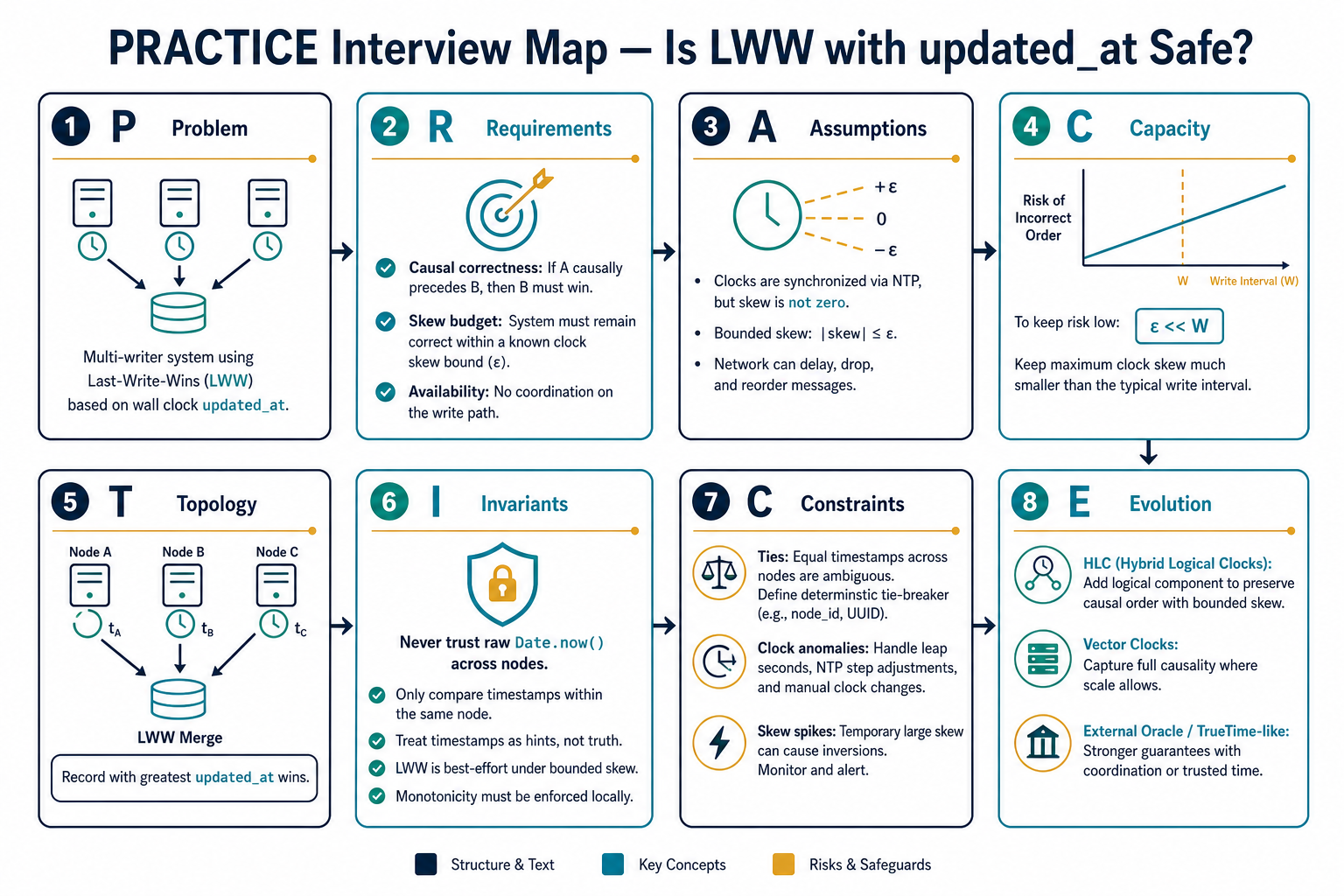
Figure A: PRACTICE map — Problem → Requirements → Assumptions → Capacity → Topology → Invariants → Constraints → Evolution.
Student interview script (PRACTICE)
P — Problem framing
"Last-write-wins with
updated_atmeans: on conflict, keep the row whose wall-clock timestamp is larger. The question is whether larger timestamp ⇒ later in real causality. Across nodes, usually no—not safely.Unsafe means: concurrent or near-concurrent writers on different machines can invert order—the causally newer write loses because another node's clock was ahead, stepped, or skewed.
Non-goals: claiming NTP makes clocks identical, or redesigning the whole store in one answer. I'll define when LWW is acceptable vs when we need HLC / vectors / a timestamp oracle."
R — Requirements
| Type | Requirement |
|---|---|
| FR | Multi-writer merge on same key (profile, cart, config) without losing the "real" latest intent |
| NFR | Conflict rate visible; no silent data corruption under measured skew |
| Correctness | Prefer causal / protocol order over wall-clock luck |
| Ops | Skew budget in ADR; alert on NTP sync loss; fail closed before corrupt merges |
"I'll ask: single-leader writes or multi-master? Client- or server-stamped
updated_at? Cross-region? I'll assume multi-writer / multi-master with per-node wall clocks—the dangerous case."
A — Assumptions (state aloud)
| Assumption | Why it matters |
|---|---|
| Nodes use NTP/chrony, not TrueTime | Skew is statistical, not zero |
updated_at = Date.now() on the writing node | Cross-node comparison is the hazard |
| Concurrent writes to same key happen | LWW is exercised in production |
| Ties possible (same ms) | Need a deterministic tie-break |
| Clock can step backward | Duplicate or regressing timestamps |
"If all writes go through one leader that stamps time, LWW is much safer—but then you're not really distributed LWW; you're single-writer with a clock."
C — Capacity (skew budget math)
Measured max pairwise skew S     → e.g. 50–500 ms (monitor; don't guess)
Inter-write gap for same key Δt  → often << S under concurrent edits
Unsafe condition                 → when S ≳ Δt, wrong winner is likely
Write rate on hot keys           → higher conflict rate → more inversions
Clock step events                → NTP step / leap → sudden inversions / duplicates
"I'd say: measure S in prod, compare to how close concurrent writes get. If skew exceeds the gap between writes, wall-clock LWW is not a correctness mechanism—it's a coin flip with bias toward fast clocks."
T — Topology (draw this)
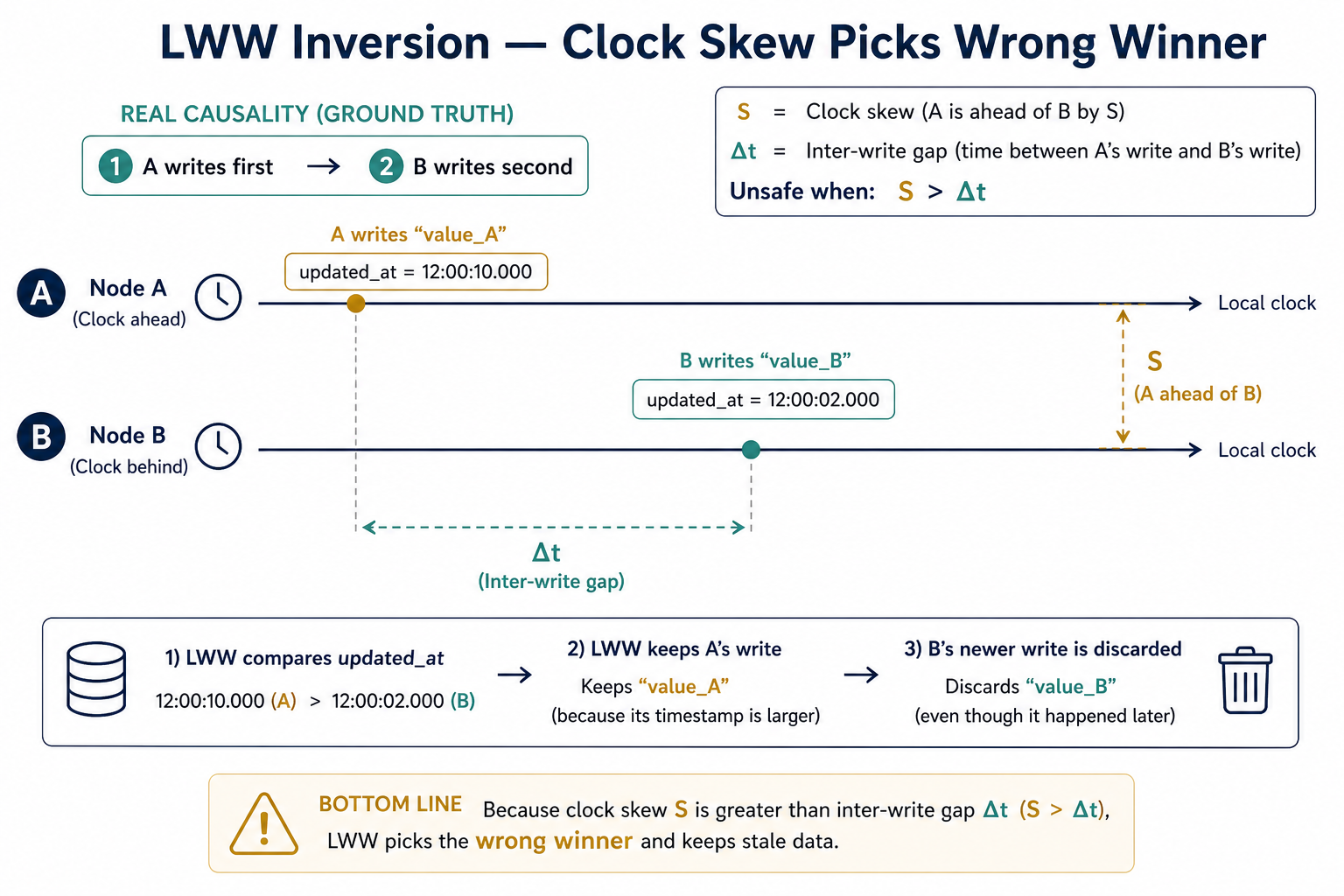
Figure B: Causally A then B, but A's fast clock wins LWW—B's newer value is discarded.
What "safe enough" LWW needs:
| Control | Purpose |
|---|---|
| Measured skew budget S documented in ADR | Explicit risk |
| Alert on NTP offset / sync loss | Fail closed before merges go wild |
| Deterministic tie-break (node_id, version) | Same-ms collisions |
| Prefer server-side stamp on a single writer path | Avoid client-skewed stamps |
| Never use LWW alone for money / inventory | Wrong winner = real loss |
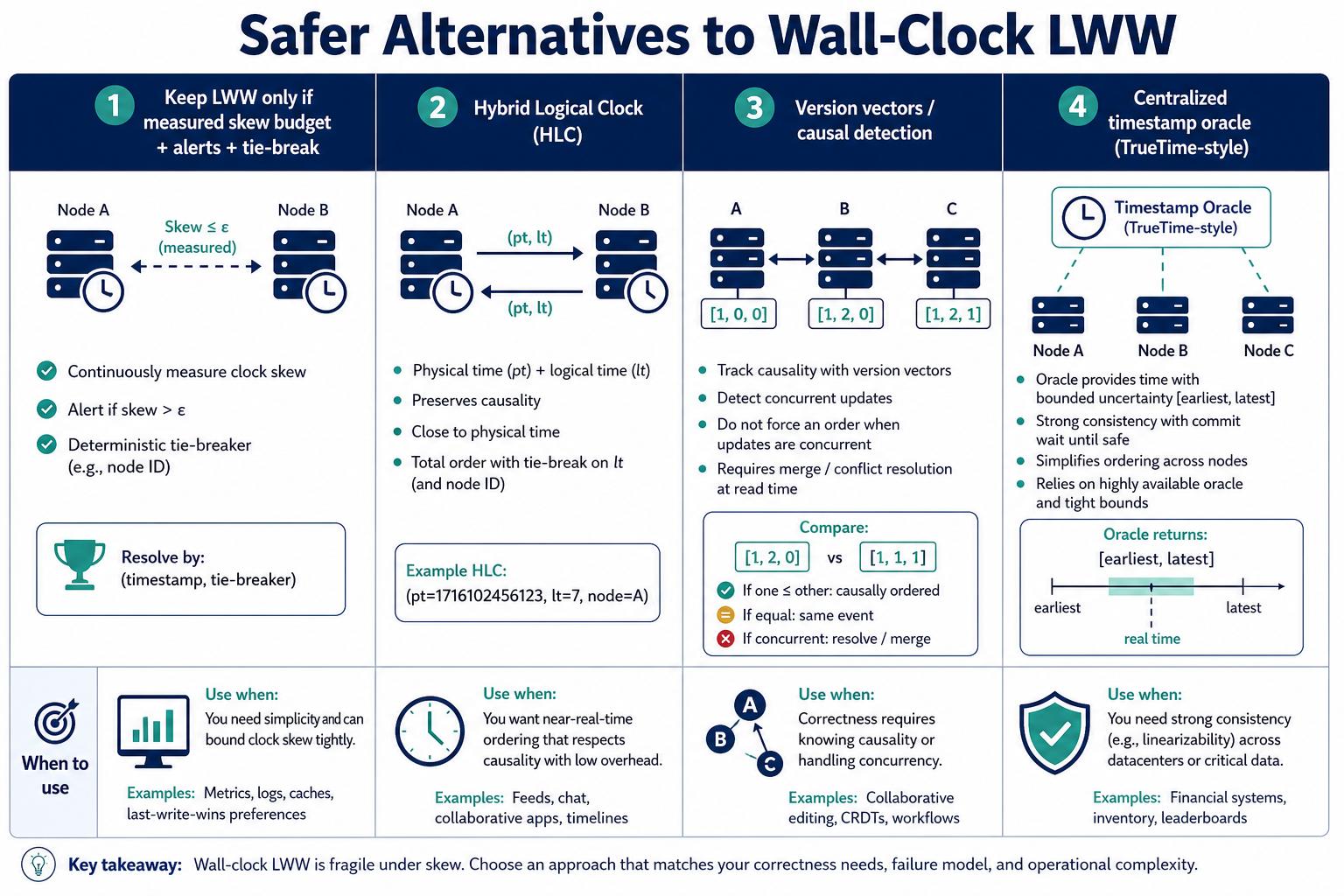
Figure C: Keep LWW only with budget+alerts; else HLC, version vectors, or centralized/TrueTime-style oracle.
I — Invariants (safety)
"Non-negotiable:
timestamp(A) < timestamp(B)does not imply A happened before B across nodes.- NTP ≠ ordering—it bounds drift statistically; it does not give linearizability.
CLOCK_MONOTONICis per-node—great for durations, useless for cross-node LWW.- If we keep LWW, skew budget + monitoring are part of the correctness story—or it's unsafe by omission.
- Concurrent writes need concurrency detection (vectors) or a total order (log/consensus/oracle)—not hope."
C — Constraints (second C)
| Constraint | Design response |
|---|---|
| Multi-region writers | HLC with NTP bounds, or single-region write + async replicate |
| Cassandra-style LWW | Document known anomaly; don't use for critical merges |
| Leap seconds / steps | Smear policy; detect backward jumps; refuse or escalate |
Client-supplied updated_at | Reject—easy to forge or skew |
| Need human-readable time | Keep wall clock for display/metrics; use logical for merge |
E — Evolution (what I'd recommend)
Decision tree I'd say aloud:
| Situation | Choice |
|---|---|
| Low conflict, single region, measured S ≪ Δt, non-critical | LWW OK with alerts + ADR skew budget |
| Need causal "don't lose newer write" | HLC or Lamport on the write path |
| Need detect concurrent edits (merge UI) | Version / vector clocks |
| Need external consistency / global commit order | TrueTime-style or centralized TSO + consensus |
| Leases / leaders involved | Fencing tokens / epochs—not wall-clock lease alone |
Phased harden:
| Phase | Deliverable |
|---|---|
| M1 | Instrument clock offset; alert on sync loss; ADR skew budget |
| M2 | Stop client-stamped updated_at; server stamp + tie-break |
| M3 | Replace critical LWW paths with HLC or version vectors |
| M4 | Chaos: inject skew / block NTP in staging; prove wrong-winner gone |
| M5 | Document remaining LWW surfaces as accepted risk |
Failure modes:
| Failure | Mitigation |
|---|---|
| Clock ahead wins forever | HLC / vectors; or single writer |
| NTP step backward | Detect jump; pause writes; monotonic IDs |
| Tie at same ms | (ts, node_id) total order |
| Zombie writer after lease | Fencing epoch, not updated_at |
Observability: ntp_offset_ms, max pairwise skew, LWW conflict rate, backward-jump count, fraction of merges decided by tie-break.
Closing line (interview)
"So: wall-clock LWW is not safe by default. NTP helps drift; it does not make
updated_ata causal order. I'd only keep it with a measured skew budget, alerts, and non-critical data—otherwise HLC, version vectors, or a timestamp oracle.Date.now()is for humans and metrics; correctness needs a protocol."
Scoring signals
| Strong | Weak / red flag |
|---|---|
| Redefines "last" / causality | "NTP so clocks are equal" |
| Skew inversion example | No failure mode |
| Skew budget + monitoring | No ops story |
| HLC / vectors / oracle alternatives | "Just use timestamps" |
| Monotonic ≠ distributed order | Conflates CLOCK_MONOTONIC with global time |
| ADR + chaos for skew | Treats LWW as always simple |
Compact outline (if time-boxed to 2 minutes)
"Unsafe across nodes: skew/steps invert LWW. NTP ≠ linearizability. Measure S vs write gap. Keep LWW only with budget+alerts+tie-break on non-critical data. Else HLC, version vectors, or central TSO/TrueTime-style. Never client
updated_at. Fencing for leaders—not wall clock alone."
24. Weak Answer Example
Question: "Your service uses last-write-wins with updated_at timestamps. Is that safe?"
"We use NTP, so all servers have the same time. LWW just works."
Why weak / red flags: Treats NTP as exact; ignores leap seconds and steps; no skew budget; no mention of partitions or fencing; conflates synchronization with ordering.
25. Hands-On Exercise
Lab: Skew and LWW
- Deploy three VMs or containers with a trivial key-value API storing
{value, updated_at}. - Configure one node to run
chronywith an intentional offset (lab only—usechronycmanual adjustment or libfaketime). - Write concurrently from two nodes to the same key; observe wrong winner when skew exceeds inter-write delay.
- Repeat with Lamport timestamp or HLC library added to the write path; verify causally ordered writes never lose.
- Block NTP on one node for 48 hours in staging; graph skew vs conflict rate.
- Write a one-page postmortem-style report: root cause, mitigation, monitoring.
Success criteria: Demonstrate at least one LWW inversion from skew and one mitigation that restores causal ordering.
26. Knowledge Check
- What problem does NTP solve, and what does it not solve?
- Define clock skew and drift.
- Why can leap seconds cause duplicate timestamps?
- What is smearing?
- What interval does TrueTime return?
- Why does Spanner use commit-wait?
- Name one advantage of
CLOCK_MONOTONICover wall clock for timeouts. - When is PTP justified over NTP?
- State the Lamport happens-before ordering guarantee.
- What should happen when TrueTime uncertainty exceeds policy threshold?
27. Flashcards
| Front | Back |
|---|---|
| Physical time | Wall-clock UTC from real-time clocks; drift and skew |
| Logical time | Ordering by causality (Lamport, vector, HLC) |
| Clock drift | Rate clock diverges from true time (ppm) |
| Clock skew | Difference between two clocks at one instant |
| NTP | RFC 5905 UDP protocol for clock sync; stratum hierarchy |
| Slew vs step | Gradual frequency adjust vs instant jump |
| Leap second | UTC adjustment; can repeat or skip seconds |
| Leap smear | Spread leap adjustment to avoid backward jump |
| PTP (IEEE 1588) | High-precision LAN sync; often needs HW timestamping |
| TrueTime | Interval [earliest, latest] bounding actual time |
| Commit-wait | Delay until earliest passes commit timestamp |
| Uncertainty ε | Half-width of TrueTime interval; drives wait latency |
| HLC | Hybrid Logical Clock; physical + logical components |
| Monotonic clock | Never decreases; per-node only |
| Stratum | NTP distance from reference clock |
28. Cheat Sheet
PHYSICAL TIME                         LOGICAL TIME
  NTP: coarse sync, Internet-scale      Lamport: total order, no concurrency
  PTP: LAN, μs with HW                  Vector: detects concurrency
  Drift: ppm, accumulates daily           HLC: practical middle ground
  Skew: Δ between nodes

NEVER
  infer causality from wall clock alone
  use LWW without skew budget + monitoring

TRUETIME PATTERN
  TT.now() → [e, l]; commit ts ≤ l; wait until e > ts
  safety when bound holds; liveness risk when it doesn't

OPS
  monitor offset/jitter; unify leap policy; fence leases
29. Related Concepts
- Distributed System Models — timing models and why pure async cannot trust clocks
- Safety and Liveness — commit-wait trades liveness for safety
- Partial Failure — clock sync loss as partial failure mode
- Time, Ordering, and Coordination Overview — domain map
- Consensus — ordering via agreed log, not clocks alone
- Consistency — external consistency and linearizability
30. References
Primary sources (formal and protocol specifications)
- Mills, D. L. (2010). Computer Network Time Synchronization: The Network Time Protocol. RFC 5905. [NTP version 4]
- IEEE Std 1588-2019. IEEE Standard for a Precision Clock Synchronization Protocol for Networked Measurement and Control Systems. [PTP]
- Lamport, L. (1978). Time, Clocks, and the Ordering of Events in a Distributed System. Communications of the ACM. [Logical clocks, happens-before]
- Corbett, J. C., et al. (2012). Spanner: Google's Globally-Distributed Database. OSDI. [TrueTime, commit-wait, external consistency]
- Kulkarni, S., et al. (2014). Logical Physical Clocks and Consistent Snapshots in Globally Distributed Databases. [Hybrid Logical Clocks]
Leap seconds and operational policy
- International Earth Rotation and Reference Systems Service (IERS). Leap second announcements. [Civil time adjustments]
- Google Cloud Documentation. Leap seconds in Google Compute Engine. [Smear policy example—verify current docs for your environment]
- RFC 8915. Network Time Security for the Network Time Protocol. [Authenticated NTP]
Books (synthesis)
- Kleppmann, M. (2017). Designing Data-Intensive Applications. O'Reilly. [Chapters on ordering, timestamps, and clock problems]
- Lynch, N. A. (1996). Distributed Algorithms. Morgan Kaufmann. [Timing assumptions]
Distinction
- Formal guarantees (happens-before, TrueTime external consistency proof) come from peer-reviewed papers and hold only under stated assumptions.
- Implementation choices (chrony vs ntpd, smear length, cloud NTP endpoints) vary by vendor—verify in primary documentation.
- Operational experience (leap-second incidents, skew-related split brain) is widely reported but environment-specific; measure in your fleet rather than assuming industry-wide numbers.