Distributed System Models
1. Executive Summary
A distributed system model is the set of assumptions an algorithm or architecture makes about process behavior, network behavior, and timing. Every correctness argument—safety, liveness, fault tolerance—holds only relative to a model. Choosing the wrong model is one of the most expensive mistakes in production: you may deploy an algorithm proven correct under crash-stop assumptions into an environment with Byzantine actors, unbounded delays, or crash-recovery with lost in-memory state.
This chapter covers two orthogonal axes:
- Failure models — what can go wrong with processes: crash-stop, crash-recovery, and Byzantine faults.
- Timing models — what can be assumed about message delay and processing speed: asynchronous, synchronous, and partially synchronous.
Together, these models define the design space for coordination primitives (locks, leader election, consensus) and for the guarantees you can honestly claim in architecture reviews. The chapter also introduces the FLP impossibility result—a foundational limit in the asynchronous crash-stop model that explains why consensus algorithms in production universally rely on timeouts, leaders, or external failure detectors rather than pure asynchrony.
2. Why This Topic Matters
Principal architects are judged on whether they can state assumptions explicitly before recommending technology. Interviewers at senior levels rarely ask "What is Raft?" in isolation; they ask "Under what model does your design remain safe when the network partitions?" or "Why can't we solve consensus without a leader in an async network?"
System models matter because:
- Correctness proofs are conditional. A quorum write is safe under crash-stop; it is not automatically safe under Byzantine faults or arbitrary message reordering without additional mechanisms.
- Operational tooling encodes models. Heartbeats assume eventual synchrony. Fencing tokens assume crash-recovery with possible duplicate processes. Byzantine fault tolerance (BFT) protocols assume malicious behavior and pay a replication cost.
- CAP and PACELC are often misapplied when the underlying timing and failure assumptions are left implicit. Models make those assumptions legible.
- Incident postmortems frequently reveal a mismatch: the team assumed fail-stop, production delivered crash-recovery with stale leaders.
If you can articulate the model, you can defend tradeoffs, scope incident response, and choose algorithms that match reality rather than idealized diagrams.
3. Problems Being Solved
Distributed coordination must answer:
| Problem | Why the model matters |
|---|---|
| Consensus — agree on a single value | Impossible in pure async + crash-stop (FLP); feasible in partial synchrony or with randomization |
| Leader election — pick one decision-maker | Duplicate leaders appear when timing assumptions break |
| Exactly-once processing | Requires idempotency and deduplication when crash-recovery replays work |
| Linearizable reads | Depends on bounded staleness assumptions; unbounded delay breaks naive timeout logic |
| Membership / failure detection | "Suspected dead" is a guess under asynchrony; certainty requires sync bounds or external oracles |
Without an explicit model, teams debate symptoms (split brain, duplicate writes, stuck pipelines) instead of root cause: the algorithm's assumptions were violated.
4. Assumptions and System Model
This chapter itself assumes:
- A message-passing system: processes communicate by sending messages over channels; no shared memory unless explicitly introduced (e.g., via a distributed store with its own model).
- Channels are typically assumed reliable (messages are not corrupted or dropped permanently) unless stated otherwise. Unreliable channels can be modeled as processes that omit messages.
- Processes are identified and membership is either static or handled by a separate protocol.
- We distinguish safety (nothing bad happens) from liveness (something good eventually happens), as covered in the prerequisite chapter on Safety and Liveness.
A complete system specification names:
- Process failure model (crash-stop, crash-recovery, Byzantine)
- Timing model (async, sync, partial sync)
- Channel assumptions (fair loss, omission, Byzantine channels)
- Initial knowledge (unique IDs, clocks, failure detectors)
Production systems are almost always partially synchronous with crash-recovery and non-Byzantine processes—unless you operate in adversarial environments (multi-tenant control planes, blockchain, cross-organizational consensus).
5. Essential Terminology
| Term | Definition |
|---|---|
| Crash-stop (fail-stop) | A process runs correctly until it halts permanently; no recovery, no arbitrary behavior |
| Crash-recovery | A process may crash and restart; volatile state may be lost; stable storage may survive |
| Omission fault | A process or channel fails to send or deliver a message |
| Byzantine fault | A process may behave arbitrarily: lie, equivocate, or collude |
| Asynchronous system | No upper bound on message delay or processing time; clocks are not trustworthy for coordination |
| Synchronous system | Known upper bounds on message delay and step duration; timeouts are meaningful |
| Partial synchrony | The system is asynchronous for some period, then becomes synchronous after an unknown global stabilization time (GST) |
| Failure detector | A module that provides suspect(p) / trust(p) hints; must eventually be accurate in partial synchrony |
| FLP impossibility | No deterministic consensus in asynchronous crash-stop systems, even with one faulty process |
| GST (Global Stabilization Time) | Unknown time after which partial synchrony holds |
6. Core Mechanism
System models are not implemented as a single component—they are contracts that algorithms rely on. Mechanistically, production systems approximate models through:
- Timeouts and leases → partial synchrony
- Persistent logs and epoch numbers → crash-recovery
- Fencing tokens / generation counters → detect stale primary after recovery
- Quorums → mask crash-stop failures up to a threshold
- Cryptographic signatures and proof-of-work → narrow Byzantine attack surface (full BFT is a separate algorithm family)
Failure model spectrum
Crash-stop is the simplest model: once a process fails, it never sends another message. Algorithms count failures and use quorums: with n replicas and f crash-stop failures, many protocols require n ≥ 2f + 1.
Crash-recovery adds complexity because a "dead" process may return with stale state. A recovered node is not a new process from the network's perspective—it may duplicate work unless the protocol uses epochs, ballots, or fencing.
Byzantine faults include malicious or buggy behavior that violates protocol rules. Classical results show that interactive consistency requires more replicas: to tolerate f Byzantine faults, you need n > 3f (equivalently n ≥ 3f + 1 for integer counts). This is a formal guarantee from the Byzantine Generals Problem literature, not an implementation tuning knob.
Timing model spectrum
Asynchronous model: Messages are delivered eventually if the sender retransmits forever and the receiver is eventually non-faulty. There is no shared notion of "now" for correctness—only for performance heuristics.
Synchronous model: If every step takes at most φ time and messages arrive within Δ, algorithms can use round-based progress: "If no response in 2Δ + φ, declare failure."
Partially synchronous model (Chandra-Toueg): There exists unknown time GST such that after GST, all delays are bounded by Δ and all non-faulty processes take steps within φ. This matches real datacenters: periods of congestion look async; healthy periods look sync.
FLP impossibility (preview)
The Fischer-Lynch-Paterson (FLP) result (1985) states:
In an asynchronous network where processes are subject to crash-stop failure, there is no deterministic algorithm that solves consensus while guaranteeing both safety and termination (liveness), even for a single faulty process.
Implications for architects:
- Pure async + deterministic consensus does not exist; something must give: randomization, failure detectors, leaders with timeouts, or synchronous assumptions.
- Production consensus (Raft, Paxos, ZooKeeper, etcd) uses partial synchrony in practice: leaders, elections, and lease timeouts.
- This chapter previews FLP; the Consensus domain develops the constructive side (Raft, Paxos, failure detectors).
The sequence illustrates the core FLP intuition: without timing bounds, a process cannot tell whether another is slow or failed, so it cannot safely commit to a decision without risking inconsistency or blocking forever.
7. Step-by-Step Walkthrough
Scenario: A three-node replicated control plane must elect a leader and agree on configuration updates.
Step 1 — Declare the model
| Dimension | Choice | Rationale |
|---|---|---|
| Failure | Crash-recovery | Nodes restart after OOM or host maintenance; SSD retains log |
| Timing | Partially synchronous | WAN jitter exists; healthy LAN has predictable RTT |
| Channels | Fair loss | TCP retries; not adversarial |
| Goal | Consensus on config | Requires agreement + validity + termination |
Step 2 — Map model to mechanisms
- Epoch / term numbers increase on each election → stale leaders cannot commit new entries after recovery.
- Quorum (
n ≥ 2f + 1) → toleratefsimultaneous crash-stop failures among voters. - Election timeout randomized → reduces split-vote probability under partial synchrony (Raft-style).
- Persistent log before ack → crash-recovery safety: acknowledged writes survive restart.
Step 3 — Identify model violations
- GC pause longer than lease → looks like crash; another node becomes leader → duplicate primaries unless fencing.
- Disk loss on one replica → breaks quorum safety if that replica votes with empty log → need log consistency checks and removal from quorum.
- Byzantine client forging requests → outside crash-recovery model → need authn/authz and possibly BFT if threat model requires it.
Step 4 — State guarantees relative to model
Under crash-recovery + partial synchrony + majority quorums:
- Safety: Committed entries are not lost if a majority never loses persistent state.
- Liveness: Eventually a leader is elected if GST holds and majority is reachable—not guaranteed during extended async periods (election may stall, but safety holds).
8. Invariants and Guarantees
Guarantees are always model-relative:
| Property | Crash-stop + sync | Crash-recovery + partial sync | Byzantine + async |
|---|---|---|---|
| Agreement | Achievable with quorums | Achievable with epochs + persistent log | Requires BFT protocol (n > 3f) |
| Validity | Achievable | Achievable | Achievable with authenticated messages |
| Termination | Achievable in sync rounds | Achievable after GST with failure detector | Harder; randomized or partial sync |
| Linearizability | Achievable with strong leader | Achievable with lease + fencing | Costly; few production examples |
Invariants commonly preserved:
- Quorum intersection: Any two majorities overlap in at least one correct node (crash-stop).
- Monotonic epochs: Ballot/term numbers only increase; stale leaders cannot commit.
- Log matching: If two nodes have same index and term, prefixes are identical (Raft invariant).
Violating model assumptions breaks invariants without "buggy code"—the proof simply does not apply.
9. Failure Scenarios
Crash-stop model
- Minority crash during write: Leader accepts write, replicates to one follower, crashes before second ack. With
n=3, f=1, quorum is 2—write not committed; system remains safe, may block until new leader. - Majority crash: Cluster cannot form quorum; liveness lost, safety preserved—no false commits.
- Network partition isolates leader: Leader may continue accepting writes on minority side; without step-down logic, minority diverges—mitigated by quorum commit rule (writes not acknowledged to clients until majority).
Crash-recovery model
- Zombie primary: Node pauses (GC), lease expires, new leader elected; old leader resumes and serves stale reads/writes → violates linearizability unless fencing tokens or epoch checks reject stale ops.
- Replay after crash: Node restarts mid-transaction, replays WAL, duplicates side effects → requires idempotent handlers and deduplication keys.
- Empty disk recovery: Replica rejoins with wiped disk but old node ID; casts votes with outdated log → must run data directory validation and force full resync before voting.
Byzantine model
- Equivocating leader: Leader sends different values to different followers; crash-stop protocols may fork state → BFT protocols require evidence and
n > 3f. - Sybil-style membership: Attacker adds fake voters → model assumes authenticated membership; violation is operational/security, not algorithmic alone.
- Malicious client amplifying writes: Not a process fault but drives need for rate limits and signed requests; pure crash-stop quorum does not help.
Asynchronous model
- Indistinguishable delay vs failure: Failure detector cannot be both accurate and complete in pure async → protocols must not decide solely on suspicion.
- Unbounded reordering: Messages arrive in unexpected order; algorithms need sequence numbers and buffered delivery.
- FLP-style stall: Consensus may never terminate although no one crashed—liveness failure with safety intact.
Synchronous model
- Assumed Δ too small: False failure suspicion, unnecessary failover, flapping leadership.
- Clock skew breaking timeout math: Nodes disagree on lease expiry → duplicate leaders if wall clocks trusted incorrectly.
- Step bound violated under load: Backpressure causes processing > φ; synchronous round structure breaks.
Partially synchronous model
- Extended async period before GST: Elections retry; client timeouts fire; operators see "cluster unhealthy" though safety holds.
- Asymmetric partitions: One side has majority, other minority; minority must not serve committed writes—correct implementations return errors.
- Slow follower after GST: Leader cannot commit until majority ack; lagging replica does not break safety but affects durability visibility.
10. Performance Characteristics
Models affect performance mechanisms, not raw throughput numbers (which are workload- and hardware-specific):
| Model choice | Typical performance impact |
|---|---|
| Crash-stop vs recovery | Recovery paths add log replay, catch-up, anti-entropy |
| Sync assumptions | Aggressive timeouts → faster failover, more false positives |
| Async assumptions | More buffering, longer client-visible latency before declaring failure |
| Byzantine | Additional message rounds and signatures; higher replication factor |
Design guidance: Prefer the weakest model that matches your threat environment. Crash-recovery + partial sync captures most internal microservices; adding Byzantine tolerance multiplies coordination cost.
11. Scalability Limits
- Quorum size: Larger
ntolerates more failures but increases replication fan-out per write. - Byzantine threshold:
n > 3fis a hard lower bound for classical BFT agreement—not a tunable "performance knob." - Leader-based protocols: Leader becomes hotspot; partition tolerance trades off write locality.
- Failure detector gossip: Membership at scale (thousands of nodes) usually shards into smaller consensus groups (cell-based, multi-Paxos) because single-group consensus does not scale linearly with uniform membership.
12. Operational Considerations
- Document the assumed model in architecture decision records (ADRs): failure types, timing, quorum math.
- Tune timeouts from measured RTT distributions, not defaults—partial synchrony is an operational hypothesis.
- Run chaos tests that violate crash-stop (kill -9, disk full, long pauses) to exercise crash-recovery paths.
- Monitor epoch/term inflation and leader churn—symptoms of timing model stress.
- Bootstrap and replace nodes with explicit join protocols; ad-hoc cloning breaks log-matching invariants.
13. Security Considerations
- Crash-stop ≠ secure: A compromised node is Byzantine, not crashed—TLS and authn do not restore crash-stop semantics if the process is malicious.
- Byzantine threat model requires authenticated channels, often signed messages, and sometimes hardware roots of trust.
- Timing attacks: Adversary induces delay to manipulate failure detectors—relevant in multi-tenant networks.
- Model elevation: Treat external inputs as untrusted; internal RPC may be crash-recovery while edge is adversarial.
14. Cost Considerations
- Replication factor:
3for crash-stop quorums vs4+for Byzantine tolerance in classical formulations—direct infra cost. - Operational toil: False leader elections from aggressive timeouts increase incident volume and engineer time.
- BFT in cloud: Rare except blockchain and high-assurance control planes; cost often pushes teams toward trusted environments + crash-recovery instead.
15. Production Implementations
| System | Dominant model (simplified) | Notes |
|---|---|---|
| etcd / ZooKeeper / Consul | Crash-recovery, partial sync, leader-based quorum | Epochs/terms, session timeouts |
| Kafka (KRaft) | Crash-recovery, quorum metadata | Controller quorum separate from partition leadership |
| Spanner / TrueTime | Crash-recovery + bounded clock uncertainty | Uses time synchrony as additional assumption |
| PBFT / Tendermint | Byzantine + partial sync | Higher n, crypto overhead |
| Dynamo-style stores | Crash-stop omission, eventual sync via hinted handoff | Availability bias; conflict resolution explicit |
Implementations often layer models: TCP gives reliable channels; app layer adds crash-recovery; business layer may assume Byzantine clients at the API edge.
16. Alternatives and Tradeoffs
| If you need… | Consider… | Tradeoff |
|---|---|---|
| Simplicity | Crash-stop + sync assumptions in design docs | Misleading if recovery happens |
| Realistic infra | Crash-recovery + partial sync | Fencing, idempotency required |
| Adversarial tenants | BFT or trusted hardware enclaves | Cost, complexity, latency |
| Availability over consistency | AP systems under partition | Explicit weak consistency model |
| No leader | Async-compatible structures (CRDTs, eventual consistency) | Weaker semantics than consensus |
CAP note: Under network partition, crash-stop models still force a consistency/availability tradeoff for linearizable operations—the model does not remove the tradeoff, it clarifies which failures count.
17. Common Misconceptions
- "We use Raft, so we are safe." Raft assumes crash-recovery and partial synchrony; zombie primaries and disk loss are out-of-model failures if not handled operationally.
- "Async means we don't use timeouts." Production async algorithms still use timeouts for liveness; they cannot use them as sole correctness basis in pure async (FLP).
- "Byzantine = any bug." Informally yes; formally Byzantine is arbitrary behavior. Benign bugs often look like crash-stop or omission.
- "Sync clocks fix distributed ordering." Clock sync is an additional assumption (see Time and Ordering); it does not replace logical ordering for correctness.
- "More replicas always help." Without matching failure model math, extra replicas can increase split-brain risk if misconfigured.
18. Principal Architect Perspective
At principal level, the question is not naming models—it is governing assumptions across teams:
- Align threat model with business risk: Internal batch pipeline vs cross-bank settlement implies different failure models.
- Make models visible in reviews: Ask "What happens when this node recovers with a stale lease?" in every HA design.
- Prevent implicit sync: Organizations that punish downtime often incentivize aggressive failover, which only works if partial synchrony holds most of the time—document that bet.
- Educate incident commanders: During partitions, "no leader" may be safe liveness loss, not data loss—model literacy reduces harmful manual overrides.
19. Architecture Review Exercise
System: Multi-region active-active inventory service with async replication between regions.
Review prompts:
- What failure model applies to regional leaders? Crash-recovery or crash-stop?
- Is the cross-region link modeled as fair-loss or Byzantine? Should it be?
- During partition, can two regions sell the last unit? Which invariant breaks—safety or liveness?
- What fencing or version mechanism prevents stale regional primary writes?
- Does the chosen consistency model require sync bounds across regions? If not, what user-visible anomalies are acceptable?
Deliverable: One-page ADR stating process model, timing model, channel assumptions, and explicit CAP/PACELC positioning.
20. Whiteboard Explanation
Draw two axes:
        Timing →
        Async    Partial-Sync    Sync
Failure
Crash-Stop     [FLP no-go]     [Raft/Paxos]    [Classic sync rounds]
Crash-Recovery [stall risk]    [etcd/ZK]       [lease + fence]
Byzantine      [very hard]     [PBFT]          [rare]
Narration script (90 seconds): "Every distributed algorithm is a proof under assumptions. We run in crash-recovery with partial synchrony: nodes restart, networks jitter, but eventually stabilize. That's why we use terms, quorums, and leases. Pure async can't deterministically consensus—FLP—so we don't pretend timeouts prove correctness; they drive liveness after we stabilize. If you need Byzantine tolerance, replica count and protocol complexity jump; most SaaS doesn't need it unless the threat model says so."
21. Interview Questions
-
Define crash-stop vs crash-recovery. How does recovery change leader election?
- Signals: volatile vs stable state; zombie primary; epochs/fencing.
-
What is partial synchrony? How does it differ from "we use timeouts"?
- Signals: GST; timeouts for liveness not safety in FLP sense.
-
State the FLP impossibility result and one practical consequence.
- Signals: async + crash-stop; no deterministic consensus; leaders/failure detectors.
-
How many replicas to tolerate
fByzantine faults in classical agreement?- Signals:
n > 3f; not2f+1.
- Signals:
-
Why can a quorum intersection argument fail after crash-recovery?
- Signals: same node ID, empty disk, duplicate voting without log catch-up.
-
A client sees duplicate writes after failover. Which model mismatch is likely?
- Signals: crash-recovery without idempotency; lease without fencing.
-
Is CAP a theorem about every distributed system?
- Signals: partition + linearizability vs availability; model-dependent definitions.
-
When would you choose BFT over crash-stop replication?
- Signals: adversarial participants, regulatory multi-party, blockchain; cost tradeoff.
-
Explain fair-loss channels vs Byzantine channels.
- Signals: eventual delivery with retransmit; malicious alteration.
-
How do failure detectors relate to system models?
- Signals: ◇P in partial sync; completeness vs accuracy; Chandra-Toueg.
-
Design a heartbeat system: what model do heartbeats assume?
- Signals: eventual synchrony; false positives; not correctness proof alone.
-
What happens to Raft safety if a majority of nodes permanently lose disks?
- Signals: safety may be violated if empty nodes vote; operational safeguards.
22. Interview Follow-Ups
-
If FLP blocks deterministic consensus in async, how does randomized consensus work? — Explore Ben-Or / Rabin-style protocols; termination with probability 1.
-
Can Spanner's TrueTime be modeled as a synchronous system? — Bounded uncertainty intervals; external clock assumption; not pure logical sync.
-
How would you test that your system matches crash-recovery assumptions? — Chaos: kill -9, partition, fill disk, long STW GC; verify no split brain.
-
Does etcd violate FLP? — No: it uses partial synchrony and randomized election timeouts; not pure async correctness proof.
-
When is
n = 2f + 1insufficient for Byzantine faults? — Construct scenario withfByzantine nodes equivocating; need3f+1. -
How do PACELC and system models interact? — Partition behavior (ELC) plus normal-case latency/consistency; models clarify "else" conditions.
22A. Production Low-Level Design (Interview + Game Day)
State the system model before mechanisms. Standard: Production LLD and Game Day Standard.
Interview whiteboard — model → mechanism
| Assumption | Production translation | Example mechanism |
|---|---|---|
| Async (no bound) | Timeouts are heuristics | FLP: no perfect consensus |
| Partial synchrony | GST exists eventually | Raft election timeouts |
| Crash-stop | Fail-stop processes | etcd / ZK style |
| Byzantine | Lie / corrupt | BFT / audit / multi-party |
Step-by-step flow:
| Step | Say aloud | Anti-pattern |
|---|---|---|
| 1 | "Partial sync crash-stop unless…" | Silent sync assumption |
| 2 | Safety first under partition | "Always available AND linearizable" |
| 3 | Raft/Paxos/quorum matching model | Homegrown majority without ballots |
| 4 | Tune timeouts to GST reality | Copy-paste 5s everywhere |
LLD hooks
- Document timeout bases (RTT p99 × k + jitter).
- Failure detector class (P/◇P) if discussing completeness/accuracy.
- One DR sentence under your timing assumptions.
22B. Game Day Playbooks
| # | Drill | Inject | Detect | Mitigate | Verify |
|---|---|---|---|---|---|
| GD-1 | Stretch asynchrony | Delay RPCs >> election timeout | Leader flaps / unavailability | Raise timeout / stabilize GST | Election rate normal; no split brain |
| GD-2 | Crash-stop vs pause | Freeze process (not kill) | False suspect | φ-accrual / longer suspect | No unsafe fencing |
| GD-3 | Clock jump | +30s skew on one node | Lease expiry storms | Monotonic clocks / ignore wall | Leases stable |
GD-1 — Timeout vs asynchrony
23. Strong Answer Example
Question: "Why can't we build consensus without a leader in an asynchronous network?"
Answer this as a 45-minute design discussion using the PRACTICE framework. Below is how a strong student sounds aloud—FLP first, then gently reframe the "without a leader" part.
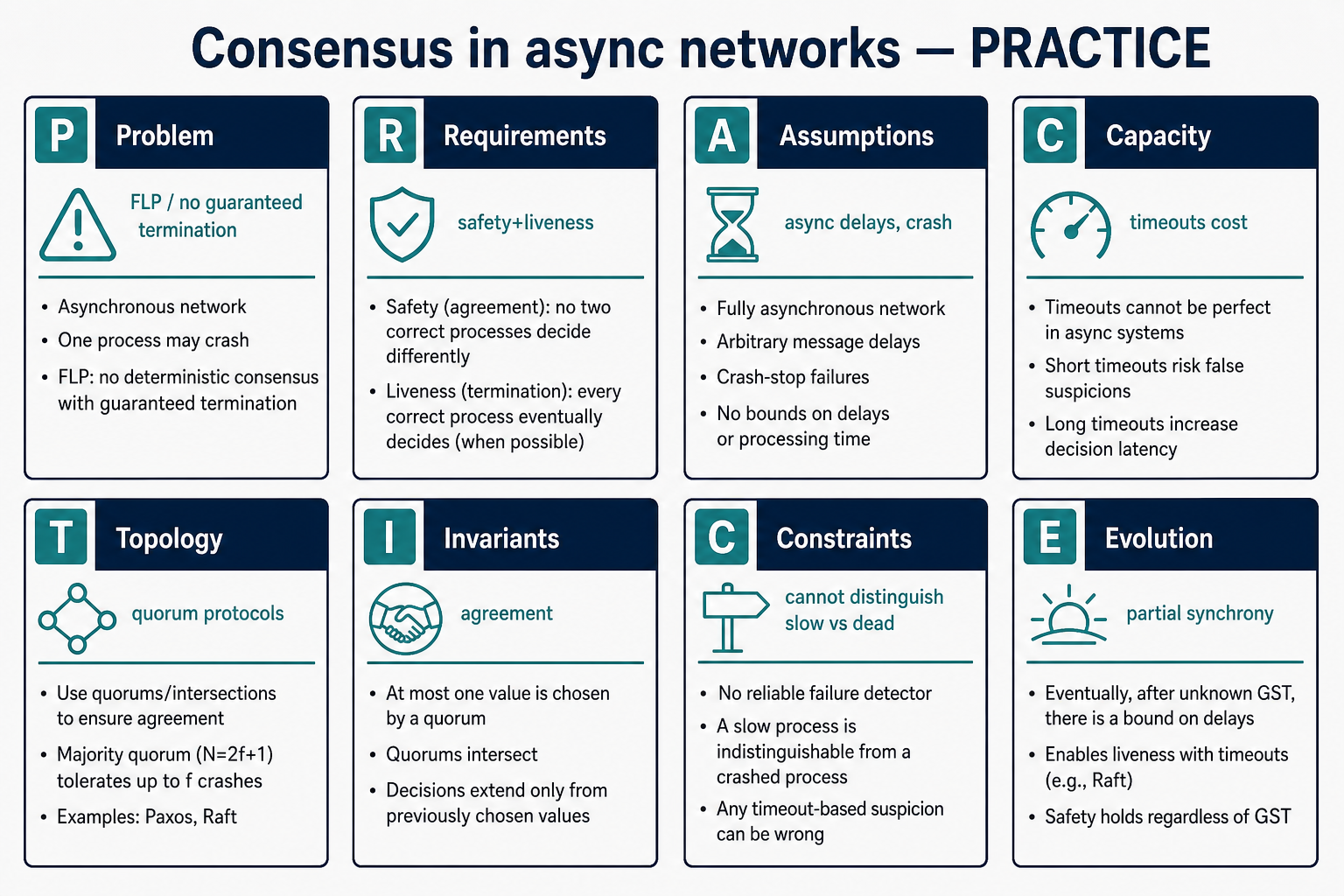
Figure A: PRACTICE map — Problem → Requirements → Assumptions → Capacity → Topology → Invariants → Constraints → Evolution.
Student interview script (PRACTICE)
P — Problem framing
"I'd gently reframe the question. The deep result isn't 'you must have a leader'—it's FLP (Fischer–Lynch–Paterson, 1985): in a fully asynchronous message-passing system with even one crash-stop failure, no deterministic protocol can guarantee both consensus safety (agreement/validity) and termination (liveness).
Why? You cannot distinguish a crashed process from a very slow one when delays are unbounded. Decide too early → risk disagreement; wait forever for certainty → never terminate.
Leaders (Raft/Multi-Paxos) are how production systems structure progress under partial synchrony—election timeouts after the network stabilizes. Removing the leader doesn't escape FLP; you'd still need timeouts, randomization, or weaker semantics (e.g. CRDTs, not consensus).
Short answer: Pure async + crashes blocks deterministic consensus; we use partial synchrony + quorums (+ often a leader) for liveness while keeping safety."
R — Requirements (what consensus demands)
| Property | Meaning |
|---|---|
| Agreement | All correct processes decide the same value |
| Validity | Decide a value that was proposed |
| Termination | Eventually decide (liveness) |
"FLP says you can't deterministically get all three under pure async + one crash. Something must give."
A — Assumptions (state the model aloud)
| Model knob | FLP setting | Production usually |
|---|---|---|
| Timing | Fully async (unbounded delay) | Partially synchronous (GST) |
| Failures | Crash-stop (≥1) | Crash-recovery + fencing |
| Algorithm | Deterministic | Timeouts / random election jitter |
| Adversary | Not Byzantine (classic FLP) | Usually crash; BFT if needed |
"I'd ask: are we talking pure async theory, or etcd/Raft in the datacenter?"
C — Capacity (cost of escaping FLP)
Pure async + det. consensus     → impossible (FLP)
Partial sync + Raft             → election RTTs; unavailable without majority
Randomized consensus            → probabilistic termination; rarer in infra
CRDT / eventual                 → no single agreed value; weaker product semantics
BFT                             → n > 3f; much higher cost
"I'd pick the weakest model that matches the threat—don't buy BFT for an internal control plane."
T — Topology (draw this)
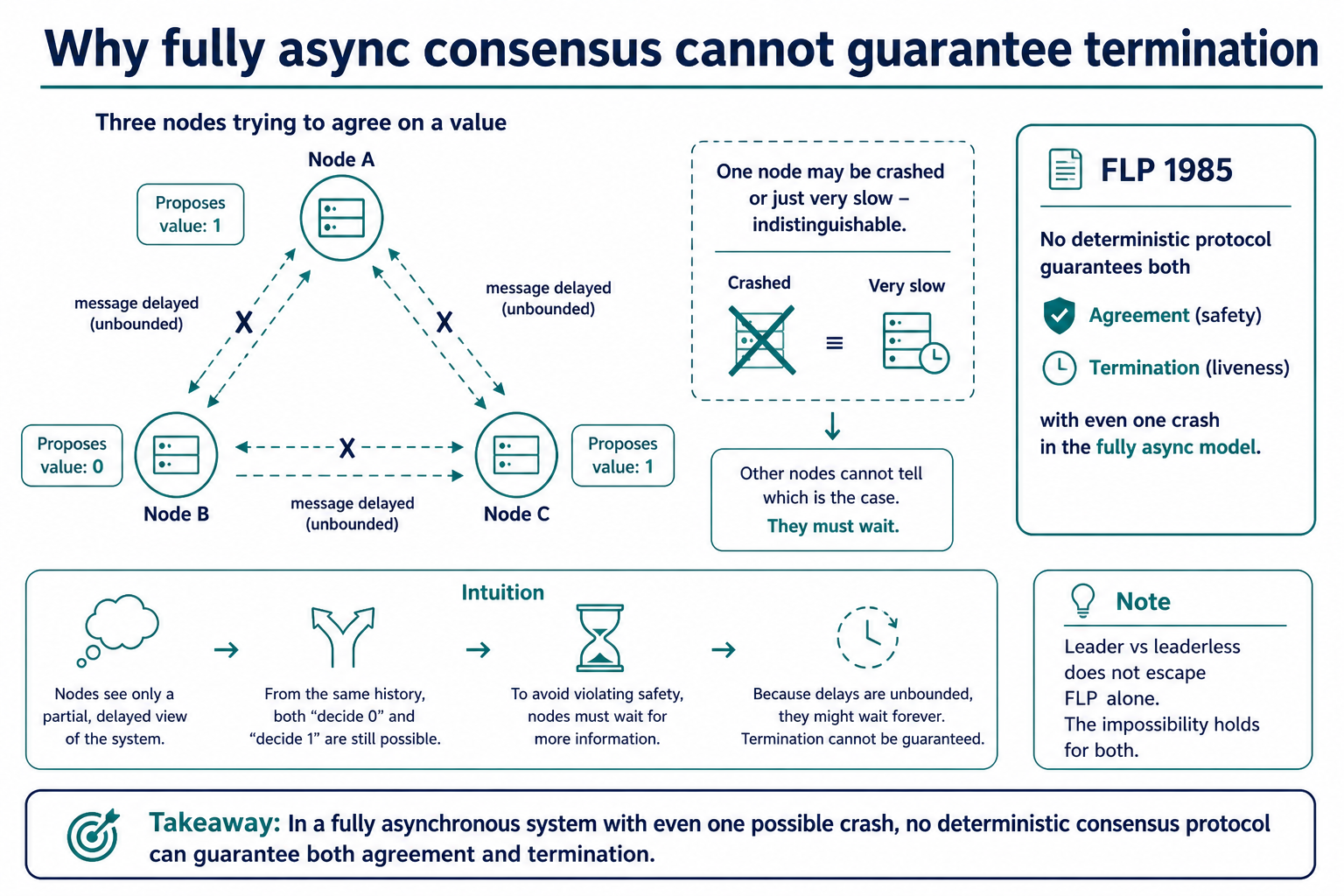
Figure B: Unbounded delay makes crash and slow look the same—deterministic terminate vs agree conflict.
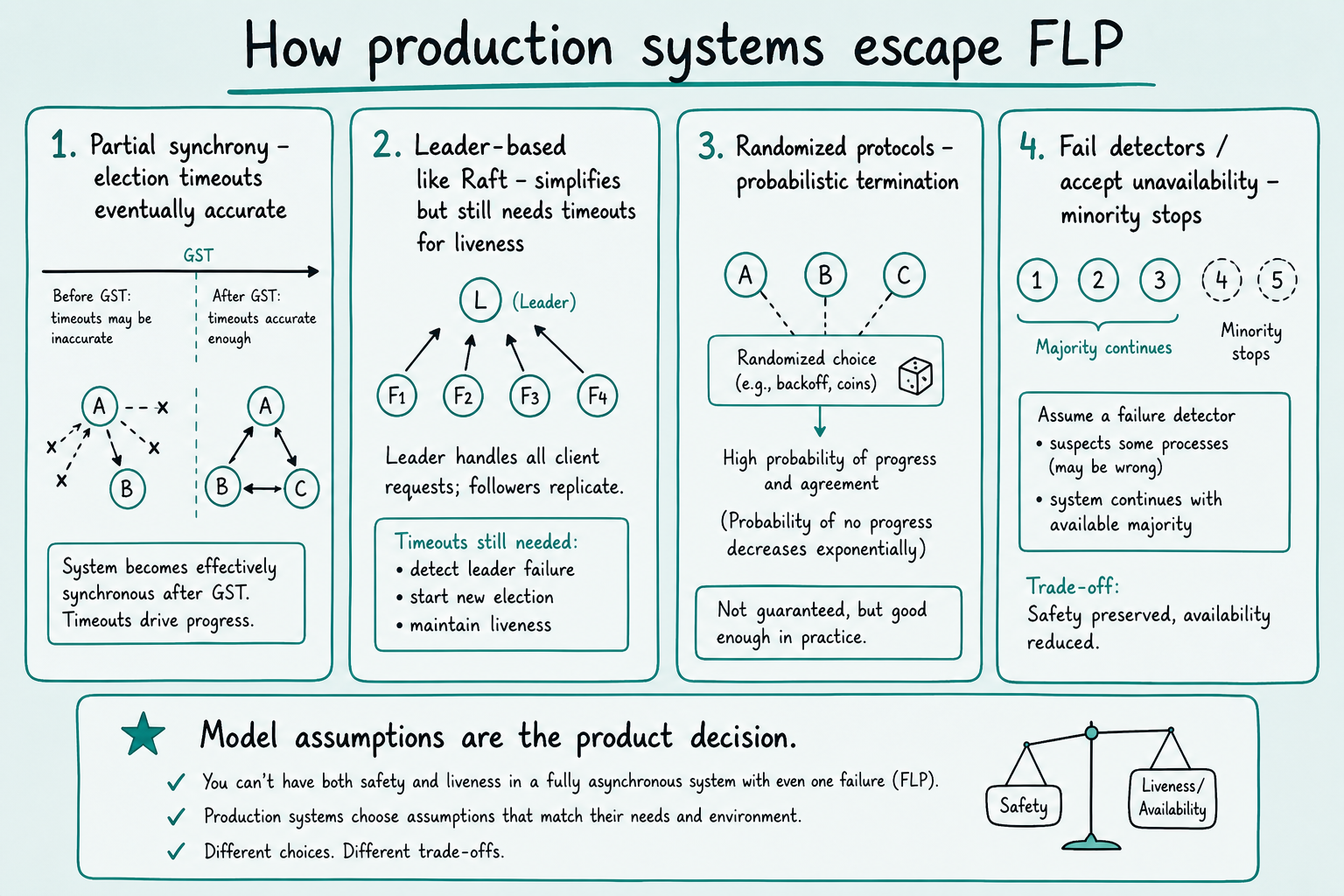
Figure C: Partial synchrony, leader+timeouts, randomization, or accept unavailability—model is the product choice.
| Escape hatch | What changes |
|---|---|
| Partial synchrony | After GST, timeouts work → elections terminate |
| Leader + election timeout | One sequencer; still needs majority quorum for safety |
| Randomized protocols | Termination with probability → 1 |
| Weaker problem | Leaderless CRDTs / eventual consistency—not consensus |
| Fail closed | No majority → no progress (safety over liveness) |
I — Invariants (safety)
"I'd separate carefully:
- FLP does not say 'consensus is impossible'—it says deterministic + fully async + crash + termination can't all hold.
- Safety can still hold while stuck (no leader / no quorum)—that's often correct.
- Leader is not the impossibility—it's an engineering pattern under timeouts.
- etcd/Raft do not violate FLP—they aren't pure-async correctness proofs.
- Quorums + terms/epochs keep agreement across crash-recovery."
C — Constraints (second C)
| Constraint | Design response |
|---|---|
| Interview says "need a leader because faster" | Correct: FLP/liveness, not speed |
| GC pause > election timeout | Fencing / step-down; dual primary risk |
| Aggressive timeouts | Leader flap (liveness noise), safety usually OK |
| "Async means no timeouts" | Timeouts drive liveness after stabilize; not pure-async safety proof |
| Adversarial nodes | Different model (BFT); leader alone insufficient |
E — Evolution (how you'd explain product choice)
Phased reasoning in the interview:
| Step | Say |
|---|---|
| 1 | Define consensus properties |
| 2 | State FLP under async + crash-stop |
| 3 | Intuition: slow ≡ dead |
| 4 | Reframe: leaderless still blocked without new assumptions |
| 5 | Escapes: partial sync, leaders+timeouts, randomization, weaker specs |
| 6 | Pick model for this product (e.g. Raft for control plane) |
Failure modes / traps:
| Trap | Better |
|---|---|
| "Consensus is impossible" | Deterministic async+crash termination is |
| "Need leader for speed" | Need timing assumptions for liveness |
| "Raft violates FLP" | Different model (partial sync) |
| Leaderless = escape FLP | Only if randomized or not consensus |
Observability: leader/term churn, election duration, quorum availability—symptoms of timing-model stress.
Closing line (interview)
"So the precise answer is FLP: fully asynchronous networks with even one crash cannot run a deterministic consensus algorithm that always terminates while preserving agreement. The 'without a leader' bit is a bit of a red herring—leaderless doesn't escape FLP. We escape by changing the model: partial synchrony, election timeouts, often a leader, plus quorums for safety. Raft/etcd live in that world; they don't refute FLP."
Scoring signals
| Strong | Weak / red flag |
|---|---|
| Names FLP + async + crash + deterministic | "Consensus is impossible" / "leader is faster" |
| Slow vs dead indistinguishability | No model vocabulary |
| Reframes leader ≠ root cause | Treats leader as the theorem |
| Partial synchrony / timeouts / quorum | Claims Raft violates FLP |
| Safety can hold while stuck | Equates no-leader with data loss |
Compact outline (if time-boxed to 2 minutes)
"FLP: no deterministic consensus termination in fully async crash systems—can't tell slow from dead. Leader isn't the theorem; leaderless still blocked. Escape with partial synchrony, timeouts, often Raft leader + quorum. Safety may hold while unavailable."
24. Weak Answer Example
Question: "Why can't we build consensus without a leader in an asynchronous network?"
"We need a leader because it's faster, and FLP says consensus is impossible."
Why weak / red flags: Conflates performance with impossibility; overstates FLP ("consensus impossible"); no async/crash/deterministic nuance; no partial synchrony; no safety vs liveness—sounds memorized without model vocabulary.
25. Hands-On Exercise
Lab: Model mismatch simulation
- Deploy a 3-node Raft cluster (e.g., etcd or a Raft simulator).
- Crash-stop test: Stop one follower permanently; verify writes commit with majority.
- Crash-recovery test:
kill -9leader mid-write; restart; measure whether duplicate or lost client writes occur without idempotency tokens. - Async stress: Introduce
tc netemdelay/jitter exceeding election timeout; observe leader flapping and client errors—document as liveness, not safety, failure. - Write ADR: State the model each test validated or violated.
Success criteria: Written explanation of at least one scenario where safety held but liveness failed, and one where operational mitigation (fencing/idempotency) was required for crash-recovery.
26. Knowledge Check
- Name the three classical failure models discussed in this chapter.
- What does GST mean in partial synchrony?
- Why is
n > 3frequired for Byzantine agreement (high level)? - Can a failure detector be perfectly accurate in a purely asynchronous system? Why?
- What property does FLP preserve while blocking termination?
- How does crash-recovery differ from crash-stop for quorum voting?
- Give one production symptom of partial synchrony violation.
- Why are heartbeats insufficient as a sole correctness mechanism in async models?
27. Flashcards
| Front | Back |
|---|---|
| Crash-stop | Process halts permanently; no recovery |
| Crash-recovery | Process restarts; volatile state may be lost |
| Byzantine fault | Arbitrary/process malicious behavior |
| Asynchronous system | No bound on message delay or processing speed |
| Partial synchrony | Eventually bounded delay after unknown GST |
| Synchronous system | Known bounds Δ, φ used by algorithm |
| FLP (1985) | No deterministic async crash-stop consensus |
| Quorum for crash-stop | Typically n ≥ 2f + 1 |
| Byzantine replica bound | n > 3f for classical agreement |
| Failure detector ◇P | Eventually accurate suspicion after GST |
| Safety vs liveness (FLP) | FLP: safety possible; deterministic termination not |
| Fencing token purpose | Reject stale primary after recovery |
28. Cheat Sheet
FAILURE MODELS
  crash-stop     → halted forever
  crash-recovery → restart + stable storage
  Byzantine      → arbitrary; need n > 3f

TIMING MODELS
  async          → unbounded delay; FLP blocks det. consensus
  partial sync   → bounded after GST; production default
  sync           → known Δ, φ; enables round-based FD

PRODUCTION PATTERN
  quorum + persistent log + epochs + timeouts

NEVER CLAIM
  "proven safe" without stating the model
29. Related Concepts
- Safety and Liveness — prerequisite properties every model must specify separately
- Partial Failure — why models exist in practice
- Consensus — constructive algorithms after FLP
- Replication — quorum replication under crash-stop assumptions
- Time, Ordering, and Coordination — clocks and ordering beyond timing models
- Consistency — client-visible guarantees layered on failure/timing models
30. References
Primary sources (formal guarantees)
- Fischer, M. J., Lynch, N. A., & Paterson, M. S. (1985). Impossibility of Distributed Consensus with One Faulty Process. Journal of the ACM. [FLP impossibility]
- Lamport, L., Shostak, R., & Pease, M. (1982). The Byzantine Generals Problem. ACM Transactions on Programming Languages and Systems. [
n > 3frequirement] - Chandra, T. D., & Toueg, S. (1996). Unreliable Failure Detectors for Reliable Distributed Systems. Journal of the ACM. [Partial synchrony and ◇P]
- Dwork, C., Lynch, N., & Stockmeyer, L. (1988). Consensus in the Presence of Partial Synchrony. Journal of the ACM. [GST formalization]
Books (synthesis)
- Lynch, N. A. (1996). Distributed Algorithms. Morgan Kaufmann. [System models and proofs]
- Herlihy, M. P., & Wing, A. V. (1990). Linearizability: A Correctness Condition for Concurrent Objects. ACM Transactions on Programming Languages and Systems. [Safety-style object guarantees]
- Kleppmann, M. (2017). Designing Data-Intensive Applications. O'Reilly. [Chapters on replication, consistency, and fault tolerance—implementation-oriented]
Implementation-oriented (engineering practice)
- Ongaro, D., & Ousterhout, J. (2014). In Search of an Understandable Consensus Algorithm (Extended Version). [Raft: crash-recovery + partial sync in practice]
- etcd documentation: Raft implementation and operational guidance — https://etcd.io/docs/
- Google Spanner paper: Corbett et al. (2012). Spanner: Google's Globally-Distributed Database. [External time synchrony as additional assumption]
Distinction
- Formal guarantees (FLP, Byzantine bound, ◇P) come from peer-reviewed papers.
- Implementation choices (Raft election timeouts, etcd tuning) reflect operational practice under partial synchrony, not proofs in the pure async model.
- Operational experience (zombie primaries, GC pauses) illustrates crash-recovery model violations; document as anecdotal unless measured in your environment.