ACID and Isolation Levels
1. Executive Summary
ACID—Atomicity, Consistency, Isolation, and Durability—is the foundational contract between application developers and transactional storage systems. Atomicity ensures a transaction's effects are all-or-nothing. Consistency (in the database sense) means each transaction preserves application-defined integrity constraints when executed alone. Isolation governs how concurrent transactions' intermediate states are visible to one another. Durability guarantees committed data survives process crashes and media failures within the system's stated recovery model.
Isolation levels are standardized (primarily via SQL and the ANSI SQL isolation definitions, with known ambiguities) as a ladder from weak to strong: READ UNCOMMITTED, READ COMMITTED, REPEATABLE READ, and SERIALIZABLE. Each level prevents specific anomalies: dirty reads, non-repeatable reads, phantoms, and serialization anomalies. Serializability is the gold standard for isolation: the concurrent execution must be equivalent to some serial order of transactions.
This chapter covers ACID semantics, isolation level definitions, anomaly catalogs, the difference between pessimistic locking and multi-version concurrency control (MVCC), how production databases map SQL isolation names to actual behavior, failure modes when isolation is mis-specified, and principal-level interview framing. Understanding ACID and isolation is prerequisite to MVCC, distributed transactions, sagas, and the transactional outbox pattern.
2. Why This Topic Matters
Principal architect interviews use transactions as a correctness precision test:
- Can you define each ACID property without conflating database "consistency" with CAP consistency?
- Can you name which anomalies each isolation level prevents—and which it does not?
- Do you know that REPEATABLE READ in PostgreSQL prevents phantoms but REPEATABLE READ in MySQL InnoDB (historically) may not?
- Can you explain when snapshot isolation is weaker than serializability (write skew)?
Production incidents from weak isolation include double-spend windows, inventory oversell, incorrect audit trails, and "impossible" balances visible to concurrent readers. Architects who default every service to READ COMMITTED without analyzing invariants design subtle data corruption that surfaces only under concurrent load.
Conversely, architects who demand SERIALIZABLE everywhere pay latency and deadlock costs without quantifying which invariants actually require it. Principal-level judgment is matching isolation to invariants, not reciting ACID mnemonics.
3. Problems Being Solved
| Problem | Without transactions | With ACID + appropriate isolation |
|---|---|---|
| Partial updates | Money debited but not credited | Atomicity rolls back entire transaction |
| Concurrent lost updates | Two writers overwrite each other | Isolation + locking or MVCC prevents or detects |
| Dirty reads | Read uncommitted data that rolls back | READ COMMITTED+ hides uncommitted writes |
| Non-repeatable reads | Same query returns different rows | REPEATABLE READ+ stabilizes read set |
| Phantom reads | New rows appear in repeated range scan | SERIALIZABLE or predicate locking |
| Constraint violations | Concurrent txs break invariants | Serializable execution or explicit constraints |
| Crash mid-write | Torn pages, unknown state | Durability + WAL recovery |
Transactions solve local (single-database) atomicity and concurrent correctness for a defined set of operations. They do not automatically solve distributed atomicity across services—that requires 2PC, sagas, or outbox patterns covered in later chapters.
4. Assumptions and System Model
Assume a single logical database with crash-recovery storage unless stated otherwise:
- Transactions are sequences of reads and writes with BEGIN/COMMIT/ROLLBACK boundaries.
- Concurrency arises from multiple transactions interleaving operations on shared data.
- Storage uses a write-ahead log (WAL) or equivalent for durability—implementation detail varies by engine.
- Isolation is defined over histories of transaction operations; a history is serializable if equivalent to some serial execution.
- Failures: Process crash (recoverable via WAL); not Byzantine unless discussing BFT databases.
Not assumed: Distributed consensus across nodes (that is replication/consensus territory). Synchronized clocks for ordering (logical transaction IDs or MVCC timestamps are typical). That SQL standard isolation names map identically across vendors—they do not; always verify engine behavior.
Scope: ACID applies within one database instance or one shard's transactional boundary. Cross-shard transactions are a separate coordination problem.
5. Essential Terminology
| Term | Definition |
|---|---|
| Atomicity | All operations in a transaction succeed together or none persist. |
| Consistency (C in ACID) | Transaction preserves integrity constraints; database moves between valid states. |
| Isolation | Degree to which concurrent transactions' effects are separated. |
| Durability | Committed data survives crashes per recovery guarantees. |
| Isolation level | Named policy (READ UNCOMMITTED … SERIALIZABLE) defining allowed anomalies. |
| Dirty read | Reading uncommitted data from another transaction. |
| Non-repeatable read | Re-reading a row sees a different value within one transaction. |
| Phantom read | Re-running a range query sees new rows inserted by another transaction. |
| Write skew | Two transactions read overlapping data, write disjoint rows, violating an invariant serial execution would prevent. |
| Serializability | Concurrent history equivalent to some serial order of transactions. |
| Snapshot isolation (SI) | Each transaction reads from a consistent snapshot; writes conflict on commit. |
| Predicate lock | Lock on a logical condition (range), not just a row. |
| Two-phase locking (2PL) | Acquire locks before access; release after commit—basis of many serializable implementations. |
Mnemonic: ACID = All or nothing, Correct invariants, Invisible intermediate states (isolation), Durable after commit.
6. Core Mechanism
ACID properties in depth
| Property | Mechanism (typical) | What it does not guarantee |
|---|---|---|
| Atomicity | Undo log / WAL rollback | Cross-service atomicity |
| Consistency | CHECK constraints, FK, app logic | CAP "consistency" |
| Isolation | Locks, MVCC snapshots, SSI | Global linearizability across shards |
| Durability | WAL fsync, replication | Survival of total datacenter loss without DR |
Isolation level anomaly matrix
| Level | Dirty read | Non-repeatable read | Phantom | Serialization anomalies |
|---|---|---|---|---|
| READ UNCOMMITTED | Allowed | Allowed | Allowed | Allowed |
| READ COMMITTED | Prevented | Allowed | Allowed | Allowed |
| REPEATABLE READ | Prevented | Prevented | Varies by engine | Often allowed (write skew) |
| SERIALIZABLE | Prevented | Prevented | Prevented | Prevented |
ANSI note: The SQL standard definitions are incomplete; Berenson et al. (1995) and subsequent work (Adya, 1999) formalized anomaly phenomena (P0–P4, G0–G3). Interview answers should cite phenomena, not only level names.
Figure 1: Lost update anomaly—both transactions read the same value and both write, losing one debit unless prevented by isolation or explicit locking.
Pessimistic vs optimistic concurrency
Figure 2: Pessimistic locking serializes access early; MVCC allows concurrent reads and detects write conflicts at commit.
Serializable execution equivalence
Figure 3: Serializability requires existence of a serial order producing the same final state and read results—not a specific real-time order.
7. Step-by-Step Walkthrough
Scenario: Bank transfer between accounts A and B; invariant: total balance unchanged.
| Step | Actor | Action | Isolation note |
|---|---|---|---|
| 1 | T1 | BEGIN | — |
| 2 | T1 | SELECT balance FROM accounts WHERE id=A FOR UPDATE | Pessimistic: locks row A |
| 3 | T1 | SELECT balance FROM accounts WHERE id=B FOR UPDATE | Locks row B |
| 4 | T2 | BEGIN; try UPDATE accounts SET balance=balance-10 WHERE id=A | Blocks on T1's lock |
| 5 | T1 | UPDATE A, UPDATE B; COMMIT | Releases locks |
| 6 | T2 | Proceeds with updated balance | Sees T1's commit |
Walkthrough with READ COMMITTED + no explicit lock:
| Step | Effect |
|---|---|
| T1 reads A=100, T2 reads A=100 concurrently | Both see same snapshot moment |
| Both debit 50 and commit | Final A=50, lost one debit—invariant violated |
Mitigation: SELECT FOR UPDATE, SERIALIZABLE isolation, or UPDATE accounts SET balance = balance - 50 WHERE id=A AND balance >= 50 with row-count check.
Phantom walkthrough (shift scheduling):
| Step | T1 (count on-call doctors) | T2 (insert doctor) |
|---|---|---|
| 1 | BEGIN | — |
| 2 | SELECT COUNT(*) WHERE on_call=true → 1 | — |
| 3 | — | INSERT on_call=true; COMMIT |
| 4 | SELECT COUNT(*) → 2 | Phantom—violates "at least one on call" decision |
Mitigation: SERIALIZABLE or predicate locking (PostgreSQL SSI).
8. Invariants and Guarantees
| Property | Type | Statement |
|---|---|---|
| Atomicity | Safety | No partial transaction effects visible after crash or abort |
| Durability | Safety | Committed data recoverable from WAL after crash |
| Isolation (per level) | Safety | Anomalies per level table are prevented |
| Serializability | Safety | History equivalent to serial execution |
| Progress | Liveness | Not guaranteed—deadlocks may require abort |
| Bounded commit time | Liveness | Not implied—lock wait unbounded |
Distinction: Serializability is a safety property on histories. Deadlock freedom and wait-free progress are separate liveness concerns—databases typically abort one transaction to break deadlock.
9. Failure Scenarios
Scenario 1: Lost update at READ COMMITTED
Setup: Two concurrent inventory decrements without locking.
Effect: Oversell—stock goes negative or count wrong.
Mitigation: Optimistic versioning (UPDATE ... WHERE version = ?), FOR UPDATE, or SERIALIZABLE.
Scenario 2: Write skew under snapshot isolation
Setup: Two transactions read "at least one on-call doctor," both see one, both assign current doctor off-call.
Effect: Zero on-call doctors—serializable execution would have blocked one transaction.
Mitigation: PostgreSQL Serializable Snapshot Isolation (SSI); explicit locking; materialize constraint.
Scenario 3: Long-running transaction + bloat
Setup: REPEATABLE READ holds snapshot; prevents vacuum of dead tuples (PostgreSQL).
Effect: Table bloat, transaction ID wraparound risk—operational failure.
Mitigation: Short transactions, monitor age(datfrozenxid), connection pool timeouts.
Scenario 4: Dirty read in reporting
Setup: Analytics job at READ UNCOMMITTED reads uncommitted order totals.
Effect: Reports include rolled-back orders—downstream bad decisions.
Mitigation: Never use READ UNCOMMITTED for business reports; READ COMMITTED minimum.
Scenario 5: ORM default isolation mismatch
Setup: App assumes serializable; connection pool uses READ COMMITTED.
Effect: Latent bugs under production concurrency only.
Mitigation: Explicit SET TRANSACTION ISOLATION LEVEL; integration tests with concurrent load.
10. Performance Characteristics
| Factor | Impact |
|---|---|
| Lock contention | SERIALIZABLE and FOR UPDATE serialize hot rows—latency tails grow |
| MVCC reads | No read locks—readers don't block writers (snapshot isolation) |
| Abort/retry rate | Optimistic serializable (SSI) aborts on conflict—app must retry |
| Index range locks | Phantom prevention (next-key locks in InnoDB) widens lock scope |
| WAL fsync | Durability cost per commit—group commit amortizes |
Qualitative rule: Stronger isolation on hot keys is a serialization bottleneck. Measure lock waits (pg_locks, InnoDB innodb_lock_waits) before upgrading isolation globally.
READ COMMITTED is the default in PostgreSQL and many systems—good default for low-contention OLTP with explicit locking on critical paths.
11. Scalability Limits
- Single-node serializable throughput bounded by lock manager or SSI conflict detection.
- Hot row updates (global counter, seat map) don't scale with SERIALIZABLE—shard or relax invariant.
- Long transactions block vacuum, hold locks, increase deadlock probability.
- Cross-shard transactions don't scale linearly—each shard serializes; 2PC adds coordination latency.
When SERIALIZABLE doesn't scale: Global inventory counter, viral event ticket sales, real-time bidding without partitioning.
12. Operational Considerations
- Document isolation per service in ADRs—not just "we use Postgres."
- Monitor: deadlocks/sec, lock wait time, serialization failures (SQLSTATE 40001), oldest xmin.
- Connection pool: reset session state (
DISCARD ALLor isolation level on checkout). - Migrations: changing isolation on live traffic—load test concurrent paths.
- Read replicas: replication lag means replicas are not part of the same transactional isolation guarantee for reads routed to standbys.
13. Security Considerations
- TOCTOU in authorization: Check permission at READ COMMITTED, act later—role may change. Re-check or use serializable scope.
- Multi-tenant row leakage: Weak isolation doesn't cause cross-tenant reads if RLS is correct—but app bugs in session variable setting are orthogonal.
- Audit integrity: Dirty reads in misconfigured replicas undermine audit trails.
- SQL injection + elevated isolation: Attacker holding locks longer—DoS via lock contention.
Isolation is correctness, not authorization—both required.
14. Cost Considerations
- Latency tax: SERIALIZABLE on contested rows vs READ COMMITTED.
- Engineering tax: Retry logic for serialization failures, deadlock handling.
- Incident tax: Weak isolation bugs are expensive—hard to reproduce, reputational damage on financial paths.
- Opportunity cost: Over-strong isolation blocks throughput features (high-concurrency counters).
Decision criterion: Pay for SERIALIZABLE where invariant violation cost exceeds retry + latency cost—inventory, balances, seat assignment—not for idempotent analytics aggregates.
15. Production Implementations
PostgreSQL
Default READ COMMITTED; REPEATABLE READ and SERIALIZABLE use MVCC snapshots. SERIALIZABLE implemented via Serializable Snapshot Isolation (SSI)—detects rw-conflicts, may abort with 40001. REPEATABLE READ prevents non-repeatable reads and phantoms for standard SQL but not all serialization anomalies without SERIALIZABLE.
MySQL InnoDB
Default REPEATABLE READ with next-key locking preventing phantoms for standard statements. Gap locks can cause unexpected deadlocks. READ COMMITTED reduces gap locks—common in high-contention workloads.
Oracle
Default READ COMMITTED; SERIALIZABLE uses snapshot isolation semantics (SI, not full SSI)—write skew possible unless locking used.
SQL Server
Supports all standard levels plus snapshot isolation as separate setting. Read committed snapshot (RCSI) uses row versioning without holding read locks.
CockroachDB / Spanner
Default SERIALIZABLE globally—distributed optimistic concurrency with retry on write conflicts.
Distinction: Always separate SQL level name from engine implementation (Berenson/Adya phenomena).
16. Alternatives and Tradeoffs
| Approach | Strength | Cost | Use when |
|---|---|---|---|
| READ COMMITTED + explicit locks | Predictable hot-path control | Deadlock management | Known contention points |
| REPEATABLE READ (MVCC) | Stable reads in transaction | Snapshot bloat, write skew | Reporting in one txn |
| SERIALIZABLE | Full anomaly prevention | Aborts, latency | Financial invariants |
| Snapshot isolation | Good read concurrency | Weaker than serializable | Many OLTP workloads accept write skew risk |
| Application-level locking (Redis) | Cross-service coordination | Not ACID with DB—fencing needed | See distributed chapters |
| Event sourcing | Serialize via log | Complexity, replay | Audit-heavy domains |
PACELC reminder: Stronger isolation often trades normal-case latency for correctness even without network partition.
17. Common Misconceptions
| Misconception | Reality |
|---|---|
| "ACID consistency = CAP consistency" | ACID C is application integrity; CAP C is linearizability. |
| "REPEATABLE READ = serializable" | Write skew and other anomalies may remain. |
| "MVCC means no locking" | Writers still lock; DDL locks exist; SSI tracks dependencies. |
| "READ UNCOMMITTED is faster" | Many engines implement it as READ COMMITTED anyway. |
| "Transactions fix distributed consistency" | Single-node only; microservices need sagas/2PC/outbox. |
| "Isolation level is per database" | Usually per session/transaction—pools can leak state. |
| "Serializable means no deadlocks" | Deadlocks still occur; one victim aborted. |
18. Principal Architect Perspective
- Inventory invariants before choosing isolation—"transfer money" vs "increment view count" differ.
- Name engine-specific behavior—PostgreSQL SERIALIZABLE ≠ Oracle SERIALIZABLE.
- Design for retries on serialization failure—idempotent operations, exponential backoff.
- Bound transaction duration—long txs are operational debt (bloat, locks, replication lag).
- Test concurrency—unit tests miss isolation bugs; use parallel integration tests or Jepsen-style workloads.
Interview signal: explaining write skew with the on-call doctor example separates principal candidates from ACID acronym recitation.
19. Architecture Review Exercise
Scenario: E-commerce checkout: READ COMMITTED, SELECT stock FROM inventory WHERE sku=?, if stock>0 then UPDATE inventory SET stock=stock-1, insert order row—in one transaction.
Review prompts:
- What anomaly under concurrent checkouts for last item?
- Does wrapping in a transaction fix it at READ COMMITTED?
- Options:
SELECT FOR UPDATE,UPDATE ... WHERE stock>0with row count, SERIALIZABLE? - Cost of SERIALIZABLE on hot SKU during flash sale?
- Alternative: partition inventory per warehouse shard?
Expected findings: Lost update possible; transaction alone insufficient without locking or atomic conditional update; hot-key sharding or queue may be needed at scale.
20. Whiteboard Explanation
90-second version:
"ACID: transactions are all-or-nothing, preserve app constraints, hide concurrent intermediate states, and survive crashes after commit. Isolation levels trade concurrency for safety—READ COMMITTED stops dirty reads but allows lost updates unless you lock or use conditional updates. REPEATABLE READ stabilizes row reads but snapshot isolation can still have write skew. SERIALIZABLE means the concurrent run equals some serial order—PostgreSQL uses SSI and may abort transactions on conflict. Default READ COMMITTED is fine for many paths; money, inventory, and seat maps need explicit analysis. Always check your engine—SQL level names aren't portable. And ACID is single-database—microservices need sagas or outbox for cross-service atomicity."
21. Interview Questions
-
Define each ACID property.
- Signals: Atomicity all-or-nothing; C is constraints; isolation concurrency; durability post-commit survival.
- Red flags: Conflating consistency with CAP.
-
What anomalies does READ COMMITTED prevent?
- Signals: Dirty reads prevented; non-repeatable and phantoms allowed.
-
Explain lost update. How do you prevent it?
- Signals: Concurrent read-modify-write;
FOR UPDATE, optimistic version, atomic UPDATE.
- Signals: Concurrent read-modify-write;
-
What is write skew?
- Signals: Two txs read overlapping state, write disjoint rows, violate invariant; SI allows it.
-
REPEATABLE READ vs SERIALIZABLE in PostgreSQL?
- Signals: RR is snapshot without full SSI; SERIALIZABLE detects rw-dependencies, aborts.
-
Does a transaction guarantee no lost updates?
- Signals: No—isolation level and explicit locking matter.
-
What is a phantom read?
- Signals: Range query returns different row set; prevented by serializable or predicate locks.
-
Pessimistic vs optimistic concurrency?
- Signals: Lock early vs detect conflict at commit; retry on abort.
-
Why are long transactions bad in MVCC systems?
- Signals: Block vacuum, hold xmin, bloat, increase conflict window.
-
How does InnoDB REPEATABLE READ differ from PostgreSQL?
- Signals: Next-key/gap locks vs MVCC snapshot; phantom handling differences.
-
When would you choose READ COMMITTED over SERIALIZABLE?
- Signals: Low contention, idempotent ops, explicit locks on critical sections.
-
What happens on serialization failure?
- Signals: SQLSTATE 40001; app must retry whole transaction.
-
Is snapshot isolation serializable?
- Signals: No—write skew counterexample.
-
How do you test isolation in production?
- Signals: Concurrent integration tests, formal checkers, metrics on abort rate—not usually full Jepsen on prod.
22. Interview Follow-Ups
-
Design ticket sales for 100k concurrent users.
- Signals: Hot row, SERIALIZABLE won't scale; queue, sharded counters, or reservation holds.
-
ORM hides isolation—what do you mandate?
- Signals: Explicit level on connection, pool reset, ADR per bounded context.
-
Compare serializability to linearizability.
- Signals: Transaction histories vs single-object real-time order.
-
Financial transfer across two databases?
- Signals: ACID doesn't span; 2PC or saga; outbox for events.
-
Executive wants strongest isolation everywhere—response?
- Signals: Latency, deadlock, throughput; risk-based per use case.
22A. Production Low-Level Design (Interview + Game Day)
Isolation level per bounded context—payments ≠ analytics. Production LLD and Game Day Standard.
Transaction API
| Service | Isolation | Rationale |
|---|---|---|
| Payment ledger | SERIALIZABLE or explicit row locks | No lost updates |
| Order read API | READ COMMITTED | Throughput |
| Inventory hold | SELECT FOR UPDATE + short txn | Hot row control |
Step-by-step flow:
| Step | Anomaly prevented | Ops note |
|---|---|---|
| 1 | Chooses isolation contract | Pool must reset level |
| 2–3 | Phantom / skew on balance | Retry on serialization failure |
| 4 | Atomicity + durability | Alert on abort rate spike |
SLO
Payment path: 0 balance anomalies; serialization abort p99 < 2% or queue fallback.
22B. Game Day Playbooks
| # | Drill | Inject | Detect | Mitigate | Verify |
|---|---|---|---|---|---|
| GD-1 | RC on payments | Run transfer under RC | Double-spend in test | Upgrade to SERIALIZABLE | Balances match |
| GD-2 | Hot row deadlock | Flash sale on one SKU | Txn timeout ↑ | Queue + shard inventory | Throughput recovers |
| GD-3 | ORM default level | Audit connection pool | Wrong isolation in prod | Mandate level in ADR | Integration tests pass |
GD-1 — READ COMMITTED payment unsafe path
23. Strong Answer Example
Question: "We use READ COMMITTED for payments. Is that safe?"
Answer this as a 45-minute design discussion using the PRACTICE framework. Below is how a strong student sounds aloud—not by default, and ACID ≠ isolation strong enough for money.
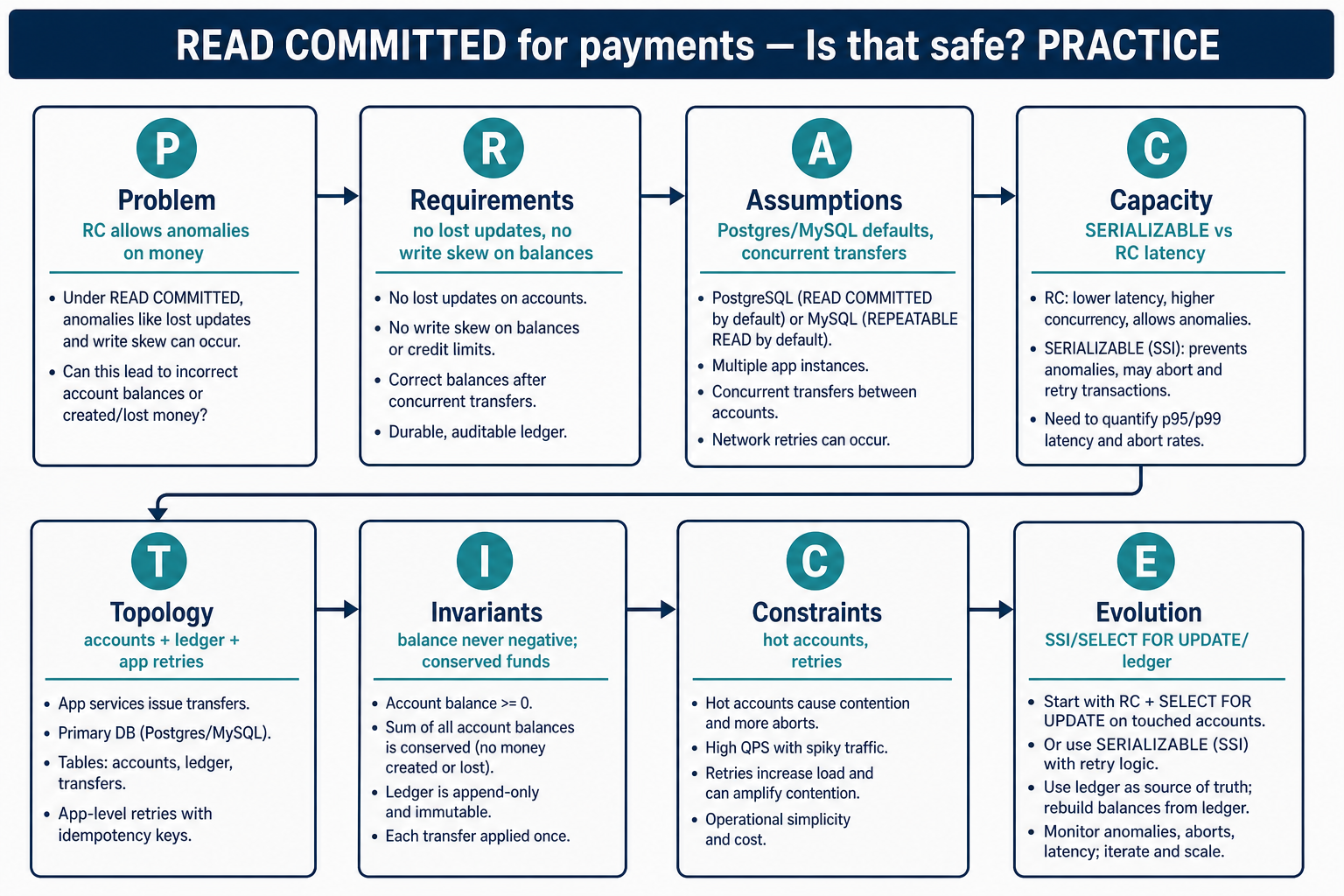
Figure A: PRACTICE map — Problem → Requirements → Assumptions → Capacity → Topology → Invariants → Constraints → Evolution.
Student interview script (PRACTICE)
P — Problem framing
"READ COMMITTED is a common default—Postgres uses it. It prevents dirty reads: you never see uncommitted data. For payments, the danger isn't dirty reads—it's lost updates and write skew on concurrent debit/credit logic.
Classic failure: two transfers both
SELECT balance = 100, both compute50, bothUPDATE—one debit vanishes. Atomicity of each transaction doesn't save you; isolation was too weak for the invariant.Short answer: Not safe by itself for concurrent balance updates. RC can be part of a safe design only if we add locks, conditional updates, SERIALIZABLE/SSI, or an append-only ledger—and we still need idempotency and a story for cross-service payments."
R — Requirements
| Payment invariant | RC alone enough? | What we need |
|---|---|---|
| Never see uncommitted balance | Yes | RC prevents dirty reads |
| No lost debit/credit on same account | No | Lock, conditional UPDATE, or SERIALIZABLE |
| Transfer conserves funds (A+B constant) | No if read-modify-write | Atomic multi-row txn + conflict control |
| No double-spend / double-capture | No | Idempotency key + unique constraint |
| Cross-service "atomic" pay+order | No | Outbox / saga—not isolation level |
"I'd ask: single DB transfer, or microservices? Hot wallet accounts? ORM defaults? Read replicas on the money path?"
A — Assumptions (state aloud)
| Assumption | Why it matters |
|---|---|
| Concurrent transfers hit same accounts | Contends on balance rows |
| App does read → compute → write | Classic lost-update shape under RC |
| Postgres/MySQL-style OLTP | Engine quirks (SSI vs SI vs gap locks) |
| "ACID" cited by team | Atomicity ≠ serializability |
| Money path may hit replicas | Lag breaks even strong primary isolation |
"I'd assume concurrent load until they prove single-threaded payment workers—which is rare."
C — Capacity (cost of safety)
READ COMMITTED, no locks          → high concurrency; corrupt under contention
RC + SELECT FOR UPDATE            → serialize hot accounts; watch deadlocks
SERIALIZABLE (Postgres SSI)       → abort+retry (40001); measure abort rate
Append-only ledger inserts        → high write throughput; balance = aggregate / cache
Idempotency key unique index      → cheap safety; mandatory regardless of isolation
"I'd rather pay lock waits or SSI aborts on the money path than silent lost updates. Analytics stay at RC."
T — Topology (draw this)
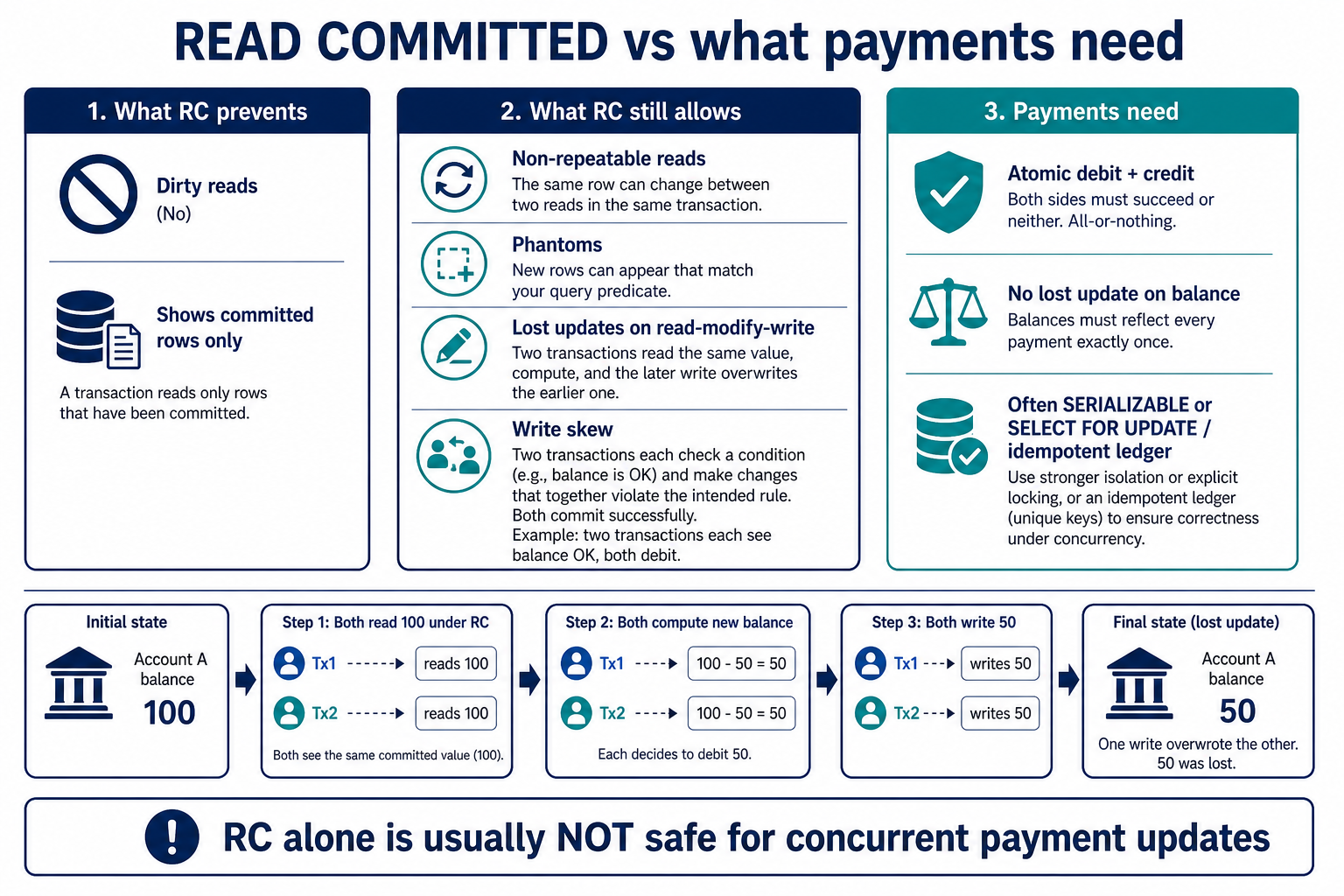
Figure B: RC stops dirty reads but still allows lost updates / write skew—unsafe for concurrent payment RMW.
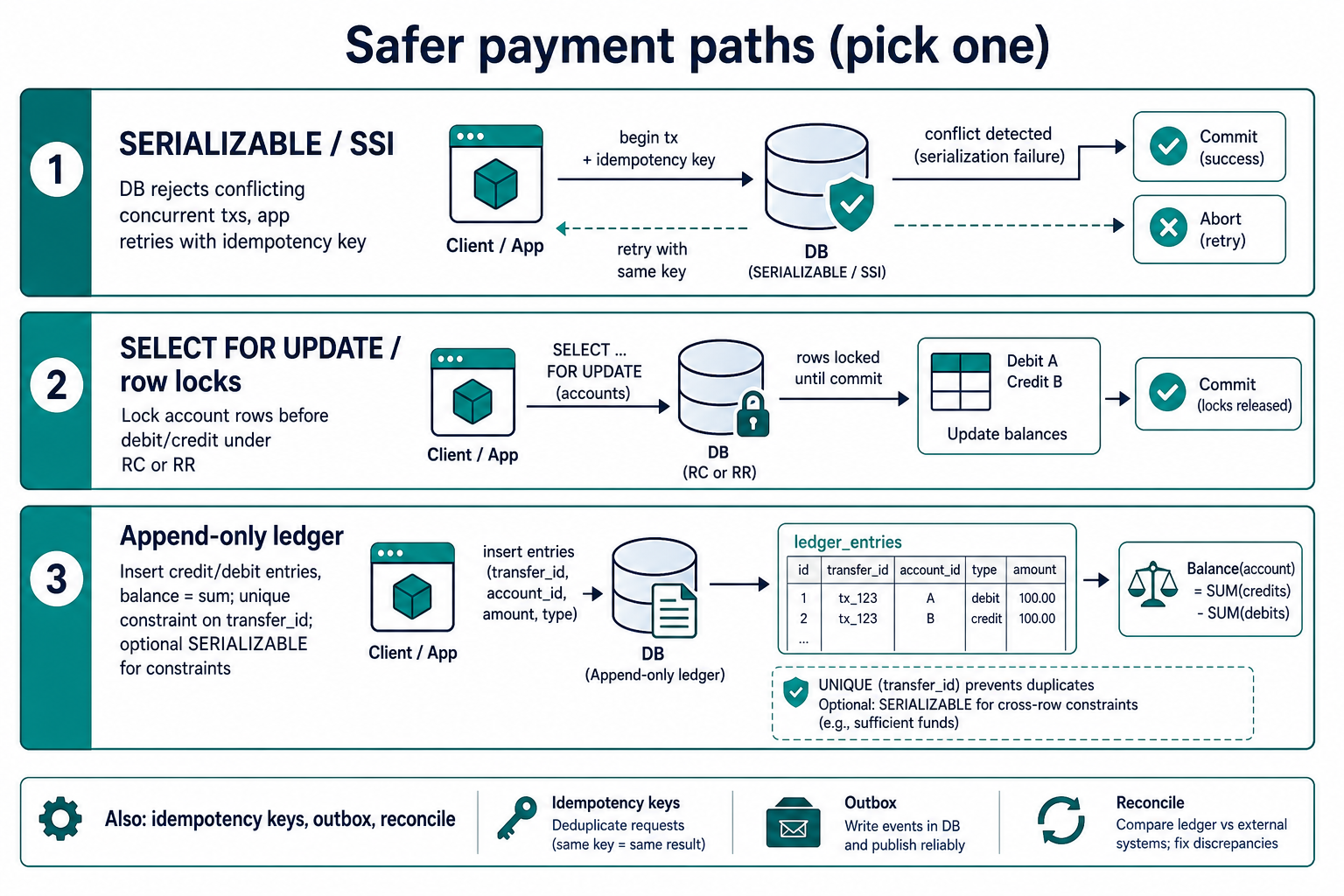
Figure C: Pick a path—SERIALIZABLE/SSI, SELECT FOR UPDATE, or append-only ledger + idempotency.
| Safe pattern | How it works | Watch-outs |
|---|---|---|
SELECT … FOR UPDATE then update | Pessimistic lock both accounts (ordered by id) | Deadlocks; lock ordering |
| Conditional update | UPDATE … SET bal=bal-50 WHERE id=? AND bal>=50; check rowcount | Easy to forget in ORM |
| SERIALIZABLE / SSI | DB aborts conflicting concurrent txs; app retries | Abort storms on hot keys |
| Append-only ledger | Insert debit/credit rows; unique transfer_id | Need careful balance query / cache |
| Idempotency key | Client retry ≠ double charge | Required even with SERIALIZABLE |
I — Invariants (safety)
"Non-negotiable for payments:
- No lost updates on balances / authorization holds.
- Conservation — transfer doesn't create or destroy money inside one DB txn.
- Non-negative (or explicit overdraft policy) enforced in the same atomic update.
- Exactly-once business effect under retries — idempotency key.
- RC alone does not imply (1)–(3) for concurrent RMW.
- Cross-service atomicity is out of scope for isolation levels."
C — Constraints (second C)
| Constraint | Design response |
|---|---|
| Hot celebrity / treasury account | Ledger or queue serialization; don't blanket SERIALIZABLE globally |
| ORM / connection pool defaults | Set isolation + FOR UPDATE in repository; reset session on checkout |
| Deadlocks under lock ordering bugs | Always lock account ids in sorted order |
| Read replica for "balance API" | Primary for money decisions; replica lag is not isolation |
| Multi-service payment | Outbox + saga compensations; not 2PC casually |
E — Evolution (prove it)
Phased delivery:
| Phase | Deliverable |
|---|---|
| M1 | Inventory payment invariants; ADR: RC default except money paths |
| M2 | Harden transfer: FOR UPDATE or conditional update + idempotency unique |
| M3 | Concurrent transfer integration tests (parallel clients) |
| M4 | Optionally move contested paths to SSI or ledger |
| M5 | Monitor deadlocks, SSI aborts, duplicate idempotency conflicts |
Failure modes:
| Failure | Mitigation |
|---|---|
| Lost update under RC RMW | Locks / conditional update / SERIALIZABLE |
| Write skew (two checks, both pass) | SERIALIZABLE or constraint locking |
| Double charge on client retry | Idempotency key |
| "Postgres is ACID so we're fine" | Teach A ≠ I strength |
| Cross-DB partial commit | Outbox / saga |
Observability: deadlock rate, serialization failure (40001) rate, idempotency conflict count, balance conservation reconciler, concurrent-transfer chaos tests.
Closing line (interview)
"So: READ COMMITTED for payments is not safe by default. It stops dirty reads but still allows lost updates and write skew on concurrent balance logic. I'd keep RC as the service default, and on the money path use
SELECT FOR UPDATEor conditional updates, or SERIALIZABLE/SSI, plus idempotency keys—and an append-only ledger if contention is high. Cross-service payments need outbox/sagas, not a stronger SQL isolation name. I'd prove it with concurrent transfer tests and document it in an ADR."
Scoring signals
| Strong | Weak / red flag |
|---|---|
| "Not by default" + names lost update | "Yes, ACID / Postgres is fine" |
| Separates atomicity from isolation | Conflates A with I |
| Concrete fix: FOR UPDATE / conditional / SSI / ledger | Only "use transactions" |
| Idempotency for retries | Ignores double-submit |
| Cross-service ≠ isolation level | Claims RC fixes microservices |
| Per-path ADR + concurrency tests | Global SERIALIZABLE with no tradeoff |
Compact outline (if time-boxed to 2 minutes)
"No—not alone. RC prevents dirty reads, not lost updates. Two concurrent debits can both read 100 and both write 50. Fix with FOR UPDATE, conditional UPDATE, SERIALIZABLE, or ledger + idempotency. Cross-service needs outbox/saga. ADR per invariant; concurrent tests."
24. Weak Answer Example
Question: "We use READ COMMITTED for payments. Is that safe?"
"Yes, Postgres is ACID so we're fine. Transactions are atomic."
Why weak / red flags: Ignores isolation level semantics, lost updates, write skew; no locking/conditional update/SSI; conflates atomicity with isolation—classic payment-incident pattern under concurrency.
25. Hands-On Exercise
Exercise: Isolation anomaly reproduction
- Spin up PostgreSQL locally; open two
psqlsessions. - Session A:
BEGIN ISOLATION LEVEL READ COMMITTED; read a row. - Session B: update and commit the same row.
- Session A: read again—observe non-repeatable read.
- Repeat with
REPEATABLE READ—stable read. - Implement write skew with two sessions and on-call doctor table.
- Retry with
SERIALIZABLE—observe40001on conflict. - Write ADR: isolation level for one service in your domain.
Success criteria: Reproduce non-repeatable read and write skew; document mitigation chosen.
26. Knowledge Check
- What does atomicity guarantee? (All-or-nothing commit/abort.)
- Dirty read allowed at which level? (READ UNCOMMITTED.)
- Does REPEATABLE READ prevent write skew in PostgreSQL? (Not necessarily—need SERIALIZABLE for SSI.)
- What is a phantom read? (New rows in repeated range query.)
- Pessimistic locking example in SQL? (
SELECT FOR UPDATE.) - SQLSTATE for serialization failure in PostgreSQL? (40001.)
27. Flashcards
| # | Front | Back |
|---|---|---|
| 1 | Atomicity | All ops commit or none persist. |
| 2 | ACID Consistency | Preserves integrity constraints per transaction. |
| 3 | Isolation | Hides concurrent uncommitted/changing state per level. |
| 4 | Durability | Committed data survives crash via WAL. |
| 5 | Dirty read | Read uncommitted data from another txn. |
| 6 | Non-repeatable read | Same row, different value on re-read. |
| 7 | Phantom read | Range query returns new rows. |
| 8 | Write skew | SI anomaly: concurrent disjoint writes break invariant. |
| 9 | Serializability | Equivalent to some serial execution order. |
| 10 | READ COMMITTED | No dirty reads; default in PostgreSQL. |
| 11 | SSI | PostgreSQL SERIALIZABLE via snapshot + conflict detection. |
| 12 | SELECT FOR UPDATE | Pessimistic row lock until commit. |
28. Cheat Sheet
ACID
  A: all-or-nothing (undo/WAL)
  C: app constraints (not CAP C)
  I: isolation level
  D: WAL + fsync

ISOLATION LADDER
  RU → RC → RR → SERIALIZABLE
  Stronger = fewer anomalies, more contention/aborts

KEY ANOMALIES
  Lost update: RC+ without lock
  Write skew: SI, not full serializable
  Phantom: needs SERIALIZABLE / predicate lock

POSTGRES
  Default RC; SERIALIZABLE = SSI, retry 40001

INTERVIEW
  Engine-specific behavior
  Invariant → level + locking
  ACID ≠ distributed atomicity
29. Related Concepts
- Linearizability — single-object consistency; related but distinct from serializability
- MVCC — snapshot-based isolation implementation
- Safety and Liveness — serializability as safety property
- Two-Phase Commit — distributed atomicity
- Sagas — cross-service compensation
- Idempotency — retry after serialization abort
30. References
Primary sources
- Gray, J., & Reuter, A. (1993). Transaction Processing: Concepts and Techniques. Morgan Kaufmann — foundational ACID and 2PL treatment.
- Berenson, H., et al. (1995). "A Critique of ANSI SQL Isolation Levels." SIGMOD — formalized anomalies P0–P4.
- Adya, A. (1999). "Weak Consistency: A Generalized Theory and Optimistic Implementations for Distributed Transactions." PhD thesis, MIT — phenomena G0–G3, snapshot isolation analysis.
Production and engineering
- PostgreSQL Documentation — Transaction Isolation — SSI behavior, isolation level semantics.
- MySQL InnoDB Documentation — InnoDB Transaction Model — next-key locks, REPEATABLE READ.
- Martin Kleppmann, Designing Data-Intensive Applications (O'Reilly) — Chapters 7–9 on transactions and isolation.
Distinction
| Claim type | Source |
|---|---|
| ACID definitions | Gray & Reuter; textbook consensus |
| Anomaly phenomena | Berenson et al. (1995); Adya (1999) |
| PostgreSQL SSI | PostgreSQL official docs |
| InnoDB gap locks | MySQL official docs |