Decision Frameworks
Structured approaches for architecture decisions at principal level. Use these to make tradeoffs explicit, align stakeholders, and document rationale in ADRs.
Related: Architecture Decision Records, Glossary, CAP Theorem, PACELC
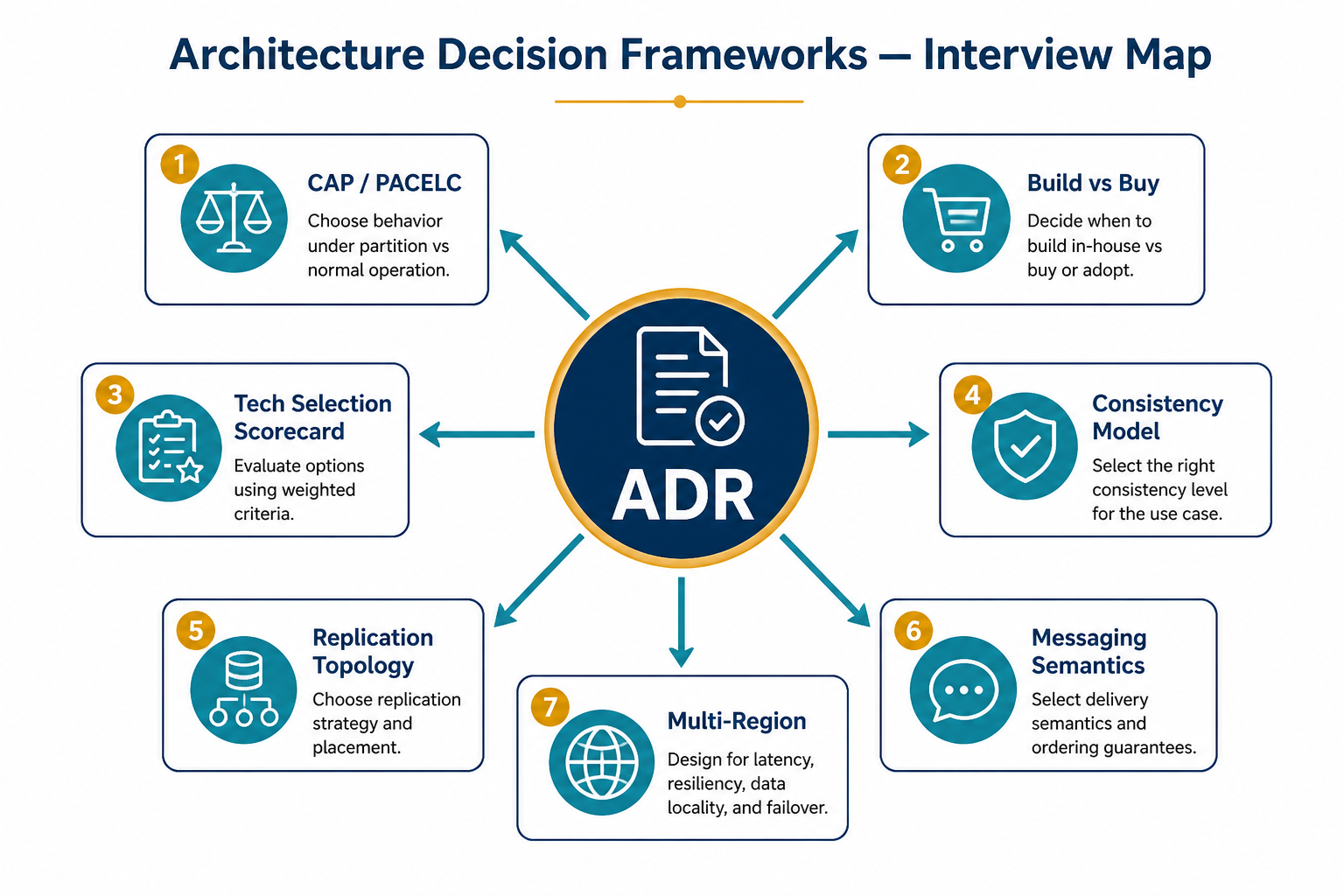
Figure A: Framework toolkit — CAP/PACELC, build vs buy, tech scorecard, consistency, replication, messaging, multi-region — all land in an ADR.
Interview walkthrough (how a strong student sounds)
When an interviewer asks "How do you make architecture decisions?" or throws a fork (database, multi-region, build vs buy), don't name-drop frameworks. Pick the right lens, state the tradeoff, and commit to an ADR with revisit triggers.
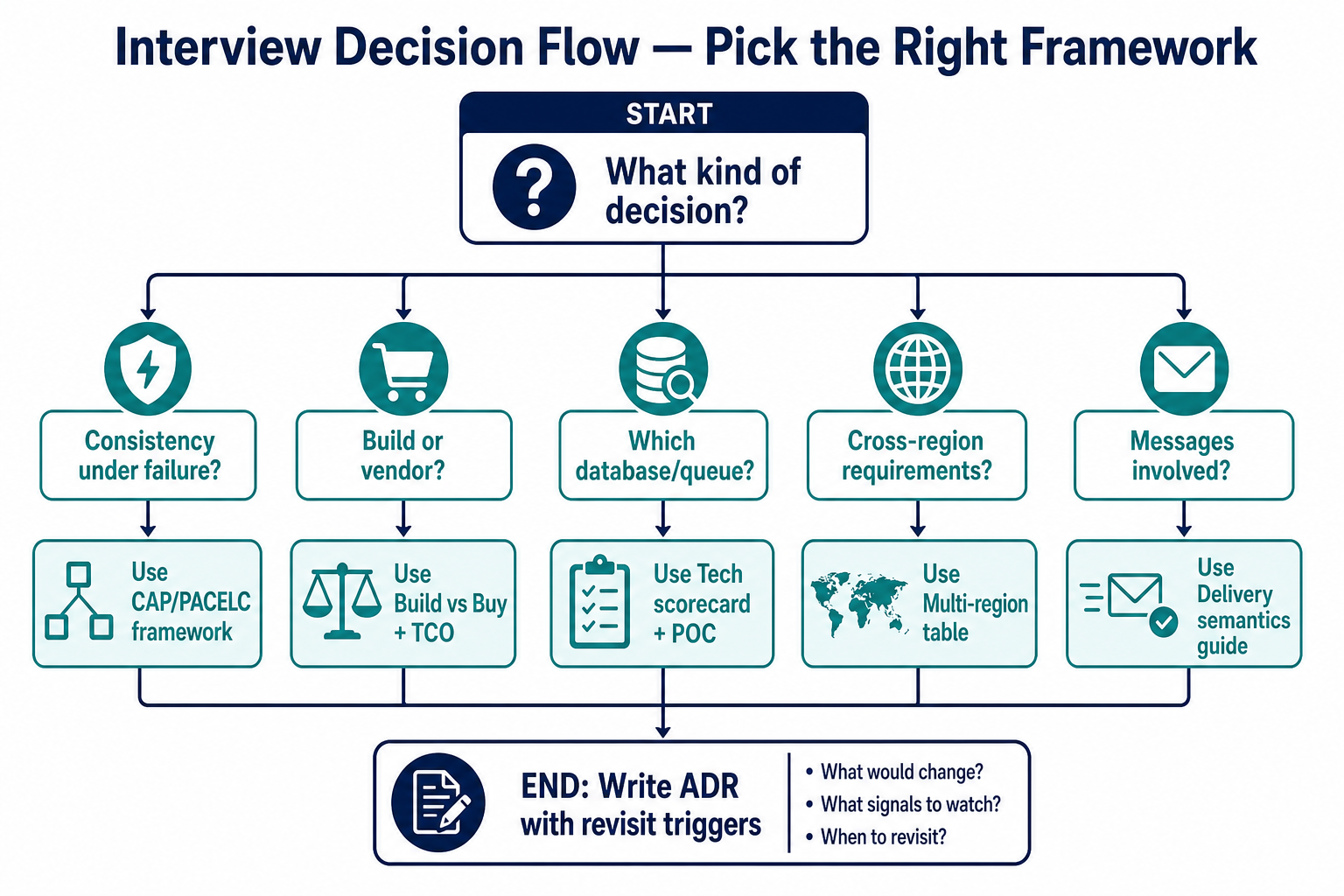
Figure B: Start from the decision type → apply the matching framework → write the ADR.
Opening (10 seconds)
"I treat decisions as explicit tradeoffs under constraints—SLOs, team size, regulatory risk—not as picking a favorite technology. I match the decision type to a framework, score options with assumptions written down, POC the riskiest claim, and capture the result in an ADR with revisit triggers so we can change our minds with evidence."
Which framework when (say this table aloud)
| Interview prompt | Framework I reach for |
|---|---|
| "What if the network splits?" | CAP — client-visible behavior under partition |
| "What about normal day-to-day?" | PACELC — latency vs consistency when healthy |
| "Should we build our own X?" | Build vs buy + 3-year TCO |
| "Postgres vs DynamoDB vs …?" | Tech selection scorecard + time-boxed POC |
| "How consistent do reads need to be?" | Consistency decision tree |
| "Single region or multi-region?" | Replication + multi-region strategy tables |
| "Kafka delivery guarantees?" | Messaging semantics (at-least-once + idempotency) |
"Avoid framework theater: a one-page ADR beats a 40-slide review with no decision."
1. When to Use a Framework
| Situation | Framework |
|---|---|
| Choosing consistency vs availability | CAP / PACELC |
| Custom software vs vendor | Build vs buy |
| Picking databases, queues, clouds | Technology selection |
| Any significant fork | ADR + weighted criteria matrix |
2. CAP Theorem
Student script — CAP
"CAP is not 'pick two of three forever.' Gilbert & Lynch: if a partition occurs, you cannot be both fully available on both sides and linearizable. I'd never say 'we are CA'—partitions happen. I name client-visible behavior: reject writes (CP-leaning) or serve and reconcile later (AP-leaning). And CAP is per subsystem—ledger ≠ social feed."
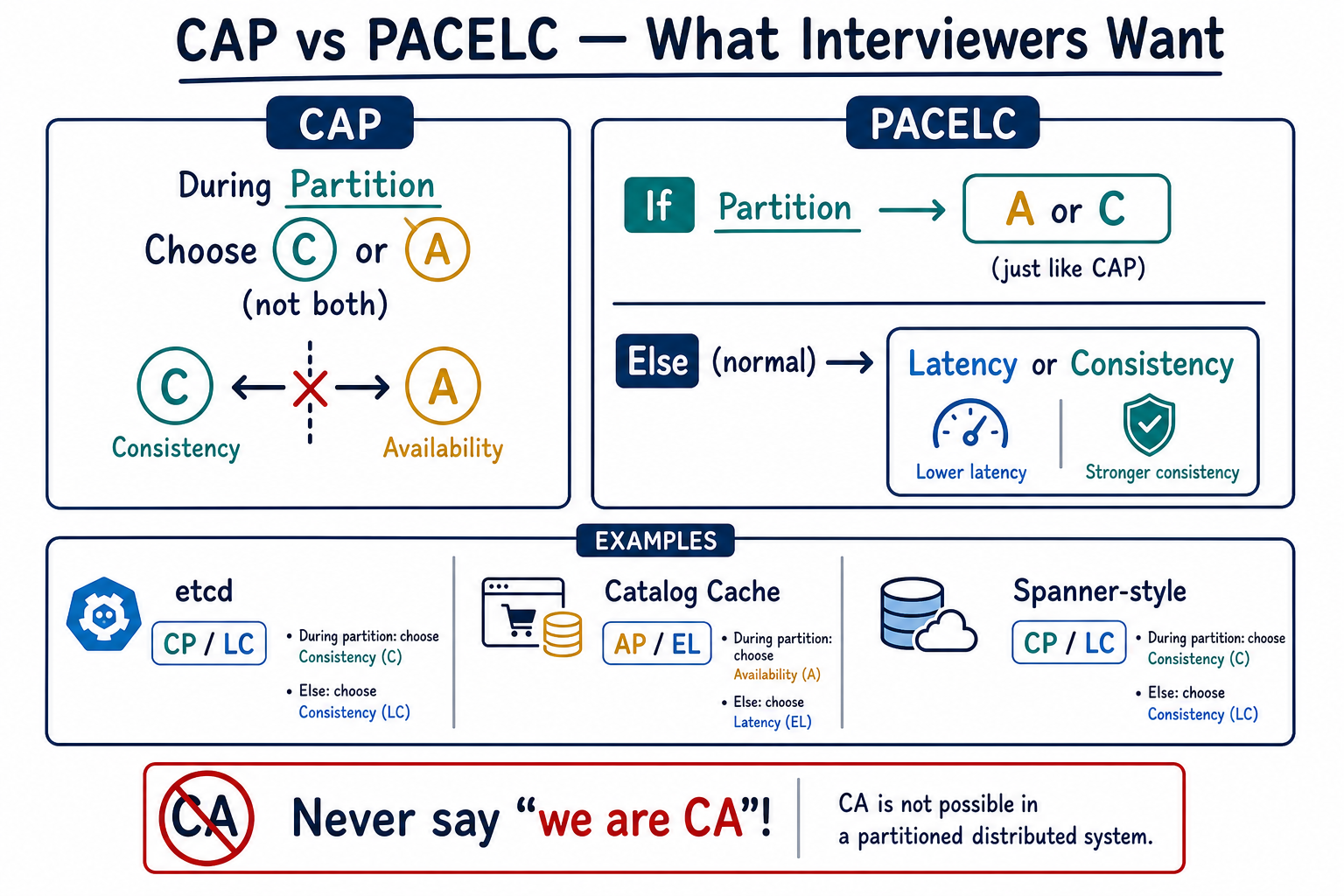
Figure C: CAP = partition fork (C vs A). PACELC adds the normal-operation fork (latency vs consistency).
2.1 Problem
During a network partition, can the system remain available (respond to all requests) and linearizable (as defined in Gilbert & Lynch, 2002) for all operations?
2.2 Mechanism
CAP is not "pick two of three forever." It states: if a partition occurs, you cannot have both strong consistency (linearizability in the CAP formalization) and full availability on both sides of the partition.
2.3 Decision criteria
| Choose CP-leaning | Choose AP-leaning |
|---|---|
| Financial ledger, inventory reservation | Social feed, analytics, config cache |
| Cannot tolerate conflicting writes | Business tolerates merge/conflict resolution |
| Clients accept unavailability during partition | Clients must always get a response |
| Strong audit requirements | High write availability across regions |
2.4 Common mistakes
| Mistake | Correction |
|---|---|
| "We are CA" | Partitions happen; clarify behavior when they happen |
| CAP applies to whole system | Different subsystems make different choices |
| CAP replaces consistency model discussion | Name specific guarantee (linearizable, causal, eventual) |
2.5 Interview relevance
Principal candidates explain client-visible behavior during partition, not slogans. Link to Partial Failure.
References: Gilbert & Lynch (2002); Kleppmann critique of CAP simplification in DDIA.
3. PACELC Extension
Daniel Abadi (2012): If Partition, choose Availability or Consistency; Else (normal operation), choose Latency or Consistency.
Student script — PACELC
"Most hours are not partitioned—so PACELC matters. Under P I choose A or C; Else I choose Latency vs Consistency. Example: feature flags—edge serves last-known (AP/EL) for sub-ms page loads; control plane is strongly consistent (LC). I document per component, not one label for the whole platform."
3.1 Why PACELC matters
Most production hours are not under partition. Teams still choose between:
- Low latency, possibly stale reads (Dynamo-style tunable reads)
- Higher coordination cost for fresher reads (Spanner-style commits)
3.2 Decision matrix
| Workload | P: partition | EL: normal operation |
|---|---|---|
| Metadata / coordination (etcd) | CP | LC (consistency over latency) |
| Product catalog cache | AP | EL (low latency, eventual) |
| User session store | CP or AP depending on stickiness | Often EL with TTL |
| Cross-region bank transfer | CP | LC |
3.3 Walkthrough example
Feature flag service evaluated on every page load:
- Partition: Serve last-known flags from edge cache (AP) vs fail closed (CP). Product choice: AP with version numbers; risky flags fail closed via policy.
- Else: Edge cache (EL) for sub-ms latency; control plane strongly consistent (LC).
Document per-component PACELC in ADR, not one label for entire platform.
4. Build vs Buy
Student script — build vs buy
"I ask: is this a differentiator or undifferentiated heavy lifting? Then I score TCO over 3 years—headcount, on-call, licenses, opportunity cost—not just license fee. Default: buy the base, build the wedge—managed Kafka + our stream logic; managed Postgres + our schema. Build when no vendor meets latency/compliance/scale, and we have a sustained platform team. Buy for email, IdP, payments rails, and coordination primitives where subtle bugs are expensive."
4.1 Problem
Should the organization implement a capability in-house or adopt managed/open-source/vendor solution?
4.2 Decision criteria matrix
| Criterion | Weight (example) | Build signal | Buy signal |
|---|---|---|---|
| Strategic differentiation | High | Core competitive advantage | Commodity capability |
| Time to market | High | Team ready; small scope | Urgent delivery |
| Total cost of ownership | High | 3-year TCO lower incl. on-call | Vendor scale economies |
| Operational burden | High | Dedicated platform team | Small team; limited SRE |
| Risk & compliance | Medium | Unique requirements | Vendor certifications (SOC2, HIPAA) |
| Exit / portability | Medium | Accept lock-in for speed | Need multi-cloud abstraction |
| Team expertise | Medium | Deep domain skills | Skill gap in protocol/ops |
4.3 TCO components (do not ignore)
- Engineering headcount (build + maintain)
- On-call and incident cost
- Infrastructure and license fees
- Migration and training
- Opportunity cost (what else team cannot build)
4.4 When build is justified
- Capability is differentiator (e.g., proprietary ranking, custom hardware path)
- No vendor meets latency, compliance, or scale constraints
- Organization has sustained platform team with Jepsen-level verification for coordination systems
4.5 When buy is justified
- Undifferentiated heavy lifting (email delivery, payments rail, identity broker)
- Coordination primitives (etcd, Consul, ZooKeeper)—subtle bugs are expensive
- Team must ship product in < 6 months without platform staffing
4.6 Hybrid pattern
Buy the base, build the wedge: managed Kafka + custom stream processing; managed Postgres + domain schema and migration tooling.
4.7 ADR template snippet
Decision: Adopt managed DynamoDB for session store
Alternatives: Self-hosted Cassandra, Redis Cluster
Criteria scores: [table]
Risks accepted: vendor lock-in, per-request cost at scale
Revisit trigger: monthly cost > $X or p99 > Y ms for 2 quarters
Link: Architecture Decision Records.
5. Technology Selection Framework
Student script — tech selection
"Requirements → filter infeasible → shortlist 2–3 → POC the riskiest assumption (partition, hot key, poison messages)—not the happy path → weighted scorecard with assumptions → ADR + pilot → production with exit criteria. I call out anti-patterns: resume-driven tech, vendor benchmarks only, analysis paralysis."
5.1 Process
5.2 Requirement categories
| Category | Example questions |
|---|---|
| Functional | Query patterns, throughput, data model |
| Non-functional | p99 latency, RPO/RTO, multi-region |
| Consistency | Linearizable? Causal? Eventual? |
| Operational | Managed vs self-hosted, upgrade path |
| Security | Encryption, IAM, audit, data residency |
| Cost | Unit economics at projected scale |
| Ecosystem | Client libraries, hiring pool, K8s operators |
| Migration | Dual-write period, rollback |
5.3 Weighted scorecard (example)
| Dimension | Weight | Option A | Option B | Option C |
|---|---|---|---|---|
| Meets consistency need | 25% | 5 | 3 | 4 |
| Operability | 20% | 3 | 5 | 4 |
| Performance at scale | 20% | 4 | 4 | 3 |
| Cost at 3-year projection | 15% | 3 | 4 | 5 |
| Team familiarity | 10% | 5 | 2 | 3 |
| Vendor risk / portability | 10% | 2 | 4 | 4 |
Score 1–5 per cell; multiply by weight; document assumptions behind each score.
5.4 Proof-of-concept scope
POC must test riskiest assumption, not happy path:
- Consensus: partition behavior, failover time, write latency at target fsync
- Database: hot key, cross-shard transaction need, replication lag under load
- Queue: consumer lag recovery, reordering, poison messages
5.5 Anti-patterns
| Anti-pattern | Why it fails |
|---|---|
| Resume-driven development | Picks tech for career, not fit |
| Benchmark marketing only | Vendor numbers without your workload |
| Single-vendor default | Misses multi-cloud or open requirements |
| Analysis paralysis | No time-boxed POC |
| No sunset criteria | Stuck on wrong choice |
6. Consistency Model Selection
Student script
"I ask four questions: Need real-time order on one object for all clients? → linearizability. Own-writes / monotonic reads? → session guarantees. Causal chains? → causal. Can merge async? → eventual + CRDTs/version vectors. Then I name the model in the ADR—not just 'strong' or 'eventual.'"
Quick decision tree (complements PACELC):
- Must all clients see writes in real-time order on one object? → Linearizability (cost: coordination).
- Must users see own writes and monotonic reads? → Session guarantees on eventually consistent store.
- Must causal chains (comments on post) be ordered? → Causal consistency.
- Can merge conflicts asynchronously? → Eventual + CRDT/version vectors.
Link: Consistency.
7. Replication Topology Selection
| Pattern | When | Risk |
|---|---|---|
| Single-leader sync | Low RPO, acceptable write latency | Leader failure, failover |
| Single-leader async | Read scale, tolerate lag | Stale reads, data loss on crash |
| Multi-leader | Multi-region write latency | Conflict resolution required |
| Leaderless quorum | High write availability | Complex read repair, SLAs |
Interview tip: Tie topology to RPO honesty—async single-leader means lag-at-crash can lose acknowledged writes unless the product accepts that.
8. Messaging Semantics Selection
| Need | Pattern |
|---|---|
| Fire-and-forget metrics | At-most-once |
| Default event processing | At-least-once + idempotent consumer |
| Financial side effects | Outbox + idempotent sink; avoid claiming true exactly-once |
| Ordering per entity | Partition key = entity id |
Link: Message Delivery Semantics.
Interview tip: "Exactly-once" without naming the sink is a red flag—I'd say at-least-once + idempotency / outbox unless the sink joins a transactional epoch.
9. Multi-Region Strategy
| Strategy | RPO | Complexity | Use when |
|---|---|---|---|
| Active-passive | Low with sync | Lower | Strict consistency, DR focus |
| Active-active eventual | Non-zero | High | Global latency, conflict tolerance |
| Cell-based architecture | Per-cell | Medium | Blast radius containment at scale |
Link: Multi-Region Architecture.
Interview tip: Don't jump to active-active for payments—conflict protocol + single-writer story first; warm/hot standby often fits RTO/RPO with less split-brain risk.
10. Documenting Decisions
Every framework output should land in an ADR with:
- Context — constraints, stakeholders, SLOs
- Decision — one clear choice
- Consequences — positive, negative, risks accepted
- Alternatives considered — why rejected
- Revisit triggers — metrics or dates
Closing line (interview)
"So: I match the decision type to a framework, make the tradeoff and client-visible behavior explicit, POC the riskiest assumption, and write an ADR with revisit triggers. Principal judgment is decision quality and reversibility—not being right forever."
Scoring signals
| Strong | Weak / red flag |
|---|---|
| Picks framework by decision type | Dumps CAP/PACELC slogans |
| Client-visible partition behavior | "We are CA" |
| Per-component PACELC | One label for whole platform |
| TCO + hybrid build/buy | License fee only / "always build" |
| Weighted scorecard + risky POC | Resume-driven / vendor bench only |
| ADR with revisit triggers | Slide deck, no decision |
References
- Seth Gilbert & Nancy Lynch, CAP (2002) —
references/papers.yaml#gilbert-lynch-2002-cap - Daniel Abadi, PACELC (2012) —
references/papers.yaml#abadi-2012-pacelc - Martin Kleppmann, Designing Data-Intensive Applications (2017)
- Michael Nygard, Release It! — stability patterns
- Mark Richards & Neal Ford, Fundamentals of Software Architecture — architecture characteristics
See Reading List.