Scenario: Stripe Payment Idempotency
Diagram convention: Arrows and messages are labeled 1, 2, 3… to show processing order. Each diagram is followed by a Step-by-step flow table explaining every numbered step.
1. The Interview Question
"A client times out while calling your payment API. How do you prevent duplicate charges, and what guarantees can you actually offer?"
2. Real-World Context
| Dimension | Detail |
|---|---|
| Company / system | Stripe — payment APIs used by millions of merchants |
| Scale | Billions of API requests; network timeouts are routine, not edge cases |
| Why architects care | Money requires safety over liveness; ambiguous outcomes are the default after timeouts |
| Public references | Stripe Idempotent Requests docs; Kleppmann DDIA Ch. 11 on stream processing and exactly-once |
Stripe requires an Idempotency-Key header on mutating requests. The server stores the key with the response for 24 hours. Retries with the same key return the original response without re-executing side effects.
AWS deployment context
Typical merchant production stack on AWS — idempotency state lives in Aurora PostgreSQL (or DynamoDB at high QPS); payment orchestration runs on ECS Fargate or Lambda behind ALB; webhooks buffer through SQS; reconciliation runs on EventBridge + Lambda.
Step-by-step flow:
| Step | Action | Explanation |
|---|---|---|
| 1 | Client request | Web/mobile user initiates checkout with Idempotency-Key header. |
| 2 | Edge routing | CloudFront serves static UI; API traffic passes WAF and Route 53 to ALB. |
| 3 | Load balance | ALB routes to healthy ECS Fargate checkout-api task. |
| 4 | Claim idempotency key | ECS inserts processing row in Aurora (idempotency_keys). |
| 5 | Load Stripe secret | ECS fetches sk_live_* from Secrets Manager. |
| 6 | Call Stripe | POST payment_intents with same Idempotency-Key (25s timeout). |
| 7 | Webhook ingest | Stripe sends event → webhook worker enqueues to SQS. |
| 8 | Async process | Consumer dedupes event_id, updates orders/charges in Aurora. |
| 9 | Sweeper heal | Lambda queries stuck processing rows; reconciles with Stripe. |
| 10 | Reconciliation | Hourly Lambda compares Aurora ledger vs Stripe settlements. |
| 11 | Observability | Structured logs and metrics emitted to CloudWatch. |
Minutes 0–5: Clarify requirements
- Functional: Accept charge requests; return success/failure; support client retries.
- Non-functional: No duplicate charges (safety); p99 latency < 500ms; audit trail for compliance.
- Non-goals: Exactly-once over the network (impossible); synchronous cross-bank settlement.
- Assumption: At-least-once delivery from client; crash-stop failures.
Say aloud: "After a timeout, we are in an ambiguous state — I cannot assume failure."
Minutes 5–15: Architecture
- Client generates UUID idempotency key per logical operation (not per HTTP attempt).
- API gateway validates key format; routes to payment service.
- Payment service opens DB transaction:
- Check
idempotency_keystable for(tenant_id, key). - If
COMPLETED: return stored response. - If
IN_FLIGHT: return 409 or wait (short poll). - Else: insert
IN_FLIGHT, call gateway, update ledger, markCOMPLETEDwith response body.
- Check
- Background reconciliation job compares ledger vs. gateway settlement files hourly.
AWS reference (interview whiteboard):
Step-by-step flow:
| Step | Action | Explanation |
|---|---|---|
| 1 | Client → CloudFront | TLS-terminated entry; static assets cached. |
| 2 | CloudFront → ALB | API path forwarded to Application Load Balancer. |
| 3 | ALB → ECS | Route to checkout service; validate idempotency key format. |
| 4 | ECS → Aurora | Atomic claim or cache hit on idempotency_keys. |
| 5 | ECS → Stripe | PaymentIntent create with merchant idempotency key. |
| 6 | Stripe → SQS | Webhook buffered for at-least-once delivery. |
| 7 | SQS → Webhook Lambda | Dedupe event_id; idempotent order update. |
| 8 | EventBridge → Reconciliation | Scheduled hourly ledger vs Stripe diff. |
Step-by-step flow:
| Step | Action | Explanation |
|---|---|---|
| 1 | First POST | Client sends charge with Idempotency-Key: abc. |
| 2 | DB lookup | API begins transaction; inserts processing. |
| 3 | Gateway charge | Stripe authorizes; success at gateway. |
| 4 | 504 timeout | Response lost — client in ambiguous state. |
| 5 | Retry same key | Client retries with identical key (not new UUID). |
| 6 | Dedup hit | DB returns completed; cached 200 — no second charge. |
Minutes 15–30: Deep dive
- Request hash: Reject same key with different body (409 Conflict) — prevents semantic bugs.
- TTL: Keys expire after 24h; document that clients must use new keys for new operations.
- Gateway support: If gateway supports idempotency, pass key through; else query-by-key before re-charge.
- State machine:
PENDING → COMPLETED | FAILED; never skip states. - Concurrent duplicates: Unique constraint on
(tenant_id, idempotency_key); one wins, others read result.
Minutes 30–45: Failures and ops
| Failure | Behavior |
|---|---|
| Idempotency store down | Fail closed on mutations; reads may use cache |
| Gateway slow | Timeout < client deadline; return 504 with retry guidance |
| Duplicate webhook | Dedupe by event_id in webhook handler |
| Reconciliation drift | Alert + manual review queue; never auto-reverse without policy |
Metrics: Idempotency cache hit rate; reconciliation gap count; charge latency by gateway.
4. Whiteboard Guide
Draw left-to-right:
- Client → API → Idempotency DB + Ledger → Gateway
- Label the timeout zone with "UNKNOWN" between gateway and API
- Add reconciliation cron below ledger ↔ gateway
AWS whiteboard layout
Step-by-step flow:
| Step | Action | Explanation |
|---|---|---|
| 1 | Sync path | Client → CloudFront → ALB → ECS API. |
| 2 | Persist state | Write idempotency_keys + ledger rows in Aurora. |
| 3 | Stripe call | External authorization — UNKNOWN zone if response lost. |
| 4 | Webhook async | Stripe event → SQS → worker updates ledger. |
| 5 | Reconciliation | EventBridge cron compares ledger ↔ Stripe (backstop). |
| Metric | Value | Reasoning |
|---|---|---|
| Peak charge QPS | 5K | Mid-size payment platform |
| Idempotency key TTL | 24h | Stripe default; covers retry windows |
| Client timeout | 30s | Mobile networks |
| Internal gateway timeout | 25s | Must be < client timeout |
| Reconciliation lag SLA | 1h | Detect drift before settlement close |
AWS service mapping at 5K QPS peak
Step-by-step flow:
| Step | Action | Explanation |
|---|---|---|
| 1 | ALB ingress | 5K req/s TLS termination and path routing. |
| 2 | ECS scale-out | 10–30 Fargate tasks; auto-scale on p99 latency. |
| 3 | Aurora writes | Idempotency + ledger strong consistency (writer). |
| 4 | DynamoDB optional | High-QPS idempotency shard if Aurora contends. |
| 5 | NAT egress | Outbound HTTPS to api.stripe.com. |
| AWS service | Role at this scale |
|---|---|
| ALB | Path-based routing /api/checkout, /webhooks/stripe |
| ECS Fargate | Stateless checkout service; 25s Stripe timeout per task |
| Aurora PostgreSQL | idempotency_keys, orders, charges — sync multi-AZ |
| ElastiCache Redis | Optional session / rate-limit counters (not dedup primary) |
| SQS | Webhook durability; DLQ for poison events |
| EventBridge | Cron rate(1 hour) reconciliation |
| Secrets Manager | sk_live_* rotation; IAM task role for ECS |
| CloudWatch | idempotency_processing_stuck, charge_latency_p99 alarms |
- Distinguishes network failure from application failure
- Names safety (no double charge) vs liveness (eventual settlement)
- Mentions fail-closed when dedup store unavailable
- Describes reconciliation as the backstop, not hope
7. Red Flags
- "Retry until success" without idempotency keys
- "Kubernetes restarts fix it"
- Claims exactly-once without idempotent consumers
- No mention of ambiguous timeout state
8. Follow-Up Questions
| Follow-up | Strong outline |
|---|---|
| Same key, different amount? | 409 Conflict; store request hash |
| Store partitioned? | Per-tenant sharding; sticky routing |
| Cross-region active-active? | Avoid for payment write path; Route 53 weighted writes to single region |
AWS — sticky routing for payment writes:
Step-by-step flow:
| Step | Action | Explanation |
|---|---|---|
| 1 | Read path | Route 53 latency routing → CloudFront catalog (geo). |
| 2 | Write path | Route 53 failover → single ALB us-east-1 only. |
| 3 | Checkout | ECS processes payment; Aurora primary is sole writer. |
Hands-On Lab (Local)
Run the full scenario stack on your laptop — no AWS account required ($0 cost).
| Lab | Path | What you build |
|---|---|---|
| Intro | labs/lab-008-idempotent-api/ | FastAPI + Swagger on :8081; in-memory idempotency store |
| Full stack | labs/lab-017-stripe-payment-idempotency/ | FastAPI + PostgreSQL/SQLite + Redis + Stripe mock + webhook worker + sweeper |
Quick start (SQLite — no Docker)
cd labs/lab-017-stripe-payment-idempotency
python3 -m venv .venv && source .venv/bin/activate
pip install -r requirements.txt
pytest tests/ -v                    # 8 acceptance tests
python -m src.main --serve          # API on :8080
In another terminal:
./scripts/demo_retry.sh # same Idempotency-Key twice → no double charge
Full stack (Docker Compose)
docker compose -f docker/docker-compose.yml up --build -d
curl http://localhost:8080/health
./scripts/demo_retry.sh
Services: API :8080, PostgreSQL :5434, Redis :6381.
STEP mapping
| Phase | Exercise in lab |
|---|---|
| Scope | Read requirements.md — FR/NFR from this scenario |
| Topology | Compare architecture.md local map to AWS diagrams in §2 and §11 |
| Explore | Trace src/service.py idempotency state machine; run pytest |
| Production | Run webhook worker (python -m src.main --worker) and sweeper |
| Evolve | Extension exercises in lab README (DynamoDB, metrics, Stripe CLI) |
Full lab guide: labs/lab-017-stripe-payment-idempotency/README.md.
Engineer guide: how the local stack works
This section documents the runtime behavior of lab-017 as you would read it in a production runbook — component boundaries, request path, persistence, and how to verify correctness.
Runtime topology
| Process | Port / entrypoint | Responsibility |
|---|---|---|
| Checkout API | :8080 — python -m src.main --serve | Synchronous charge path; idempotency claim + Stripe call |
| PostgreSQL | :5434 — stripe_lab / stripe_lab | Durable idempotency store + order ledger |
| Redis | :6381 | Webhook event queue (SQS stand-in) |
| Webhook worker | python -m src.main --worker | Consumes Redis queue; dedupes by event_id |
| Sweeper | python -m src.main --sweeper | Heals rows stuck in processing |
Browser entrypoints: http://localhost:8080/ (HTML landing), http://localhost:8080/docs (Swagger UI), http://localhost:8080/health.
API contract — POST /v1/charges
Required headers
| Header | Rule |
|---|---|
Idempotency-Key | Non-empty string; one key per logical checkout; reuse on retry |
X-Tenant-Id | Tenant namespace (default demo); keys are unique per (tenant_id, idempotency_key) |
Content-Type | application/json |
Request body (validated by Pydantic — invalid body returns 422, not 500):
{
  "amount_cents": 2500,
  "currency": "usd"
}
Success response — 201 Created:
{
  "order_id": "ord_78772d8f6715",
  "payment_intent_id": "pi_09686b12cbd048c5",
  "status": "succeeded",
  "amount_cents": 2500,
  "currency": "USD"
}
| Field | Semantics |
|---|---|
order_id | Internal ledger row — one per real charge |
payment_intent_id | Stripe mock intent — one per real charge |
status | Terminal state from mock gateway |
Handler algorithm (src/service.py)
The charge handler executes in this order on every POST /v1/charges:
- Fail closed if idempotency store is unavailable →
503(no Stripe call). - Validate
Idempotency-Keypresent →400if missing. - Validate
amount_cents+currencybefore any side effect →400/422. - Compute
request_hash = SHA-256(JSON body)— same key + different body →409 Conflict. - Lookup
(tenant_id, idempotency_key)inidempotency_keys:completed→ return cachedresponse_body(no Stripe call, no new order).processing→409 request in flight.
- Claim key —
INSERT … status='processing'with unique constraint on(tenant_id, idempotency_key); concurrent losers read winner's result. - Call Stripe mock —
create_payment_intent(); mock dedupes by idempotency key internally. - Insert order — one row in
orderstable. - Complete idempotency —
UPDATE … status='completed', persist full response JSON for replay. - Publish webhook — mock pushes
payment_intent.succeededevent to Redis queue.
How to tell: new charge vs idempotent replay
Compare response IDs, not HTTP status — both paths return 201.
| Observation | Interpretation |
|---|---|
Same Idempotency-Key, same order_id + payment_intent_id | Replay — no new charge, no new DB order |
New Idempotency-Key, new order_id + payment_intent_id | New charge — new ledger row |
SELECT COUNT(*) FROM orders unchanged after retry | Confirms no duplicate ledger entry |
Swagger UI procedure
- Open
http://localhost:8080/docs→ POST /v1/charges → Try it out. - Set
Idempotency-Key: test-2,X-Tenant-Id: demo. - Body:
{"amount_cents": 2500, "currency": "usd"}— do not use the genericadditionalProp1placeholder. - Execute → note
order_idandpayment_intent_id. - Execute again without changing the key → identical IDs = idempotency working.
PostgreSQL inspection (Docker)
# Order count — should increment only on NEW idempotency keys
docker compose -f docker/docker-compose.yml exec postgres \
  psql -U stripe_lab -d stripe_lab -c "SELECT COUNT(*) FROM orders;"

# Full ledger
docker compose -f docker/docker-compose.yml exec postgres \
  psql -U stripe_lab -d stripe_lab \
  -c "SELECT order_id, amount_cents, stripe_payment_intent_id, created_at FROM orders ORDER BY created_at;"

# Idempotency state — shows processing → completed + cached response
docker compose -f docker/docker-compose.yml exec postgres \
  psql -U stripe_lab -d stripe_lab \
  -c "SELECT tenant_id, idempotency_key, status, response_status, stripe_payment_intent_id FROM idempotency_keys;"
Schema (3 tables):
| Table | Purpose |
|---|---|
idempotency_keys | PK (tenant_id, idempotency_key); stores request_hash, status, cached response_body |
orders | Business ledger; stripe_payment_intent_id UNIQUE |
webhook_events | PK event_id; at-least-once webhook dedup |
Async path — webhooks + sweeper
After each successful charge, the Stripe mock enqueues a webhook event to Redis. The API does not block on webhook delivery.
# Terminal 1 — API (already running via compose)
# Terminal 2 — drain webhook queue
docker compose -f docker/docker-compose.yml exec api python -m src.main --worker

# Terminal 3 — heal stuck processing rows (crash mid-flight simulation)
docker compose -f docker/docker-compose.yml exec api python -m src.main --sweeper
Webhook handler dedupes on event_id — duplicate delivery inserts once into webhook_events, second call returns duplicate: true.
Error codes (charge path)
| HTTP | Condition | Client action |
|---|---|---|
201 | New charge or idempotent replay | Treat as success; same body on replay |
400 | Missing key or invalid amount/currency | Fix request |
409 | Same key, different body OR request in flight | New key for new op; backoff if in flight |
422 | Pydantic validation (Swagger default body) | Use {"amount_cents": N, "currency": "usd"} |
503 | Idempotency store down | Fail closed — retry later |
Code map
| File | Responsibility |
|---|---|
src/api.py | HTTP surface, Swagger schema (ChargeRequest), HTML landing page |
src/service.py | Idempotency state machine + orchestration |
src/db.py | PostgreSQL/SQLite persistence, unique-constraint races |
src/stripe_mock.py | PaymentIntent mock with per-key dedup |
src/queue.py | Redis list (in-memory fallback for tests) |
src/webhook_worker.py | Queue consumer |
src/sweeper.py | Stuck processing reconciliation |
tests/test_stripe_idempotency_lab.py | 9 acceptance tests |
Mapping local behavior → production (this scenario)
| Local observation | Production equivalent |
|---|---|
Same key → same payment_intent_id | Stripe Idempotent Requests (24h window) |
orders count stable on retry | Aurora ledger — no duplicate settlement |
webhook_events dedup | SQS + Lambda event_id check |
Sweeper heals processing | EventBridge scheduled reconciliation Lambda |
503 when store down | Fail closed — prefer outage over double charge |
9. Related Study
- Partial Failure
- Idempotency
- Lab (intro):
labs/lab-008-idempotent-api - Lab (full local stack):
labs/lab-017-stripe-payment-idempotency - Case study:
case-studies/stripe
10. Practice Drill
45 minutes: Answer the interview question using STEP. Record yourself. Score: Did you mention ambiguous state, idempotency store, reconciliation, and fail-closed?
11. Production High-Level Design
This section is a build guide for implementing Stripe-style payment idempotency in production — whether you are the merchant integrating Stripe or building an internal payment platform that exposes idempotent APIs to your own services.
AWS architecture diagram index
| Section | AWS diagram topic |
|---|---|
| §2 | End-to-end AWS deployment context |
| §3 | Interview AWS reference stack |
| §4 | AWS whiteboard layout |
| §5 | Service sizing at 5K QPS |
| §11.2.1 | Full VPC production stack |
| §11.4 | Pattern A vs B on AWS |
| §12.2.1 | Aurora vs DynamoDB data layer |
| §12.4 | Request path through ALB/ECS/Aurora |
| §12.6 | SQS webhook pipeline |
| §12.7 | EventBridge reconciliation |
| §13.4 | CloudFront + SPA client flow |
| §14 | Multi-AZ, multi-region DR, active-active |
| §15 | Security + observability |
| §16 | Rollout Gantt + AWS services |
| §17 | Staging + FIS chaos testing |
| §18 | Production readiness gates |
| §20 | 18 PNG exports — AWS Architecture Icons for slides |
11.1 Problem statement
| Constraint | Requirement |
|---|---|
| Safety | At most one financial side effect per logical payment intent |
| Liveness | Clients can retry after timeout without special-case logic |
| Auditability | Every charge traceable to idempotency key + gateway reference |
| Ambiguity | After timeout, neither client nor server knows outcome — design for that |
Non-goals: Exactly-once over the network; synchronous global settlement; hiding failures from merchants.
11.2 System context (C4 Level 1)
Logical view — technology-agnostic component boundaries.
Step-by-step flow:
| Step | Action | Explanation |
|---|---|---|
| 1 | Ingress | Clients hit API Gateway / load balancer. |
| 2 | Orchestrate | Payment Service claims idempotency key. |
| 3 | Persist | Write idempotency store + ledger atomically. |
| 4 | Events | Outbox publishes domain events (deduped). |
| 5 | Stripe | External charge with same idempotency key. |
| 6 | Webhook | Async confirmation updates ledger. |
| 7 | Reconcile | Worker diffs ledger vs Stripe settlements. |
11.2.1 AWS production architecture (full stack)
Physical AWS deployment — Pattern A merchant integrating Stripe.
Step-by-step flow:
| Step | Action | Explanation |
|---|---|---|
| 1 | User → edge | CloudFront + WAF + Route 53 health-checked routing. |
| 2 | ALB → ECS | Cross-AZ load balance to checkout-api tasks. |
| 3 | Claim key | INSERT idempotency_keys on Aurora writer. |
| 4 | Secrets | Fetch Stripe API key from Secrets Manager. |
| 5 | NAT → Stripe | Egress via NAT Gateway; POST with Idempotency-Key. |
| 6 | Webhook queue | Stripe webhook → ALB → SQS → ECS consumer. |
| 7 | Sweeper | Lambda heals processing rows every 30s. |
| 8 | Reconcile | EventBridge triggers hourly Stripe vs ledger job. |
| 9 | Replica sync | Aurora reader + cross-AZ sync for HA. |
| AWS component | Idempotency responsibility |
|---|---|
| ALB | TLS, path routing, 503 when target unhealthy during DR |
| ECS Fargate | Claim key, call Stripe, cache response — stateless |
| Aurora PostgreSQL | idempotency_keys unique constraint; multi-AZ sync |
| NAT Gateway | Outbound HTTPS to api.stripe.com |
| SQS | Buffer webhooks; survive consumer crash |
| Lambda sweeper | Heal processing rows; EventBridge rate(30 seconds) |
| EventBridge + Lambda | Hourly reconciliation job |
| SSM Parameter Store | payments_fail_closed=true during DR promotion |
| Secrets Manager | Stripe secret key; IAM role per ECS task |
11.3 Component responsibilities
| Component | Responsibility | Idempotency role |
|---|---|---|
| API Gateway | AuthN/Z, rate limit, validate Idempotency-Key format | Reject malformed keys before payment service |
| Payment Service | Orchestrate charge; own state machine | Atomic claim in idempotency store |
| Idempotency Store | (tenant, key) → status, request hash, response | Source of truth for "already executed?" |
| Ledger | Immutable financial records | Natural key charge_id; links to idempotency key |
| Outbox | Reliable async events | Dedupe publish via event_id |
| Webhook Ingestor | Process Stripe payment_intent.succeeded etc. | Dedupe by event.id |
| Reconciliation Worker | Compare ledger vs Stripe balance transactions | Backstop for crash-window bugs |
| Client SDK | Generate key once; retry with same key | Keys tied to business intent, not HTTP attempt |
11.4 Two deployment patterns
Pattern A — Merchant integrating Stripe (most common)
You call Stripe's API with Idempotency-Key. Stripe owns the dedup store. You still need merchant-side idempotency: persist key with order before calling Stripe, and dedupe your own POST /checkout endpoint.
Pattern B — Internal payment platform (Stripe-like)
You expose POST /v1/charges to internal teams. You own idempotency store, ledger, gateway adapter, webhooks, and reconciliation.
Both patterns share the same state machine and ambiguous timeout semantics. The sections below cover Pattern B in full; Pattern A notes appear where the merchant layer differs.
Pattern A — AWS (merchant + Stripe):
Step-by-step flow:
| Step | Action | Explanation |
|---|---|---|
| 1 | Load UI | CloudFront + S3 serves checkout SPA. |
| 2 | Checkout API | ECS receives POST with idempotency key. |
| 3 | Persist order | Aurora stores order + key before Stripe call. |
| 4 | Stripe charge | Same key passed to Stripe global dedup cache. |
| 5 | Webhook | Stripe confirms → ECS updates order status. |
Pattern B — AWS (internal payment platform):
Step-by-step flow:
| Step | Action | Explanation |
|---|---|---|
| 1 | Internal call | Billing/marketplace services call Payment API. |
| 2 | API gateway | ALB authenticates internal service. |
| 3 | Dedup claim | Payment API writes idempotency store. |
| 4 | Ledger | Immutable charge row created. |
| 5 | Stripe | External gateway with platform-owned keys. |
11.5 High-level request lifecycle
Step-by-step flow:
| Step | Action | Explanation |
|---|---|---|
| 1 | Received | POST arrives with Idempotency-Key. |
| 2 | Validated | Schema, auth, request hash computed. |
| 3 | Claimed | INSERT processing (unique constraint). |
| 4 | Gateway pending | Call Stripe outside long DB transaction. |
| 5a | Completed | Cache response; terminal success. |
| 5b | Failed | Cache error (e.g. 402); terminal failure. |
| R1 | Dedup hit | Retry returns cached response — skip gateway. |
| R2 | Conflict | Same key, different body → 422. |
| R3 | In-flight | Concurrent duplicate → 409 or short poll. |
11.6 Key architectural decisions
| Decision | Recommendation | Rationale |
|---|---|---|
| Write path topology | Single primary region; CP leader per merchant shard | Avoid split-brain double charge |
| Idempotency store consistency | Strong consistency (Postgres txn, DynamoDB conditional write) | Must not execute gateway twice |
| Gateway call inside or outside DB txn | Outside long txn; use processing + recovery sweeper | Holding DB lock during 25s gateway call kills throughput |
| Response caching | Store full HTTP status + body | Retries must be bit-identical to original |
| TTL | 24h (Stripe default) or 7d for B2B | Balance storage vs retry window |
| Fail closed | If idempotency store down → 503 on mutations | Safety over liveness for money |
12. Production Low-Level Design
12.1 API contract
Endpoint: POST /v1/charges
Required headers:
| Header | Rule |
|---|---|
Authorization | Bearer <api_key> or mTLS |
Idempotency-Key | 1–255 chars; [A-Za-z0-9_-]; unique per logical operation |
Content-Type | application/json |
Request body (example):
{
  "amount": 24750,
  "currency": "usd",
  "customer_id": "cus_8f3a",
  "payment_method_id": "pm_card_visa",
  "metadata": {
    "order_id": "ord_20260728_001"
  }
}
Response semantics:
| HTTP | Meaning | Client action |
|---|---|---|
200 / 201 | Success (may be cached on retry) | Store charge_id; stop retrying |
402 | Card declined (terminal) | Do not retry same payload blindly |
409 | Same key still processing | Retry with Retry-After (exponential backoff) |
422 | Same key, different request hash | Bug — new key required |
503 | Idempotency store or gateway unavailable | Retry with same key |
504 | Gateway timeout — ambiguous | Retry with same key |
Stripe reference: Idempotent requests — keys expire after 24 hours; same key returns cached response including errors.
12.2 Database schema
Table: idempotency_keys
CREATE TABLE idempotency_keys (
    id              BIGSERIAL PRIMARY KEY,
    tenant_id       VARCHAR(64) NOT NULL,
    idempotency_key VARCHAR(255) NOT NULL,
    request_hash    CHAR(64) NOT NULL,          -- SHA-256 of canonical JSON body
    status          VARCHAR(16) NOT NULL,       -- processing | completed | failed
    http_status     SMALLINT,
    response_body   JSONB,
    charge_id       VARCHAR(64),                -- FK to ledger when known
    stripe_pi_id    VARCHAR(64),                 -- external reference
    created_at      TIMESTAMPTZ NOT NULL DEFAULT now(),
    updated_at      TIMESTAMPTZ NOT NULL DEFAULT now(),
    expires_at      TIMESTAMPTZ NOT NULL,     -- created_at + 24h

    CONSTRAINT uq_tenant_key UNIQUE (tenant_id, idempotency_key)
);

CREATE INDEX idx_idempotency_expires ON idempotency_keys (expires_at)
    WHERE status IN ('completed', 'failed');
Table: charges (ledger)
CREATE TABLE charges (
    charge_id       VARCHAR(64) PRIMARY KEY,    -- ch_xxx generated server-side
    tenant_id       VARCHAR(64) NOT NULL,
    idempotency_key VARCHAR(255) NOT NULL,
    amount          BIGINT NOT NULL,
    currency        CHAR(3) NOT NULL,
    status          VARCHAR(16) NOT NULL,       -- pending | succeeded | failed
    stripe_pi_id    VARCHAR(64) UNIQUE,
    created_at      TIMESTAMPTZ NOT NULL DEFAULT now(),

    CONSTRAINT uq_tenant_idem UNIQUE (tenant_id, idempotency_key)
);
Table: webhook_events (async dedup)
CREATE TABLE webhook_events (
    event_id        VARCHAR(64) PRIMARY KEY,    -- Stripe evt_xxx
    event_type      VARCHAR(64) NOT NULL,
    payload         JSONB NOT NULL,
    processed_at    TIMESTAMPTZ,
    created_at      TIMESTAMPTZ NOT NULL DEFAULT now()
);
DynamoDB alternative (high QPS):
| Attribute | Type | Notes |
|---|---|---|
PK | TENANT#<id>#IDEM#<key> | Partition key |
status | String | processing / completed / failed |
request_hash | String | |
response | Map | Cached API response |
ttl | Number | Unix epoch for 24h expiry |
Use ConditionExpression: attribute_not_exists(PK) for atomic claim.
12.2.1 AWS data layer architecture
Option A — Aurora PostgreSQL (recommended for < 20K charge QPS):
Step-by-step flow:
| Step | Action | Explanation |
|---|---|---|
| 1 | ECS write | All checkout tasks write to single Aurora writer. |
| 2 | Sync replica | In-region readers serve consistent reads if needed. |
| 3 | DR replicate | Async replication to us-west-2 Global DB / replica. |
Option B — DynamoDB for idempotency + Aurora for ledger (high QPS):
Step-by-step flow:
| Step | Action | Explanation |
|---|---|---|
| 1 | Conditional put | DynamoDB PutItem claims idempotency key atomically. |
| 2 | Ledger write | Aurora stores orders/charges (relational integrity). |
| 3 | Audit stream | DynamoDB Streams → Lambda metrics/audit. |
| Store | AWS service | Idempotency pattern |
|---|---|---|
| Dedup + ledger (simple) | Aurora PostgreSQL | INSERT ... ON CONFLICT in transaction |
| Dedup only (scale) | DynamoDB | PutItem with attribute_not_exists(PK) |
| Dedup cache (optional) | ElastiCache Redis | Not primary — Aurora/DynamoDB is source of truth |
| Audit trail | S3 + Athena | Append-only payment audit logs |
12.3 Request hash (fingerprint)
Canonicalize JSON before hashing to prevent false mismatches:
- Sort object keys recursively.
- Normalize amounts (integer cents only).
SHA-256(method + path + canonical_body).
If (tenant, key) exists and request_hash differs → 422 Unprocessable Entity.
12.4 Payment service handler — step-by-step (low level)
AWS request path — end to end:
Step-by-step flow:
| Step | Action | Explanation |
|---|---|---|
| 1 | HTTPS ingress | Client POST /api/checkout via CloudFront. |
| 2 | WAF filter | Rate limit and OWASP rule check. |
| 3 | ALB route | Forward to healthy ECS task. |
| 4 | Claim key | INSERT idempotency_keys status=processing. |
| 5 | Get secret | Secrets Manager returns Stripe API key. |
| 6 | Stripe API | POST payment_intents with Idempotency-Key. |
| 7 | Persist result | UPDATE idempotency + INSERT charge. |
| 8 | Respond | 200 success or 504 ambiguous to client. |
Step 1 — Ingress validation (synchronous, <5ms)
1. Parse Idempotency-Key header — reject 400 if missing on POST
2. Authenticate tenant_id from API key
3. Validate body schema (amount > 0, currency ISO 4217)
4. Compute request_hash
Step 2 — Idempotency claim (single DB round-trip)
INSERT INTO idempotency_keys (tenant_id, idempotency_key, request_hash, status, expires_at)
VALUES ($1, $2, $3, 'processing', now() + interval '24 hours')
ON CONFLICT (tenant_id, idempotency_key) DO NOTHING
RETURNING id, status;
| Outcome | Next action |
|---|---|
| INSERT succeeded | You own the key — proceed to Step 3 |
INSERT failed — row completed | Return cached http_status + response_body — STOP |
INSERT failed — row failed | Return cached error — STOP |
INSERT failed — row processing | Go to Step 2b (concurrent handling) |
Step 2b — Concurrent duplicate
Option A (Stripe-style): Short poll — SELECT ... FOR UPDATE wait up to 2s for status change, then return cached response.
Option B: Immediate 409 Conflict + Retry-After: 1.
Step 3 — Create ledger row (same txn as claim, optional)
INSERT INTO charges (charge_id, tenant_id, idempotency_key, amount, currency, status)
VALUES ($charge_id, $tenant, $key, $amount, $currency, 'pending');
UPDATE idempotency_keys SET charge_id = $charge_id WHERE id = $idem_id;
COMMIT;
Step 4 — Call Stripe (outside long transaction)
POST https://api.stripe.com/v1/payment_intents
Headers:
  Idempotency-Key: <same key>
  Authorization: Bearer sk_live_...
Body:
  amount, currency, customer, payment_method, metadata[order_id]
Timeout: 25s (internal) < 30s (client)
| Stripe result | Action |
|---|---|
200 + pi_xxx succeeded | Update ledger succeeded, idempotency completed, cache response |
402 card_error | Mark failed, cache 402 body (retries return same 402) |
Timeout / 504 | Leave processing — critical — go to Step 5 |
500 Stripe error | Retry Stripe with same key (Stripe dedupes) or query status |
Step 5 — Ambiguous timeout recovery
Do not mark failed. Leave processing. Options:
- Client retries with same key → your handler hits
processing→ poll or query Stripe by idempotency key. - Sweeper job (every 30s):
SELECT * FROM idempotency_keys WHERE status='processing' AND updated_at < now() - interval '30 seconds'. For each:GET /v1/payment_intents?metadata[idempotency_key]=...or list by metadata. - Stripe Search API / reconciliation file for
pi_xxxif you stored partial response.
Step-by-step flow:
| Step | Action | Explanation |
|---|---|---|
| 1 | First attempt | INSERT processing; call Stripe. |
| 2 | Timeout | 504 to client; row stays processing. |
| 3 | Retry | Client retries same key. |
| 4 | Poll Stripe | Query PI or retry POST — Stripe dedupes. |
| 5 | Complete | UPDATE completed; return cached 200. |
Step 6 — Persist terminal state
UPDATE idempotency_keys
SET status = 'completed',
    http_status = 200,
    response_body = $json,
    stripe_pi_id = $pi,
    updated_at = now()
WHERE tenant_id = $1 AND idempotency_key = $2;

UPDATE charges SET status = 'succeeded', stripe_pi_id = $pi
WHERE charge_id = $charge_id;
All in one transaction. Response to client only after commit.
12.5 Reference handler pseudocode
def create_charge(tenant_id: str, idem_key: str, body: dict) -> Response:
    req_hash = sha256_canonical(body)

    # Fast path: already done
    existing = db.get_idempotency(tenant_id, idem_key)
    if existing:
        if existing.request_hash != req_hash:
            return Response(422, "Idempotency key reused with different parameters")
        if existing.status == "completed":
            return Response(existing.http_status, existing.response_body)
        if existing.status == "failed":
            return Response(existing.http_status, existing.response_body)
        if existing.status == "processing":
            return wait_or_409(existing, timeout=2.0)

    # Claim key
    claimed = db.try_insert_processing(tenant_id, idem_key, req_hash)
    if not claimed:
        return create_charge(tenant_id, idem_key, body)  # retry from top

    charge_id = generate_charge_id()
    db.insert_charge_pending(charge_id, tenant_id, idem_key, body)

    try:
        stripe_resp = stripe.payment_intents.create(
            **map_body(body),
            idempotency_key=idem_key,
            timeout=25,
        )
    except Timeout:
        return Response(504, {"error": "ambiguous", "retry_with_same_key": True})
    except StripeError as e:
        db.mark_idempotency_failed(tenant_id, idem_key, e.http_status, e.json)
        return Response(e.http_status, e.json)

    response = map_stripe_to_api(stripe_resp, charge_id)
    db.mark_idempotency_completed(tenant_id, idem_key, 200, response, stripe_resp.id)
    return Response(200, response)
12.6 Webhook path (async completion)
Stripe may confirm payment asynchronously (3DS, network delays). Webhooks are at-least-once.
Handler steps:
- Verify signature (
Stripe-Signatureheader). INSERT INTO webhook_events (event_id, ...) ON CONFLICT DO NOTHING.- If conflict (duplicate
event_id) → return200immediately. - Process
payment_intent.succeeded: updatecharges+ordersif not alreadysucceeded. - Use
charge_idorstripe_pi_idas idempotent update key:UPDATE ... WHERE status != 'succeeded'.
Never create a second charge from webhook — only transition existing ledger row.
AWS webhook architecture:
Step-by-step flow:
| Step | Action | Explanation |
|---|---|---|
| 1 | Stripe POST | Webhook hits ALB /api/webhooks/stripe. |
| 2 | Verify sig | Validate Stripe-Signature HMAC. |
| 3 | Enqueue | Push raw event to SQS (fast ACK). |
| 4 | Consume | Worker pulls message; INSERT event_id dedup. |
| 5 | Update order | Idempotent UPDATE orders SET paid. |
| 6 | DLQ | Poison messages → DLQ → CloudWatch alarm. |
| AWS component | Configuration |
|---|---|
| ALB | Fast ACK to Stripe (200 after SQS enqueue) — or sync process if low volume |
| SQS | Visibility timeout > max handler duration; maxReceiveCount=5 → DLQ |
| ECS/Lambda | Idempotent consumer: INSERT event_id ON CONFLICT DO NOTHING |
| DLQ | Manual replay after fix; never auto-replay without dedup check |
12.7 Reconciliation worker
Schedule: Hourly + end-of-day settlement.
Algorithm:
- Pull Stripe Balance Transactions for window
[T-2h, T]. - Join on
stripe_pi_id/charge_id/ metadataorder_id. - Flag:
- Stripe charge, no ledger row → crash after Stripe, before DB — auto-insert or alert.
- Ledger succeeded, no Stripe → phantom row — critical alert.
- Amount mismatch → P1 incident.
Output: Reconciliation gap dashboard; never auto-refund without policy engine approval.
AWS reconciliation architecture:
Step-by-step flow:
| Step | Action | Explanation |
|---|---|---|
| 1 | Schedule | EventBridge cron rate(1 hour). |
| 2 | Fetch ledger | Lambda reads Aurora charges for window. |
| 3 | Fetch Stripe | List Balance Transactions from Stripe API. |
| 4 | Diff | Join on stripe_pi_id; flag gaps. |
| 5 | Report | Write CSV to S3; emit reconciliation_gap_count. |
| 6 | Alert | SNS → PagerDuty on any mismatch. |
13.1 Merchant checkout (Pattern A)
| Step | Owner | Action |
|---|---|---|
| 1 | Frontend | User clicks "Pay" — disable double-submit |
| 2 | Backend | Create order row status=draft |
| 3 | Backend | Generate idempotency_key = f"ord_{order_id}" — persist on order row before Stripe call |
| 4 | Backend | POST /v1/payment_intents with key |
| 5 | Backend | On 200: update order.status=paid, store payment_intent_id |
| 6 | Backend | On 504/timeout: return 202 to frontend with order_id — frontend polls GET /orders/{id} |
| 7 | Frontend | Poll order status; backend may retry Stripe with same key server-side |
Critical bug to avoid: Generating a new UUID on each HTTP retry.
// Browser — key once per checkout session
const idemKey = sessionStorage.getItem('checkout_idem')
  ?? crypto.randomUUID();
sessionStorage.setItem('checkout_idem', idemKey);

await fetch('/api/checkout', {
  method: 'POST',
  headers: { 'Idempotency-Key': idemKey },
  body: JSON.stringify({ cartId }),
});
13.2 Server-side retry policy
| Condition | Retry? | Same key? |
|---|---|---|
503, 504, connection reset | Yes | Yes |
409 processing | Yes | Yes — after Retry-After |
200, 201 | No | — |
402 card declined | No | Same key returns same 402 |
422 hash mismatch | No | Fix bug — new key |
Backoff: min(2^n, 30s) + jitter; max 5 attempts over 2 minutes; then surface "payment pending" UX.
13.3 Batch billing jobs
Use deterministic keys: sub_{subscription_id}_{billing_period_start}.
Persist key in invoices table before calling payment API. Job retries on next cron with same key.
13.4 AWS client integration topology
Step-by-step flow:
| Step | Action | Explanation |
|---|---|---|
| 1 | Generate key | Browser stores UUID in sessionStorage (once per checkout). |
| 2 | POST checkout | SPA calls ALB with Idempotency-Key. |
| 3 | Process | ECS claims key; calls Stripe. |
| 4 | 504 poll | On timeout, return 202; SPA polls GET /orders/{id}. |
AWS-specific client patterns:
| Pattern | AWS implementation |
|---|---|
| Key persistence | Browser sessionStorage; mobile Keychain; server orders.idempotency_key column |
| Timeout UX | API returns 202 + order_id; frontend polls ALB GET /orders/{id} |
| Fail closed during DR | SSM payments_fail_closed → ALB returns 503 via Lambda@Edge or app middleware |
| Static assets | CloudFront caches checkout UI; API calls bypass cache (Cache-Control: no-store) |
Payment idempotency and HA/DR are inseparable: failover moves or duplicates your dedup store while clients keep retrying with the same keys. This section is a production runbook for Stripe-style payment flows across single-region active-passive, multi-region DR, and active-active — with minute-by-minute timelines, fencing rules, and recovery procedures.
Core principle: Your idempotency store and Stripe's idempotency cache must agree on outcome after any failover. When they cannot (async replication lag), Stripe is the global authority — query or retry with the same Idempotency-Key before creating a new charge.
See also: Idempotency HA/DR, CAP HA/DR.
14.1 DR vocabulary (payment idempotency lens)
| Term | Payment meaning | Idempotency implication |
|---|---|---|
| RPO | Max ledger + dedup loss | Dedup rows missing after promotion → retry looks like new charge |
| RTO | Max payment API downtime | Longer RTO → more client retries → more pressure on dedup |
| Active-passive | One write region for payments | Single dedup authority — simplest for money |
| Active-active | Multiple regions accept writes | Requires global dedup or Stripe-only authority |
| Split brain | Two regions both charge | Worst case — duplicate PaymentIntent unless fenced |
| Failback | Return to original primary | Stale east primary must not accept writes with old keys |
| Fencing | Revoke old primary IAM/credentials | Prevents double Stripe calls after promotion |
| Fail closed | 503 on mutations when dedup uncertain | Safety default during promotion window |
Step-by-step flow:
| Step | Action | Explanation |
|---|---|---|
| 1 | Local DB | Merchant idempotency store — may lag on async DR. |
| 2 | Stripe cache | Global 24h idempotency — retry same key. |
| 3 | Reconciliation | Hourly backstop heals crash-window gaps. |
14.2 Reference architecture — payment write path
Recommended production topology for Pattern A (merchant + Stripe) on AWS:
Step-by-step flow:
| Step | Action | Explanation |
|---|---|---|
| 1 | Normal | Route 53 → us-east-1 ALB → ECS → Aurora primary. |
| 2 | Replicate | Aurora Global DB streams to us-west-2. |
| 3 | Detect failure | Health checks fail; enable payments_fail_closed. |
| 4 | Promote | West Aurora promoted to writer. |
| 5 | Failover DNS | Route 53 → us-west-2 ALB. |
| 6 | Retry same key | Clients retry; Stripe returns cached PI. |
Rules:
- All payment mutations route to primary region only (DNS, Global Accelerator, or feature flag).
- Idempotency key persisted on
ordersrow in primary DB before Stripe call. - Same key sent to Stripe on every retry and after regional failover.
- DR region does not accept payment writes until promotion + fencing complete.
14.3 Topology 1: Single-region active-passive (hot standby)
Use when: Mid-size merchant; single AWS region; multi-AZ HA within region.
Step-by-step flow:
| Step | Action | Explanation |
|---|---|---|
| 1 | DNS | Route 53 resolves to regional ALB. |
| 2 | Multi-AZ LB | ALB distributes across AZ-a/b/c. |
| 3 | ECS tasks | Stateless workers in each AZ. |
| 4 | Aurora writer | Single writer; sync replicas in other AZs. |
| 5 | NAT egress | Stripe API calls via NAT Gateway. |
Failover within region (AZ-a loss):
Step-by-step flow:
| Step | Action | Explanation |
|---|---|---|
| 1 | AZ-a fails | Primary AZ becomes unreachable. |
| 2 | ALB drain | Unhealthy targets removed from rotation. |
| 3 | ECS reschedule | Tasks spin up in AZ-b and AZ-c. |
| 4 | Aurora failover | Writer promoted to sync replica (~30–120s). |
| 5 | Client retry | Same idempotency key → dedup hit or Stripe cache. |
| AWS behavior | Idempotency impact |
|---|---|
| ALB removes unhealthy AZ-a targets | Traffic → AZ-b/c; same dedup DB |
| Aurora auto-failover writer to replica | Brief write unavailability; sync rep = RPO ≈ 0 |
| ECS replaces tasks in healthy AZs | Stateless — no dedup state on task |
| Stripe retry same key | Backstop if dedup row lagging on new writer |
Normal operation
| Component | Behavior |
|---|---|
| App fleet | Active in AZ-a; standby in AZ-b |
| Dedup writes | All INSERT idempotency_keys → primary |
| Stripe calls | From AZ-a; Idempotency-Key on every POST |
| Retries | Same key → dedup hit on primary |
Failover scenario — primary AZ lost (granular timeline)
Setup: Async replication lag = 2s average. Sync replication not enabled. RPO ≈ 2s.
| Time | Event | Idempotency state | Risk |
|---|---|---|---|
| T+0 | Client POST /checkout key ord_991 | processing inserted primary | — |
| T+0.15s | Stripe payment_intents succeeds pi_abc | Stripe cached key ord_991 | — |
| T+0.18s | App crashes before UPDATE completed | Row still processing on primary | — |
| T+0.5s | AZ-a fails — primary DB unreachable | Replica in AZ-b lagging 1.8s | — |
| T+1s | Client timeout; retries key ord_991 | Request hits AZ-b app | — |
| T+2s | LB promotes replica to primary | Dedup row may not exist yet on replica | HIGH |
| T+2.1s | Retry: INSERT ord_991 succeeds (looks new) | Second Stripe call with same key | Stripe returns cached pi_abc ✓ |
Outcome with Stripe as authority: Safe — second Stripe call deduped.
Outcome without Stripe key (hypothetical internal gateway): Duplicate charge unless you query gateway by key before re-charging.
| Time | Event (no gateway dedup) | Result |
|---|---|---|
| T+2.1s | Second charge attempt | Double charge |
| T+3s | Replication finally applies first processing row | Too late |
Mitigations (single-region)
| Mitigation | RPO | Implementation |
|---|---|---|
| Sync replication | ≈ 0 | Postgres synchronous_standby_names; Aurora sync replica |
| Fail closed during promotion | N/A | Global 503 on POST /checkout for 60–120s |
| Stripe same-key retry | N/A | Always pass merchant key to Stripe |
| Sweeper + Stripe query | N/A | Heal processing rows via GET /payment_intents |
| Reconciliation | N/A | Hourly Stripe vs ledger |
Sync replication example (RPO ≈ 0):
| Time | Event |
|---|---|
| T+0 | INSERT processing — commit waits for sync replica ACK |
| T+0.2s | Stripe succeeds |
| T+0.25s | UPDATE completed — sync replicated |
| T+1s | AZ-a fails |
| T+90s | Promote AZ-b replica |
| T+91s | Client retries ord_991 → dedup hit completed → no Stripe call |
PACELC framing: Sync standby = PC/EC normal (+1 AZ RTT); async = PC/EL — fast writes, dedup lag risk on failover.
14.4 Topology 2: Multi-region active-passive (DR standby)
Use when: Regional disaster tolerance required. us-east-1 active, us-west-2 warm/cold DR.
Step-by-step flow:
| Step | Action | Explanation |
|---|---|---|
| 1 | Normal | Route 53 → us-east-1 ALB → ECS → Aurora primary. |
| 2 | Replicate | Aurora Global DB streams to us-west-2. |
| 3 | Detect failure | Health checks fail; enable payments_fail_closed. |
| 4 | Promote | West Aurora promoted to writer. |
| 5 | Failover DNS | Route 53 → us-west-2 ALB. |
| 6 | Retry same key | Clients retry; Stripe returns cached PI. |
DR failover sequence on AWS:
Step-by-step flow:
| Step | Action | Explanation |
|---|---|---|
| 1 | Detect | Region impairment; PagerDuty alert. |
| 2 | Fail closed | SSM payments_fail_closed=true. |
| 3 | Promote | Detach/promote Aurora Global DB secondary. |
| 4 | Scale west | ECS tasks 0 → production count. |
| 5 | DNS failover | Route 53 → us-west-2 ALB. |
| 6 | Resume | Disable fail closed; clients retry same keys. |
| 7 | Stripe dedup | Same Idempotency-Key returns cached PaymentIntent. |
Planned regional DR failover — phase-by-phase runbook
| Phase | Duration | Actions | Idempotency controls |
|---|---|---|---|
| 0 — Detect | 0–3 min | Route 53 health checks fail; PagerDuty | Enable payments_fail_closed feature flag globally |
| 1 — Isolate | 1–5 min | Revoke east DB write IAM; fence east app ENIs | Prevent east from calling Stripe if partially alive |
| 2 — Assess lag | 2–10 min | SELECT pg_last_wal_replay_lag() on west replica | Document effective RPO = lag at failure time |
| 3 — Promote | 5–15 min | Promote west DB to primary; update secrets | West must become sole write target |
| 4 — Redirect | 5–30 min | Route 53 → us-west-2; scale west app fleet | Resume mutations only after step 3 complete |
| 5 — Drain retries | 30–120 min | Clients retry with same keys | Dedup in west must serve cached responses |
| 6 — Reconcile | 1–4 h | Full Stripe settlement vs ledger | Close crash-window gaps |
| 7 — Communicate | Ongoing | Status page; merchant notification | Document max duplicate window = RPO |
Granular scenario — charge during region failure
Setup: Cross-region async replication lag = 4 minutes. RPO target = 5 min. Order key ord_8f3a_20260728_001.
| Time | Event | East | West | Stripe |
|---|---|---|---|---|
| T+0 | Customer checkout | processing inserted | Replicating... | — |
| T+0.2s | Stripe auth succeeds | pi_xxx created | — | Key cached 24h |
| T+0.25s | App crash before completed | processing | Lag 4 min behind | pi_xxx exists |
| T+30s | us-east-1 region failure | Unreachable | Replica last txn T-4min | — |
| T+2min | Fail closed enabled | — | No writes accepted | — |
| T+12min | West DB promoted | — | Primary; no row for ord_8f3a | — |
| T+15min | DNS → west | — | App accepts traffic | — |
| T+16min | Client retries same key | — | INSERT processing (new to west) | — |
| T+16.1s | Stripe call same key | — | — | Returns cached pi_xxx ✓ |
| T+16.2s | West marks completed | — | Healed | — |
Without Stripe idempotency: West would create second pi_yyy → double charge.
RPO breach scenario — unacceptable without intervention
| Time | Event | Problem |
|---|---|---|
| T+0 | Charge succeeds east; dedup completed | Row at T+0 |
| T+1min | Region fails | West replica last sync T-6min |
| T+15min | Promote west | Dedup row never existed on west |
| T+16min | Retry same key | West: new processing |
| T+16.1s | Stripe same key | Cached ✓ if Stripe was called |
| T+0 alt | Charge succeeded but Stripe never called (crash before gateway) | West retry calls Stripe — first Stripe call — OK if only one retry wins |
Edge case — east completed locally, Stripe never called, row not replicated:
| State east (lost) | State west | Client retry | Outcome |
|---|---|---|---|
completed + pi_xxx | No row | Same key → Stripe | Stripe returns pi_xxx — safe |
processing | No row | Same key → Stripe | Stripe may create or return in-flight — sweeper required |
| No row (crash before insert) | No row | Same key | New charge — correct if first never charged |
completed no Stripe | No row | New key by bug | Duplicate — reconciliation catches |
Multi-region DR — production requirements
| Requirement | Implementation |
|---|---|
| RPO ≤ idempotency TTL | 24h Stripe window >> 5 min RPO — retries safe if same key |
| Fail closed during promotion | Feature flag blocks POST /checkout globally |
| Fencing | Revoke east DB credentials; security group deny east → Stripe |
| Stripe as global dedup | Mandatory — same Idempotency-Key on every regional retry |
| Order row has key | orders.idempotency_key set before any Stripe call |
| Webhook routing | Webhooks still arrive globally — west must process evt_xxx dedup |
| Reconciliation | Run immediately post-failover; compare last 24h |
Client experience during 15-minute promotion
| User location | T+0 normal | T+2min region down | T+15min post-failover |
|---|---|---|---|
| US | East 200 ~200ms | 503 fail closed | West 200 or 202 pending |
| EU | East ~120ms (WAN) | 503 | West ~80ms (local) |
| Mobile (retry) | Same key | Same key — queued | Same key → Stripe dedup |
UX pattern during failover:
- Return
503withRetry-After: 60anderror_code: region_failover. - Client SDK backs off; never rotates idempotency key.
- After west healthy: retry →
200or202withorder_idfor polling.
14.5 Topology 3: Multi-region active-active (payments)
Default recommendation: Do not use active-active for payment writes. Use active-active for read path (catalog, CDN) only; funnel writes to single primary per merchant_id or account_id shard.
Step-by-step flow:
| Step | Action | Explanation |
|---|---|---|
| 1 | Recommended writes | All payment writes → single region ALB. |
| 2 | CDN reads | CloudFront serves catalog globally. |
| 3 | Anti-pattern | Dual-region writes without global dedup. |
| 4 | Risk | DynamoDB Global Tables lag → duplicate charges. |
If you must use DynamoDB Global Tables for dedup:
Step-by-step flow:
| Step | Action | Explanation |
|---|---|---|
| 1 | East write | ECS writes idempotency key to local region. |
| 2 | West write | Concurrent write before replication completes. |
| 3 | Replication lag | 1–30s Global Tables delay. |
| 4 | Duplicate risk | Both regions may call Stripe with different keys. |
Split-brain duplicate charge (minute-by-minute)
| Time | East | West | Stripe |
|---|---|---|---|
| T+0 | POST ord_991 → processing | — | — |
| T+0.1s | Stripe pi_aaa succeeded | Replication lag | Cached ord_991 → pi_aaa |
| T+0.5s | Response lost; client retries | — | — |
| T+0.6s | — | DNS resolves west; no dedup row | — |
| T+0.7s | — | INSERT processing succeeds | — |
| T+0.8s | — | Stripe same key ord_991 | Returns pi_aaa ✓ (if same key) |
| T+0 alt | — | Client bug: new key ord_991_retry | Creates pi_bbb → DOUBLE CHARGE |
Active-active mitigations (ranked)
| Priority | Strategy | How it works | Tradeoff |
|---|---|---|---|
| 1 | Stripe idempotency key = order key | Global dedup at gateway | Vendor lock-in; 24h TTL |
| 2 | Sticky routing | hash(merchant_id) → region | Travel / DNS breaks stickiness |
| 3 | Global dedup store | Spanner / DynamoDB global table with conditional write | +50–150ms cross-region |
| 4 | Single writer per account | Route account_id to home region; reject foreign writes | Complex routing layer |
| 5 | Fail closed on cross-region | If home_region != local → 307 redirect | Extra RTT |
Step-by-step flow:
| Step | Action | Explanation |
|---|---|---|
| 1 | East charge | POST with key ord_991. |
| 2 | Stripe caches | PI created; key stored globally. |
| 3 | Partition/lag | West has no dedup row yet. |
| 4 | Safe retry | Same key to Stripe → cached PI. |
| 5 | Bug retry | New key → duplicate charge. |
14.6 Component-level failover behavior
AWS component failover map:
Step-by-step flow:
| Step | Action | Explanation |
|---|---|---|
| 1 | ALB | Removes unhealthy AZ targets automatically. |
| 2 | ECS | Replaces crashed tasks (stateless). |
| 3 | Aurora | Auto-failover writer to sync replica. |
| 4 | Fail closed | SSM flag during promotion uncertainty. |
| 5 | Stripe retry | Same Idempotency-Key on all retries. |
| 6 | Sweeper | Heals orphaned processing rows. |
14.6.1 Idempotency store (Aurora / DynamoDB)
| Failure | Behavior | Action |
|---|---|---|
| Primary unreachable | Cannot claim keys | Fail closed 503 — do not call Stripe |
| Replica lagging | Reads stale dedup state | Route payment reads to primary only |
| Split brain (dual primary) | Duplicate INSERT possible | Fence lower epoch primary immediately |
| Promotion in progress | Uncertain authority | Global write freeze 60–120s |
Postgres promotion checklist:
-- Before accepting writes on promoted replica
SELECT pg_last_wal_replay_lag();          -- document RPO
SELECT count(*) FROM idempotency_keys
  WHERE status = 'processing'
  AND updated_at < now() - interval '5 minutes';  -- stuck rows
14.6.2 Stripe API (external authority)
| Event | Behavior | Your action |
|---|---|---|
| Stripe 503/504 | Ambiguous | Retry same key — Stripe dedupes |
| Regional Stripe outage | Rare; Stripe is global | Retry with backoff; same key |
| Key expired (>24h) | New key required | Reconciliation + manual review |
| Different key same order | New PaymentIntent | Prevent in client/SDK |
Stripe during your DR: Stripe does not failover with your region — same API endpoint globally. Your DR changes where your app runs, not Stripe's dedup store.
Reference: Stripe Idempotent Requests.
14.6.3 Webhook ingestor during failover
Webhooks are global — Stripe sends to your configured endpoint regardless of which region initiated the charge.
| Scenario | Risk | Mitigation |
|---|---|---|
| East down; webhook arrives | West must process | Multi-region webhook consumer OR Route 53 failover on webhook URL |
Duplicate event_id | At-least-once delivery | INSERT event_id ON CONFLICT DO NOTHING |
| Webhook before DB promotion | West lacks order row | Queue events in SQS; replay after promotion |
| Webhook + API race | Double order.paid update | UPDATE orders SET status='paid' WHERE status != 'paid' |
Webhook DR pattern on AWS:
Step-by-step flow:
| Step | Action | Explanation |
|---|---|---|
| 1 | Stripe webhook | Global delivery to Route 53 endpoint. |
| 2 | Primary region | East ALB → SQS → Lambda → Aurora dedup. |
| 3 | Failover | Route 53 flips to west ALB + SQS. |
| 4 | Dedup | Same event_id processed once across regions. |
Only one consumer processes each event_id (dedup table). During DR, Route 53 flips webhook endpoint; Stripe retries undelivered webhooks for up to 3 days.
14.6.4 Sweeper job during failover
| State | Sweeper action |
|---|---|
processing > 30s | Query Stripe by Idempotency-Key or metadata order_id |
Stripe has pi_xxx | Mark completed; cache response |
| Stripe has no PI | Safe to retry or mark failed per policy |
| East down | Sweeper runs in west only after promotion — elect single leader |
Leader election: Run sweeper as singleton — EventBridge triggers one Lambda with DynamoDB lease table or Aurora pg_advisory_lock.
AWS sweeper architecture:
Step-by-step flow:
| Step | Action | Explanation |
|---|---|---|
| 1 | Trigger | EventBridge every 30 seconds. |
| 2 | Acquire lease | DynamoDB lease / advisory lock (singleton). |
| 3 | Scan stuck | SELECT processing older than 30s. |
| 4 | Query Stripe | GET PaymentIntent by metadata/key. |
| 5 | Heal row | Mark completed or failed; emit metric. |
14.7 Failover scenario matrix (payments)
| Scenario | Topology | Duplicate charge risk | Required response |
|---|---|---|---|
| AZ failure, sync rep | Single-region AP | Low | Promote; retries hit dedup |
| AZ failure, async rep | Single-region AP | Medium | Stripe same-key retry |
| Region disaster, async DR | Multi-region AP | Medium–High | Fail closed → promote → Stripe authority |
| Region disaster, sync DR | Multi-region AP | Low | Global write stop during partition |
| DNS flip mid-retry | Active-active | High | Sticky routing + same Stripe key |
| Split brain (dual primary) | Misconfigured HA | Critical | Fence; reconciliation; pause mutations |
| Dedup DB down | Any | Critical | Fail closed; no Stripe calls |
| Stripe timeout | Any | Low (ambiguous) | Leave processing; same-key retry |
| Failback to east | DR | Medium | Bidirectional sync; fence west writes |
| Cold backup restore | Cold DR | Critical | 24h+ dedup loss — reconciliation only |
14.8 Failback procedure (return to primary region)
| Step | Action | Idempotency note |
|---|---|---|
| 1 | Verify east region healthy | — |
| 2 | Stop west writes — feature flag | Prevent dual writers |
| 3 | Replicate west → east (catch-up) | Merge idempotency_keys — completed wins |
| 4 | Reconcile Stripe vs both DBs | Resolve any processing stuck rows |
| 5 | Promote east DB to primary | — |
| 6 | DNS → east | — |
| 7 | Resume writes east | — |
| 8 | Scale west to read replica only | West dedup writes disabled |
Conflict resolution for dedup rows:
| East row | West row | Resolution |
|---|---|---|
completed | completed | Same stripe_pi_id — OK; different PI — P1 alert |
processing | completed | West wins — mark east completed |
processing | processing | Query Stripe; single terminal state |
| missing | completed | Copy west row to east |
14.9 RPO / RTO targets for payment idempotency
| Tier | RPO | RTO | Dedup replication | Stripe role |
|---|---|---|---|---|
| Tier 1 — Consumer checkout | 0–5s | 5 min | Sync in-region + async cross-region | Same-key retry mandatory |
| Tier 2 — B2B invoicing | 5 min | 15 min | Async cross-region | Same-key + sweeper |
| Tier 3 — Internal tools | 1 h | 4 h | Backup-based | Reconciliation-heavy |
Formula for max duplicate window:
duplicate_risk_window = max(merchant_dedup_rpo, stripe_key_ttl_remaining)
                      - stripe_idempotency_protection
If merchant_dedup_rpo > 0 and Stripe was never called → reconciliation is the only backstop.
14.10 DR drill — payment idempotency checklist
AWS game day architecture:
Step-by-step flow:
| Step | Action | Explanation |
|---|---|---|
| 1 | Inject failure | AWS FIS stops east ECS/RDS. |
| 2 | Fail closed | SSM payments_fail_closed=true. |
| 3 | Promote DB | On-call promotes Aurora west. |
| 4 | DNS flip | Route 53 → west ALB. |
| 5 | Synthetic traffic | 100 checkouts with pre-set keys. |
| 6 | Verify | Exactly one pi_xxx per key in Stripe. |
Before drill
- Document RPO/RTO for
idempotency_keystable separately fromorders - Baseline: count
processing,completedin last 24h - Baseline: Stripe Balance Transactions export
- Verify
payments_fail_closedfeature flag works - Verify east → west replication lag metric alerting
- Confirm all services pass same
Idempotency-Keyto Stripe - Webhook SQS queue depth baseline
During drill (inject region failure)
- Enable fail closed — confirm
503onPOST /checkout - Inject: stop east app + DB (game day)
- Measure detection → promotion time (target RTO)
- Promote west; fence east credentials
- Disable fail closed
- Replay script: 100 synthetic checkouts with pre-generated keys — some mid-
processing - Verify: each key → exactly one
stripe_pi_id - Verify: webhooks processed once (
event_iddedup)
After drill
- Reconciliation: zero gaps or documented exceptions
- Scan
processingolder than 5 min — must be 0 - Compare dedup row count east vs west (post-sync)
- Update runbook with observed RPO (replication lag at failure)
- Postmortem: any duplicate
pi_xxx? any missing orders?
Failback drill (optional quarter 2)
- West → east sync without dual writes
- Conflict resolution tested on conflicting
idempotency_keys - DNS cutback without client key rotation
14.11 On-call runbook snippets
Alert: idempotency_processing_stuck_count > 0
- Query:
SELECT * FROM idempotency_keys WHERE status='processing' AND updated_at < now() - interval '5 min' - For each row:
GET Stripe PaymentIntentby metadataorder_idor retryPOSTwith same key - If Stripe has PI → mark
completed; if not → markfailedor retry per policy - Page payments on-call if
stripe_pi_idmismatch
Alert: region_failover_initiated
- Enable
payments_fail_closed - Follow promotion runbook §14.4
- Do not disable fail closed until west
SELECT 1on promoted primary succeeds - Run reconciliation job manually for last 24h
Alert: reconciliation_gap_count > 0
- Halt auto-refunds
- Join ledger
stripe_pi_idvs Stripe export - For orphan Stripe PI: create compensating ledger row or refund per policy
- For orphan ledger: query Stripe; possible crash before gateway call
14.12 Architecture decision summary
| If you need... | Choose... | Idempotency pattern |
|---|---|---|
| Simplest safe payments | Single-region + Stripe keys | Merchant dedup + Stripe authority |
| Regional DR | Active-passive DR + fail closed | Same Stripe key on west retry |
| RPO = 0 | Sync cross-region or Spanner | PC/EC — expensive writes |
| Global low-latency writes | Active-active reads only | Writes to single home region |
| No vendor lock-in | Internal gateway with global dedup | Spanner/DynamoDB conditional writes |
Principal interview answer: "For Stripe integrations, I treat Stripe's idempotency cache as the global backstop across failover. My merchant dedup store must be strongly consistent in the write region and fail closed during promotion. I never run active-active payment writes without a global dedup layer — I run active-passive DR with the same Idempotency-Key on every retry, hourly reconciliation, and a game day that kills the primary mid-checkout."
15. Security, Compliance, and Operations
15.1 AWS security architecture
Step-by-step flow:
| Step | Action | Explanation |
|---|---|---|
| 1 | DDoS | Shield Standard at edge. |
| 2 | WAF | Rate limit, geo block, OWASP rules. |
| 3 | TLS | CloudFront TLS 1.3 termination. |
| 4 | VPC isolate | ECS in private subnets; SG allows ALB only. |
| 5 | IAM + secrets | Task role least privilege; Secrets Manager for Stripe key. |
| 6 | Encrypt | Aurora encrypted with KMS. |
| 7 | Audit | CloudTrail + CloudWatch Logs → S3 archive. |
| Topic | AWS implementation |
|---|---|
| PCI | Never log PAN; Stripe Elements / payment_method_id only; scope reduction via SAQ A |
| Key entropy | UUID v4 minimum; WAF rate-limit predictable keys |
| Tenant isolation | (tenant_id, key) in Aurora; IAM condition keys per merchant |
| Audit log | CloudWatch → Kinesis Firehose → S3 → Athena; append-only |
| Rate limit | WAF + API Gateway usage plans or ElastiCache token bucket |
| Fail closed | SSM payments_fail_closed + ALB health check integration |
15.2 AWS observability architecture
Step-by-step flow:
| Step | Action | Explanation |
|---|---|---|
| 1 | Emit logs | ECS structured JSON per charge. |
| 2 | CloudWatch | Logs + custom metrics dashboards. |
| 3 | Archive | S3 long-term storage. |
| 4 | Alert | Alarms → SNS → PagerDuty. |
| 5 | Query | Athena ad-hoc audit on S3 logs. |
Metrics (required):
| Metric | Alert threshold |
|---|---|
idempotency_cache_hit_rate | Informational — high after incidents |
idempotency_processing_stuck_count | > 0 for 5 min |
payment_ambiguous_timeout_rate | > 1% of charges |
reconciliation_gap_count | > 0 |
charge_latency_p99 | > 500ms |
Structured logs (every charge):
{
  "tenant_id": "acct_123",
  "idempotency_key": "ord_8f3a_20260728_001",
  "charge_id": "ch_abc",
  "stripe_pi_id": "pi_xyz",
  "outcome": "completed|ambiguous|failed",
  "duration_ms": 142
}
16. Implementation Roadmap (8-Week Production Rollout)
16.1 AWS services per phase
Step-by-step flow:
| Step | Action | Explanation |
|---|---|---|
| 1 | Week 1 | VPC, ALB, Aurora, ECS cluster. |
| 2 | Week 2–3 | Idempotency schema + Stripe adapter. |
| 3 | Week 4 | SQS webhooks + consumer. |
| 4 | Week 6 | EventBridge reconciliation. |
| 5 | Week 7 | FIS chaos + DR game day. |
| 6 | Week 8 | Route 53 weighted canary → 100%. |
| Phase | Week | AWS deliverables |
|---|---|---|
| 0 — Design | 1 | VPC design (3 AZ), IAM roles, ADR, Threat Model in Security Hub |
| 1 — Core dedup | 2 | Aurora schema; ECS service; ALB target group; CloudWatch logs |
| 2 — Stripe | 3 | Secrets Manager; NAT Gateway egress; Lambda sweeper + EventBridge |
| 3 — Ledger | 4 | Aurora migrations; SQS queue + DLQ; ECS webhook consumer |
| 4 — Client | 5 | CloudFront + S3 SPA; CORS on ALB; 202 polling endpoint |
| 5 — Reconciliation | 6 | EventBridge hourly; Lambda; S3 reports; SNS → PagerDuty |
| 6 — Hardening | 7 | AWS FIS chaos (kill ECS tasks, Aurora failover); DR game day |
| 7 — Launch | 8 | Route 53 weighted routing 1% canary; CloudWatch dashboard |
Logical deliverables (cross-cutting):
| Phase | Week | Deliverables |
|---|---|---|
| 0 — Design review | 1 | ADR: state machine, schema, fail-closed policy; threat model |
| 1 — Core dedup | 2 | idempotency_keys table; claim + cache hit; unit tests |
| 2 — Stripe adapter | 3 | Pass-through Idempotency-Key; timeout handling; sweeper job |
| 3 — Ledger | 4 | charges table; link to orders; webhook dedup |
| 4 — Client SDK | 5 | JS + server libraries; key persistence; retry policy |
| 5 — Reconciliation | 6 | Hourly job; gap dashboard; PagerDuty runbook |
| 6 — Hardening | 7 | Load test 5K QPS; chaos (DB kill, Stripe 504); DR drill |
| 7 — Launch | 8 | Shadow mode → 1% canary → 100%; post-launch review |
Launch gates:
- Jepsen-style concurrent duplicate test (100 parallel same-key requests → 1 charge)
- Timeout injection test → client retry → single
stripe_pi_id - Reconciliation zero gaps over 7-day staging soak
- On-call runbook for
processingstuck > 5 min
17. Testing Strategy
17.1 AWS test environment architecture
Step-by-step flow:
| Step | Action | Explanation |
|---|---|---|
| 1 | CI tests | Unit/integration in pipeline. |
| 2 | Staging deploy | ECS + Aurora in isolated VPC. |
| 3 | Stripe test mode | Test keys in Secrets Manager. |
| 4 | Load test | k6 from EC2 → ALB at 5K QPS. |
| 5 | Chaos | FIS kills tasks / Aurora failover. |
| 6 | DR drill | Route 53 failover + same-key verification. |
| Test type | Scenario | AWS tooling |
|---|---|---|
| Unit | Hash mismatch → 422; completed → cached response | CodeBuild / local |
| Integration | Stripe test mode; timeout mock → retry → dedup | ECS staging + Stripe test keys in Secrets Manager |
| Concurrency | 50 parallel same-key requests → 1 Stripe call | k6 from EC2; CloudWatch ConcurrentExecutions |
| Chaos | Kill ECS after Stripe success, before DB update | AWS FIS — aws:ecs:task-stop |
| DR drill | Promote Aurora west; verify same-key retry | Route 53 failover + SSM fail-closed flag |
| Contract | Golden files for API response shape on retry | S3 artifact store in pipeline |
| Reconciliation | Inject orphan Stripe PI — gap detected in < 1h | Lambda reconciliation in staging |
18. Architecture Review Checklist
18.1 AWS production readiness diagram
Step-by-step flow:
| Step | Action | Explanation |
|---|---|---|
| 1 | Network | VPC 3-AZ private subnets validated. |
| 2 | Data | Aurora Multi-AZ sync replication. |
| 3 | Scale | 5K QPS load test passed. |
| 4 | Secrets | No keys in environment variables. |
| 5 | Async | SQS + DLQ webhooks operational. |
| 6 | Reconcile | EventBridge hourly job running. |
| 7 | Alerts | CloudWatch alarms → PagerDuty. |
| 8 | DR | Game day completed; RPO/RTO documented. |
| 9 | E2E | Same-key retry → single PaymentIntent verified. |
| 10 | Fail closed | SSM flag tested during promotion. |
Before production:
- Idempotency key required on all mutating payment endpoints
- Key persisted with business entity before external gateway call
- Request hash prevents same-key-different-body bugs
-
processingstate + sweeper for ambiguous timeouts - Gateway (Stripe) receives same key as your API
- Webhook dedup by
event_id - Reconciliation as backstop, not primary dedup
- Fail closed when dedup store unavailable
- Metrics and alerts for stuck
processingand reconciliation gaps - Client documentation: one key per logical operation, retry policy table
20. AWS Architecture PNG Exports (Presentations)
High-resolution AWS Architecture Icons stencil diagrams for slides, architecture reviews, and interview whiteboards. Generated with the diagrams library (official AWS icon set).
Regenerate locally:
python3 -m venv .venv-diagrams
.venv-diagrams/bin/pip install -r scripts/requirements-diagrams.txt
make generate-stripe-aws-pngs
Download: Right-click any image → Save image as…, or copy from static/img/aws-architecture/stripe-payment-idempotency/.
PNG gallery
| # | Diagram | Use in presentations |
|---|---|---|
| 01 | End-to-end AWS stack | Executive overview slide |
| 02 | VPC production (3 AZ) | Principal / security review |
| 03 | Pattern A — merchant | Merchant integration pitch |
| 04 | Pattern B — platform | Internal payment platform ADR |
| 05 | Aurora data layer | DBA / data architecture |
| 06 | DynamoDB hybrid | High-QPS idempotency design |
| 07 | Request path ALB→ECS | Synchronous charge flow |
| 08 | Webhook SQS pipeline | Async completion deep-dive |
| 09 | EventBridge reconciliation | Ops / finance backstop |
| 10 | CloudFront SPA client | Frontend + API integration |
| 11 | Single-region multi-AZ | HA within one region |
| 12 | Multi-region DR | DR strategy slide |
| 13 | Active-passive vs active-active | Critical — why not dual-write |
| 14 | Webhook DR failover | Webhook resilience |
| 15 | Security perimeter | Security / PCI review |
| 16 | Observability | SRE / on-call setup |
| 17 | Sweeper Lambda | Ambiguous timeout recovery |
| 18 | DR game day | Chaos engineering / game day |
01 — End-to-End AWS Stack
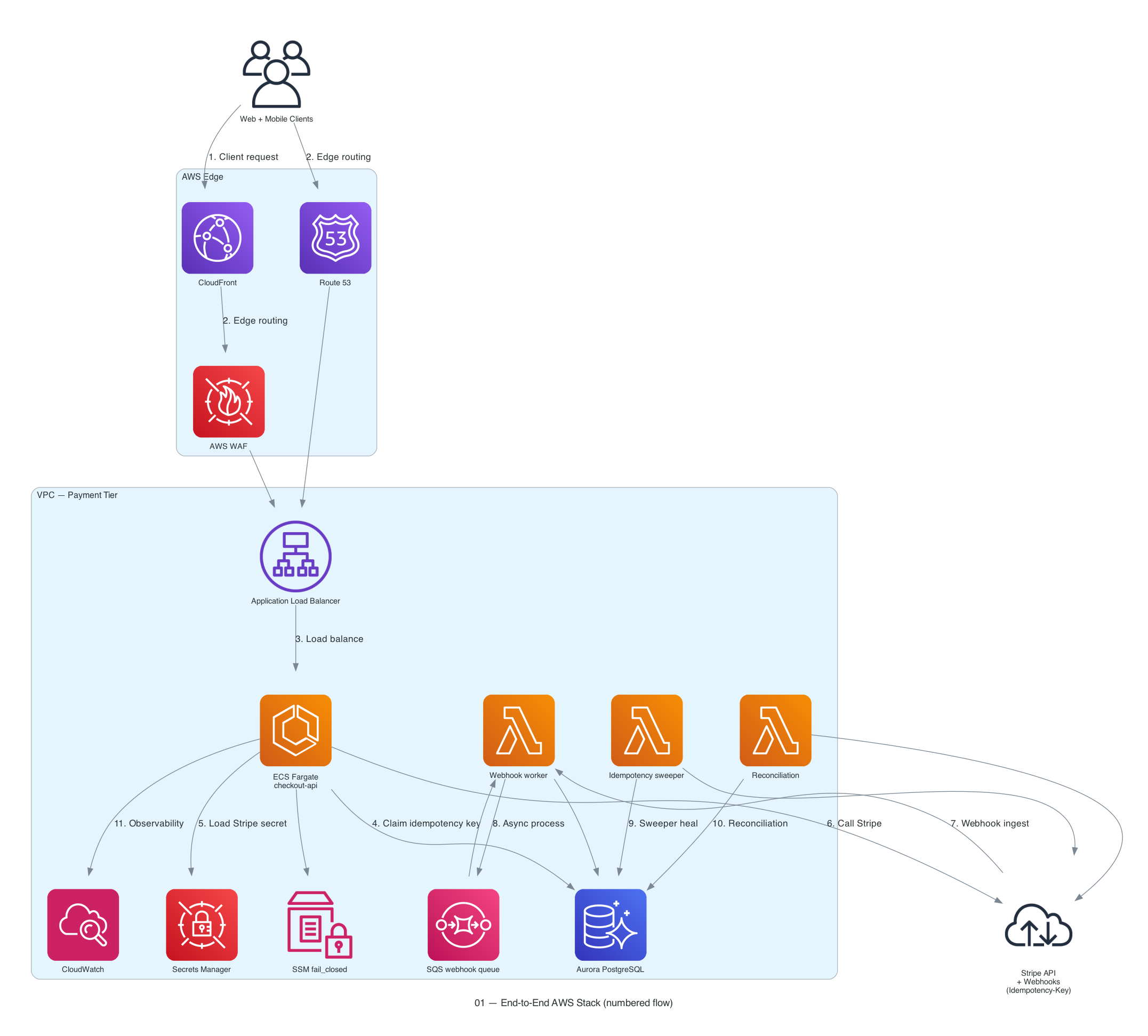
Step-by-step flow:
| Step | Action | Explanation |
|---|---|---|
| 1 | Client request | Web/mobile user initiates checkout with Idempotency-Key header. |
| 2 | Edge routing | CloudFront serves static UI; API traffic passes WAF and Route 53 to ALB. |
| 3 | Load balance | ALB routes to healthy ECS Fargate checkout-api task. |
| 4 | Claim idempotency key | ECS inserts processing row in Aurora (idempotency_keys). |
| 5 | Load Stripe secret | ECS fetches sk_live_* from Secrets Manager. |
| 6 | Call Stripe | POST payment_intents with same Idempotency-Key (25s timeout). |
| 7 | Webhook ingest | Stripe sends event → webhook worker enqueues to SQS. |
| 8 | Async process | Consumer dedupes event_id, updates orders/charges in Aurora. |
| 9 | Sweeper heal | Lambda queries stuck processing rows; reconciles with Stripe. |
| 10 | Reconciliation | Hourly Lambda compares Aurora ledger vs Stripe settlements. |
| 11 | Observability | Structured logs and metrics emitted to CloudWatch. |
Figure: CloudFront, WAF, Route 53, ALB, ECS, Aurora, SQS, Lambda sweeper, Secrets Manager, Stripe.
02 — VPC Production Full Stack (3 AZ)
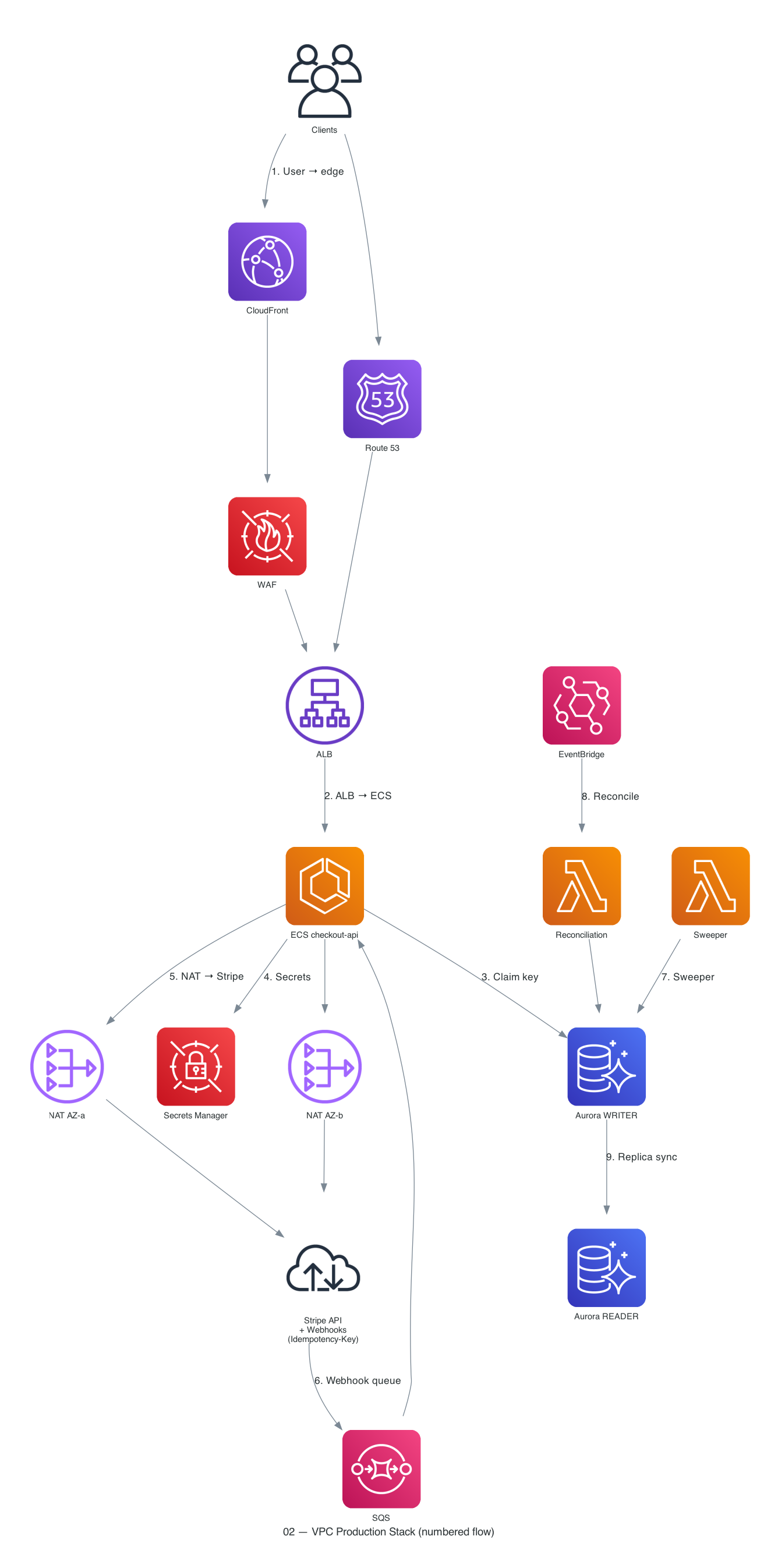
Step-by-step flow:
| Step | Action | Explanation |
|---|---|---|
| 1 | User → edge | CloudFront + WAF + Route 53 health-checked routing. |
| 2 | ALB → ECS | Cross-AZ load balance to checkout-api tasks. |
| 3 | Claim key | INSERT idempotency_keys on Aurora writer. |
| 4 | Secrets | Fetch Stripe API key from Secrets Manager. |
| 5 | NAT → Stripe | Egress via NAT Gateway; POST with Idempotency-Key. |
| 6 | Webhook queue | Stripe webhook → ALB → SQS → ECS consumer. |
| 7 | Sweeper | Lambda heals processing rows every 30s. |
| 8 | Reconcile | EventBridge triggers hourly Stripe vs ledger job. |
| 9 | Replica sync | Aurora reader + cross-AZ sync for HA. |
Figure: Public/private/isolated subnets, NAT gateways, Aurora writer/reader, EventBridge reconciliation.
03 — Pattern A: Merchant + Stripe
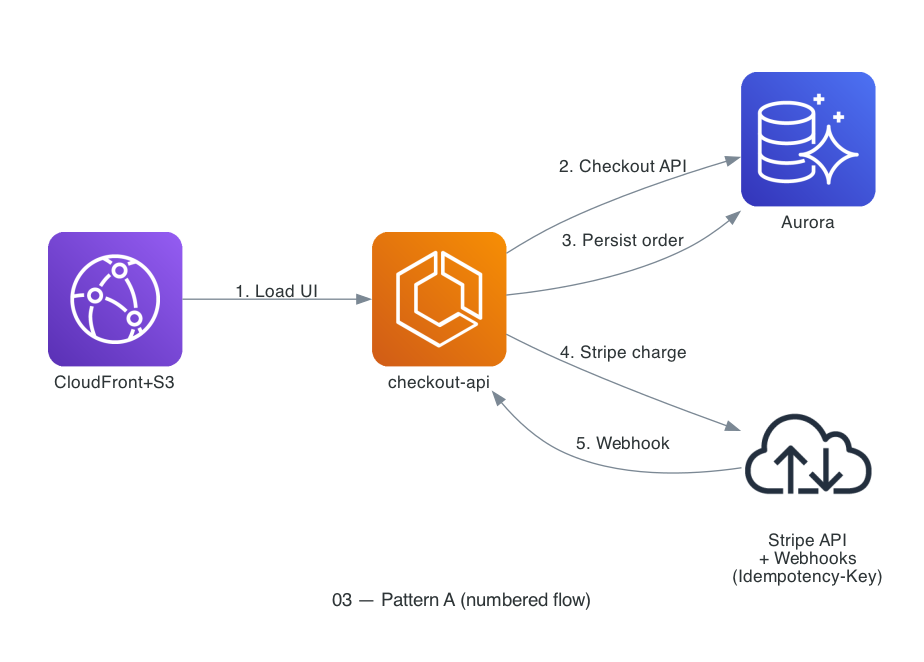
Step-by-step flow:
| Step | Action | Explanation |
|---|---|---|
| 1 | Load UI | CloudFront + S3 serves checkout SPA. |
| 2 | Checkout API | ECS receives POST with idempotency key. |
| 3 | Persist order | Aurora stores order + key before Stripe call. |
| 4 | Stripe charge | Same key passed to Stripe global dedup cache. |
| 5 | Webhook | Stripe confirms → ECS updates order status. |
04 — Pattern B: Internal Payment Platform
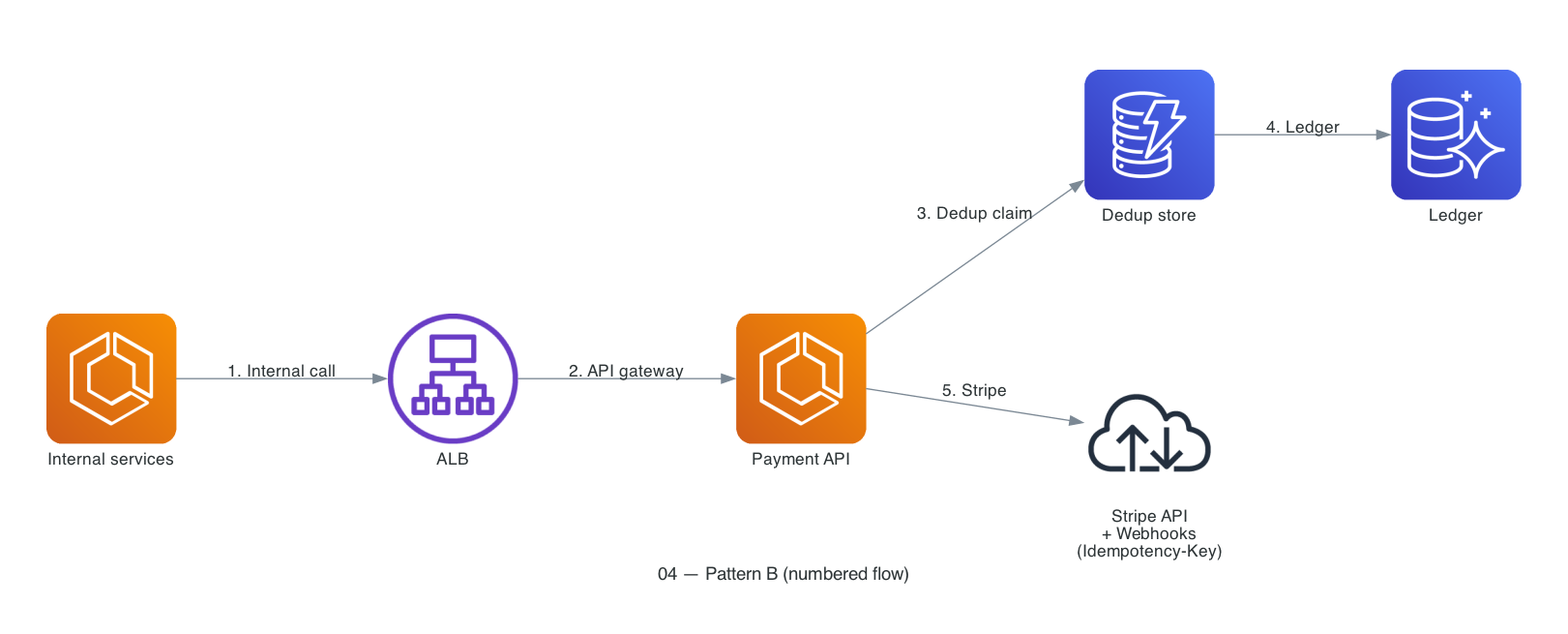
Step-by-step flow:
| Step | Action | Explanation |
|---|---|---|
| 1 | Internal call | Billing/marketplace services call Payment API. |
| 2 | API gateway | ALB authenticates internal service. |
| 3 | Dedup claim | Payment API writes idempotency store. |
| 4 | Ledger | Immutable charge row created. |
| 5 | Stripe | External gateway with platform-owned keys. |
05 — Data Layer: Aurora Multi-AZ
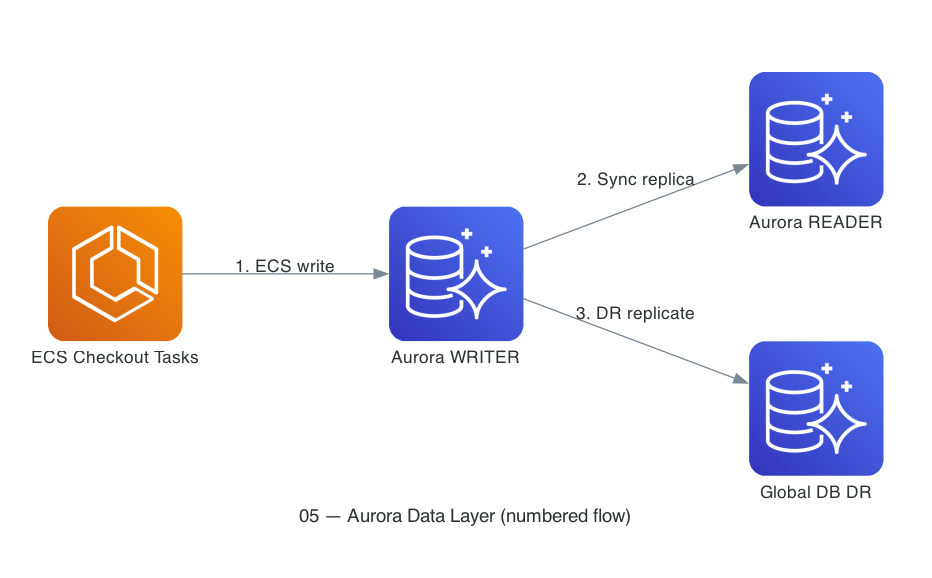
Step-by-step flow:
| Step | Action | Explanation |
|---|---|---|
| 1 | ECS write | All checkout tasks write to single Aurora writer. |
| 2 | Sync replica | In-region readers serve consistent reads if needed. |
| 3 | DR replicate | Async replication to us-west-2 Global DB / replica. |
06 — Data Layer: DynamoDB + Aurora Hybrid
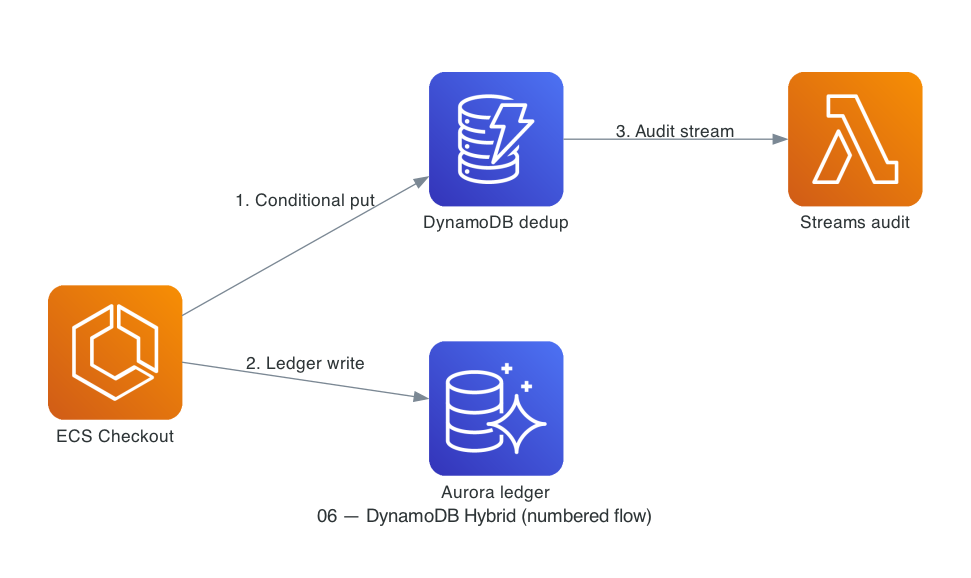
Step-by-step flow:
| Step | Action | Explanation |
|---|---|---|
| 1 | Conditional put | DynamoDB PutItem claims idempotency key atomically. |
| 2 | Ledger write | Aurora stores orders/charges (relational integrity). |
| 3 | Audit stream | DynamoDB Streams → Lambda metrics/audit. |
07 — Synchronous Request Path
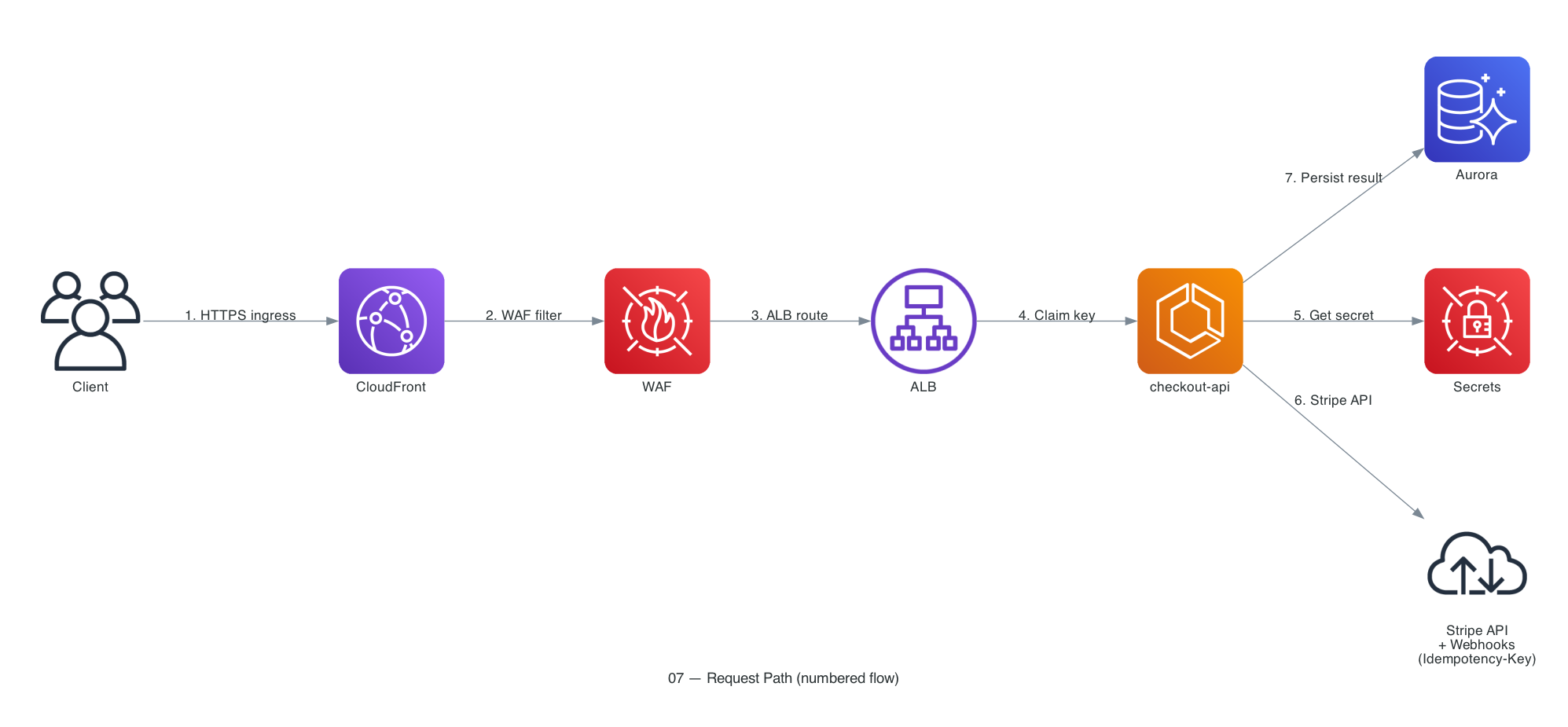
Step-by-step flow:
| Step | Action | Explanation |
|---|---|---|
| 1 | HTTPS ingress | Client POST /api/checkout via CloudFront. |
| 2 | WAF filter | Rate limit and OWASP rule check. |
| 3 | ALB route | Forward to healthy ECS task. |
| 4 | Claim key | INSERT idempotency_keys status=processing. |
| 5 | Get secret | Secrets Manager returns Stripe API key. |
| 6 | Stripe API | POST payment_intents with Idempotency-Key. |
| 7 | Persist result | UPDATE idempotency + INSERT charge. |
| 8 | Respond | 200 success or 504 ambiguous to client. |
08 — Webhook SQS Pipeline
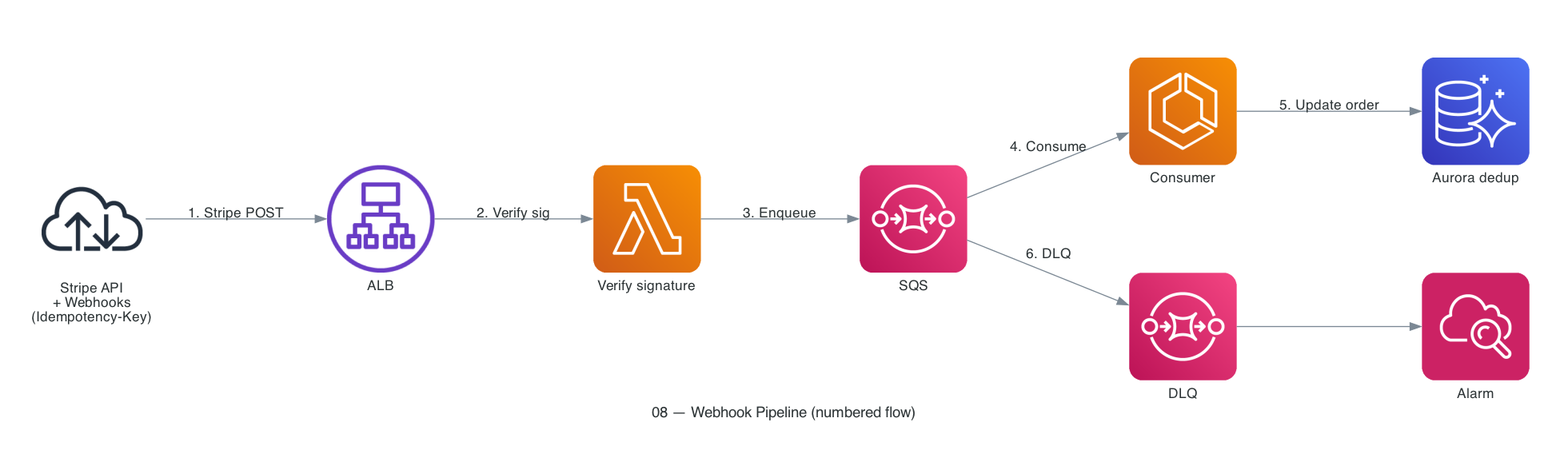
Step-by-step flow:
| Step | Action | Explanation |
|---|---|---|
| 1 | Stripe POST | Webhook hits ALB /api/webhooks/stripe. |
| 2 | Verify sig | Validate Stripe-Signature HMAC. |
| 3 | Enqueue | Push raw event to SQS (fast ACK). |
| 4 | Consume | Worker pulls message; INSERT event_id dedup. |
| 5 | Update order | Idempotent UPDATE orders SET paid. |
| 6 | DLQ | Poison messages → DLQ → CloudWatch alarm. |
09 — Reconciliation (EventBridge)
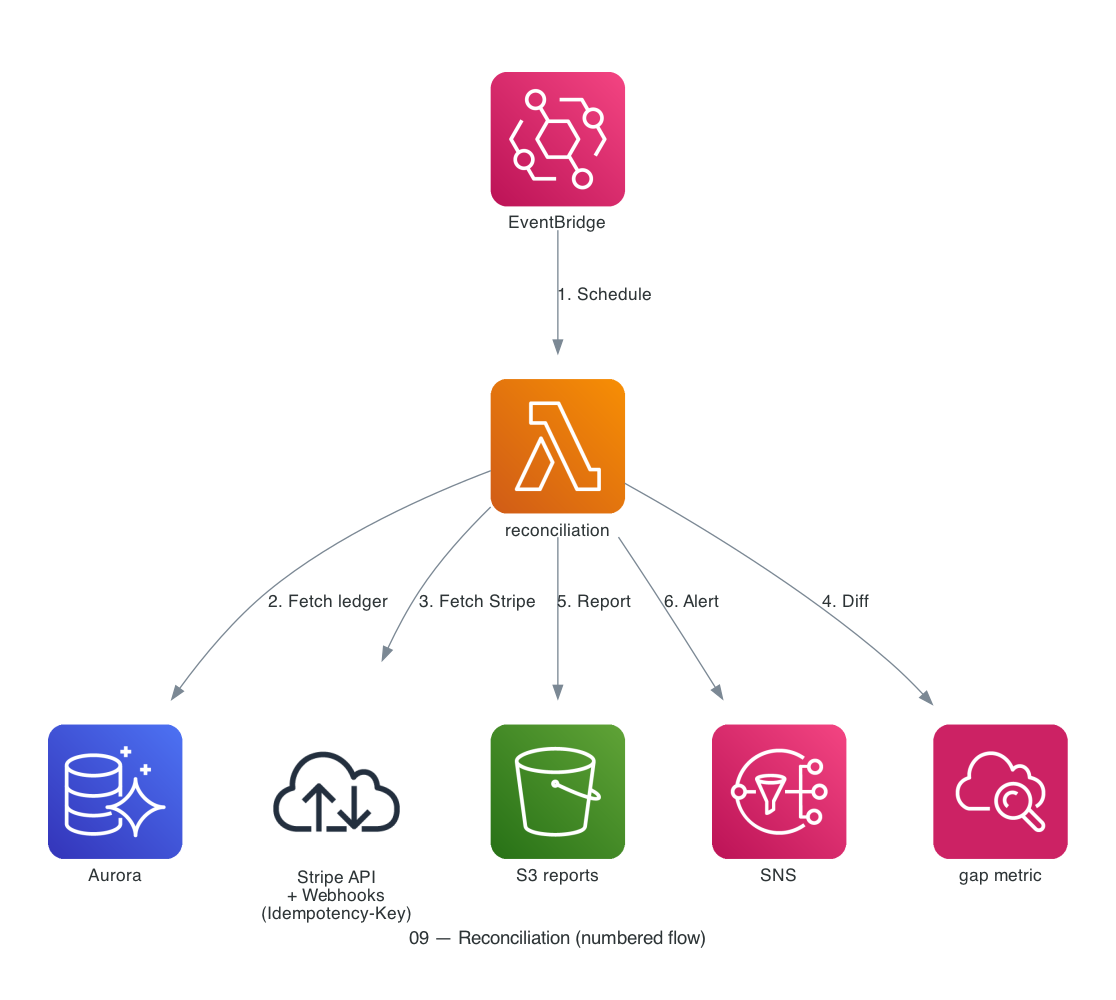
Step-by-step flow:
| Step | Action | Explanation |
|---|---|---|
| 1 | Schedule | EventBridge cron rate(1 hour). |
| 2 | Fetch ledger | Lambda reads Aurora charges for window. |
| 3 | Fetch Stripe | List Balance Transactions from Stripe API. |
| 4 | Diff | Join on stripe_pi_id; flag gaps. |
| 5 | Report | Write CSV to S3; emit reconciliation_gap_count. |
| 6 | Alert | SNS → PagerDuty on any mismatch. |
10 — Client Integration (CloudFront SPA)
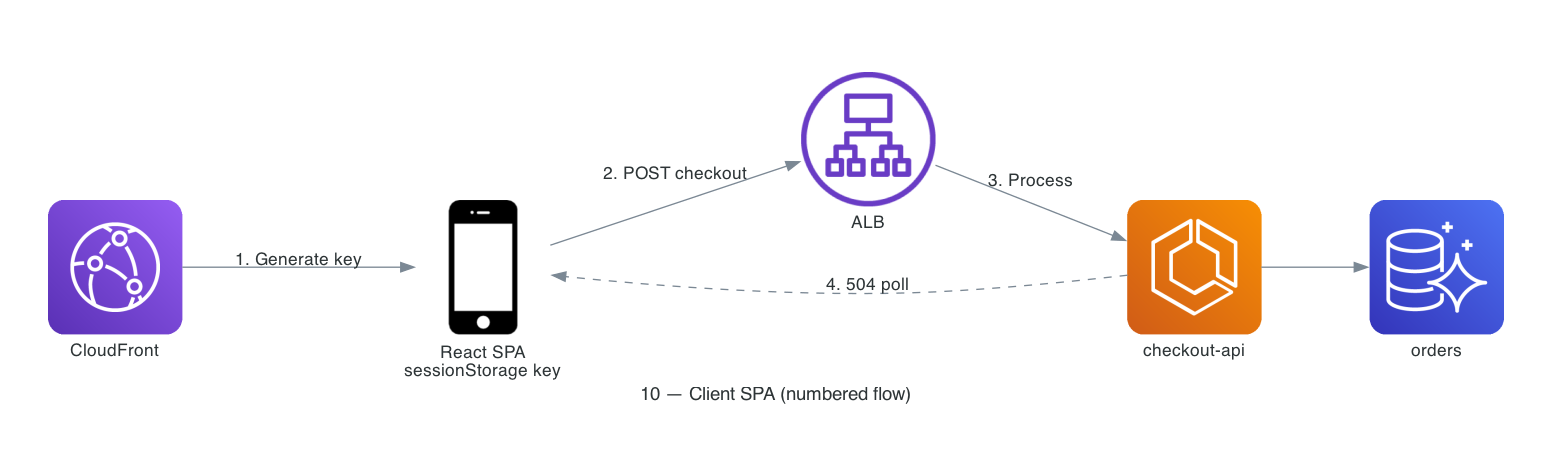
Step-by-step flow:
| Step | Action | Explanation |
|---|---|---|
| 1 | Generate key | Browser stores UUID in sessionStorage (once per checkout). |
| 2 | POST checkout | SPA calls ALB with Idempotency-Key. |
| 3 | Process | ECS claims key; calls Stripe. |
| 4 | 504 poll | On timeout, return 202; SPA polls GET /orders/{id}. |
11 — Single Region Multi-AZ
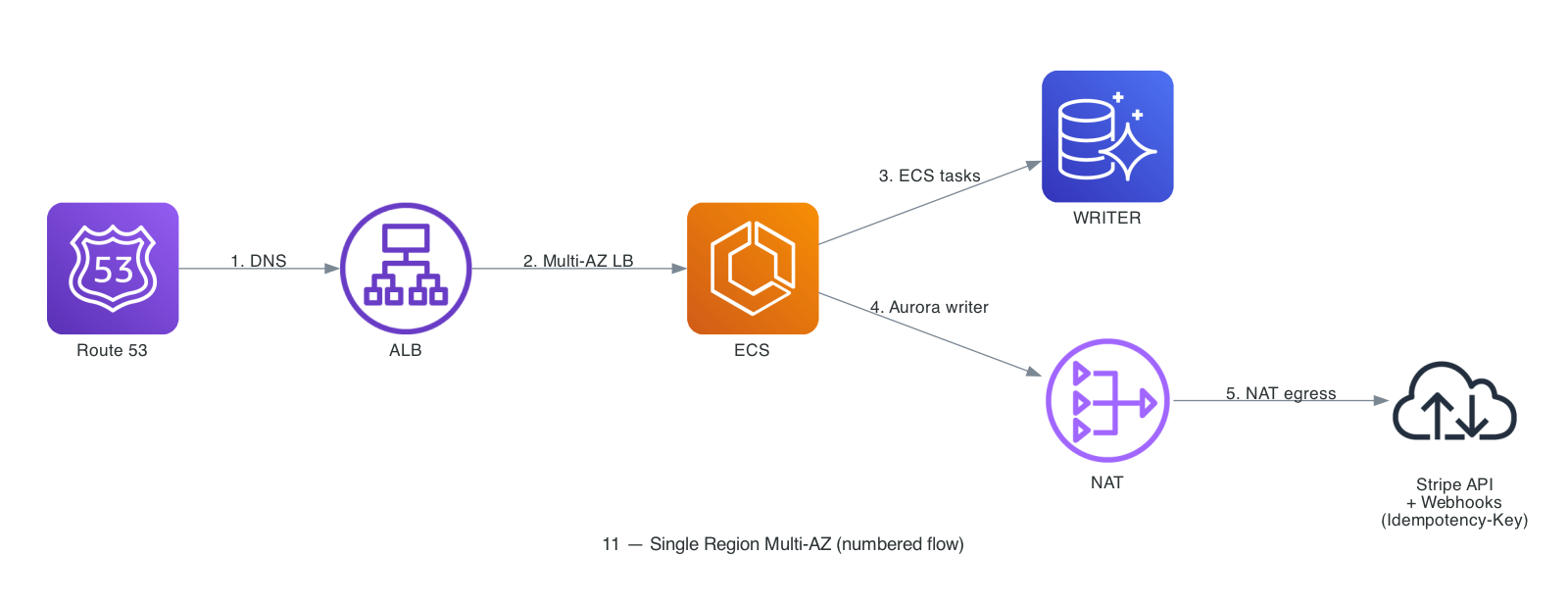
Step-by-step flow:
| Step | Action | Explanation |
|---|---|---|
| 1 | DNS | Route 53 resolves to regional ALB. |
| 2 | Multi-AZ LB | ALB distributes across AZ-a/b/c. |
| 3 | ECS tasks | Stateless workers in each AZ. |
| 4 | Aurora writer | Single writer; sync replicas in other AZs. |
| 5 | NAT egress | Stripe API calls via NAT Gateway. |
12 — Multi-Region DR (Active-Passive)
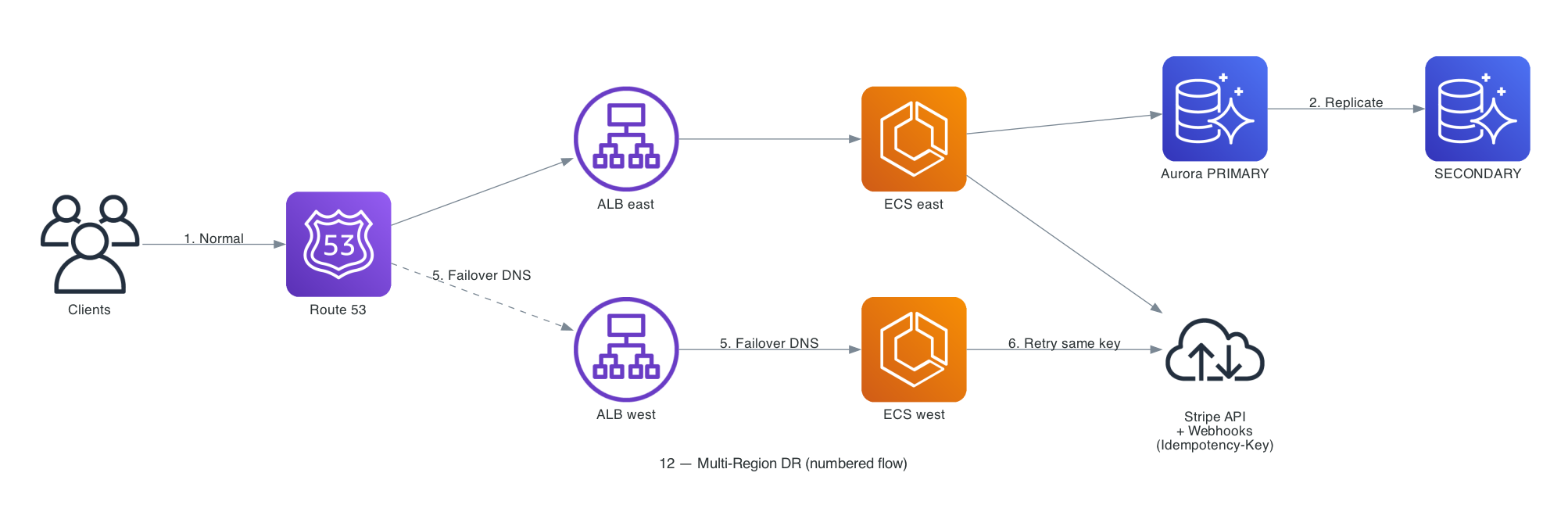
Step-by-step flow:
| Step | Action | Explanation |
|---|---|---|
| 1 | Normal | Route 53 → us-east-1 ALB → ECS → Aurora primary. |
| 2 | Replicate | Aurora Global DB streams to us-west-2. |
| 3 | Detect failure | Health checks fail; enable payments_fail_closed. |
| 4 | Promote | West Aurora promoted to writer. |
| 5 | Failover DNS | Route 53 → us-west-2 ALB. |
| 6 | Retry same key | Clients retry; Stripe returns cached PI. |
13 — Active-Passive vs Active-Active
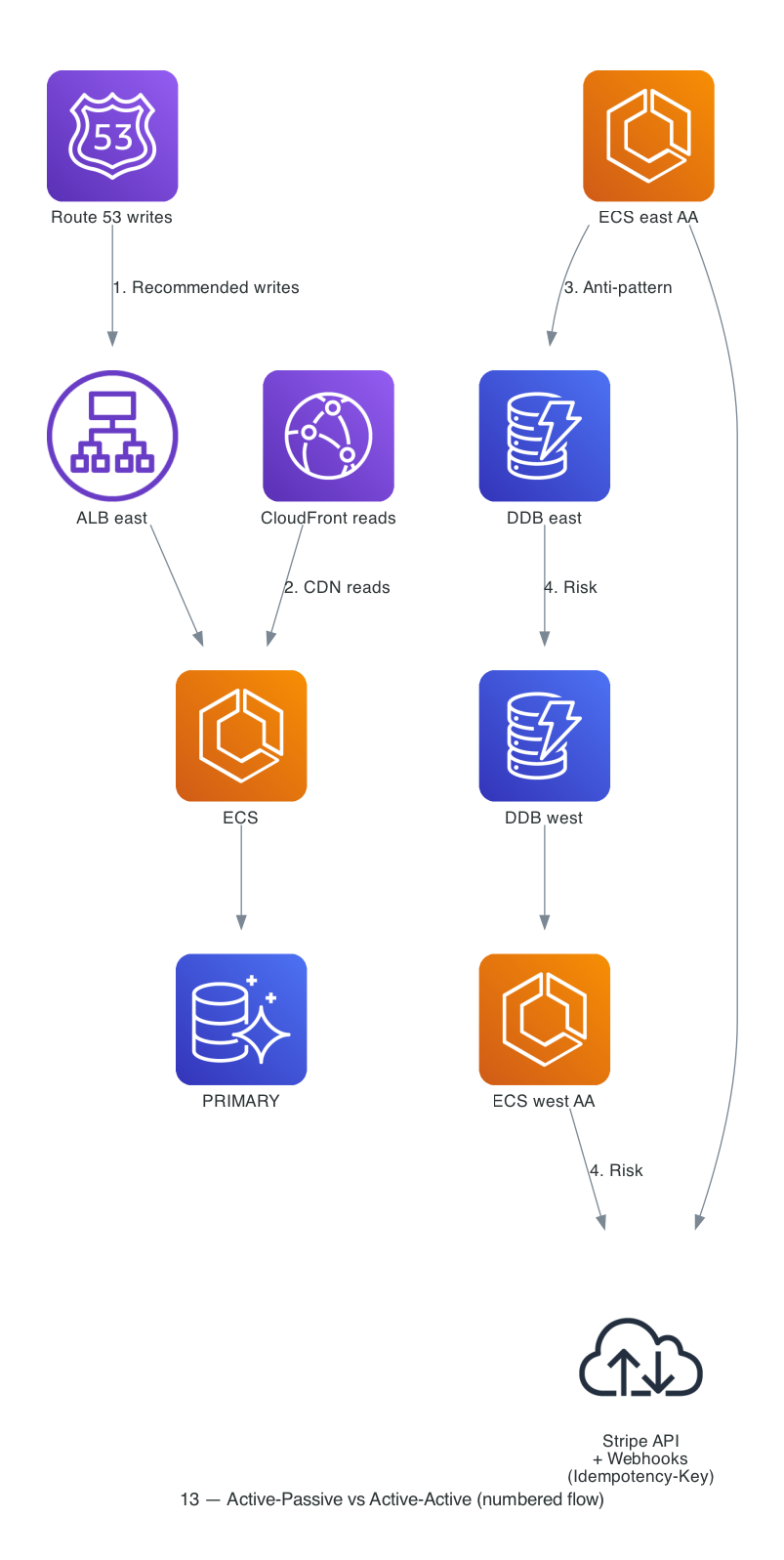
Step-by-step flow:
| Step | Action | Explanation |
|---|---|---|
| 1 | Recommended writes | All payment writes → single region ALB. |
| 2 | CDN reads | CloudFront serves catalog globally. |
| 3 | Anti-pattern | Dual-region writes without global dedup. |
| 4 | Risk | DynamoDB Global Tables lag → duplicate charges. |
14 — Webhook DR Failover
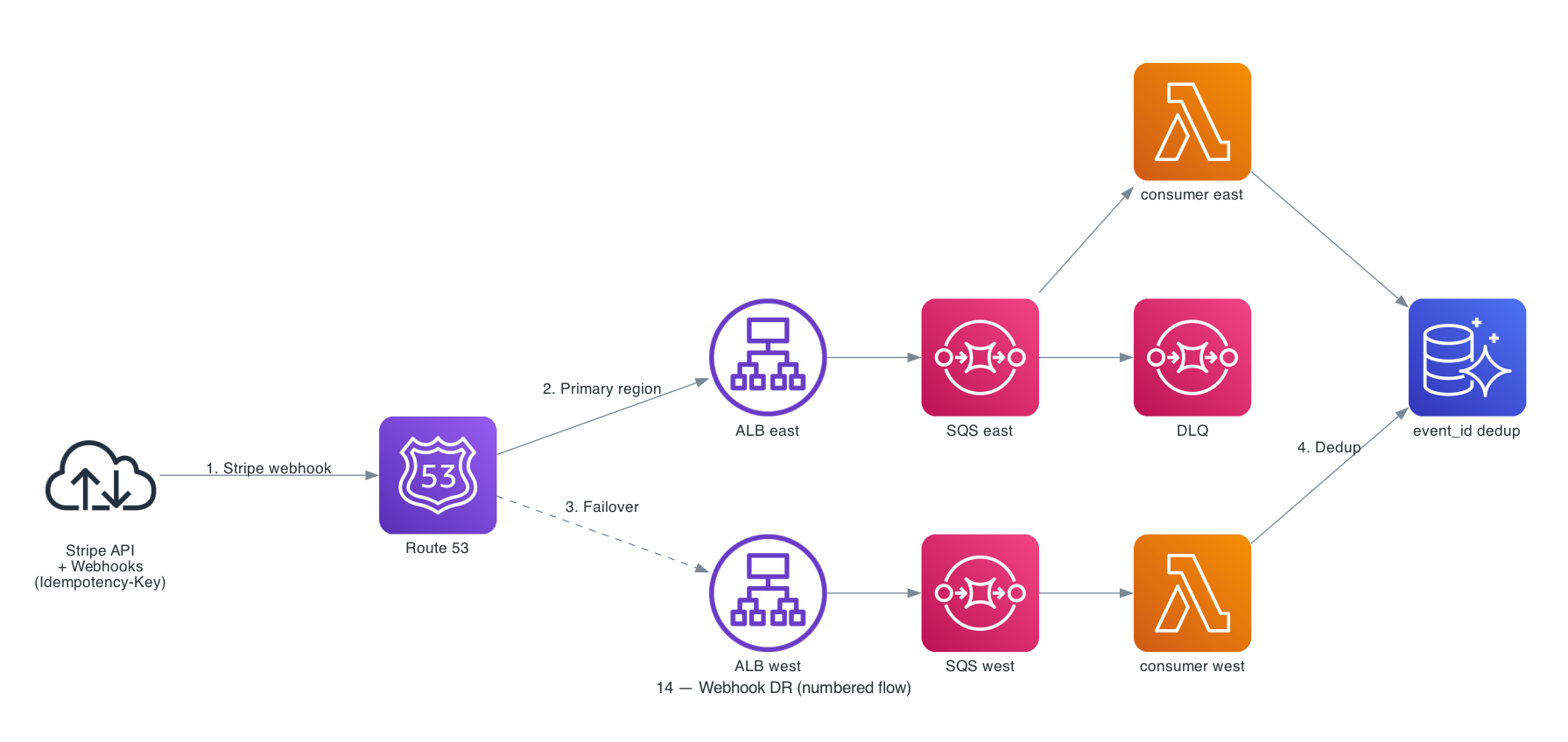
Step-by-step flow:
| Step | Action | Explanation |
|---|---|---|
| 1 | Stripe webhook | Global delivery to Route 53 endpoint. |
| 2 | Primary region | East ALB → SQS → Lambda → Aurora dedup. |
| 3 | Failover | Route 53 flips to west ALB + SQS. |
| 4 | Dedup | Same event_id processed once across regions. |
15 — Security Perimeter
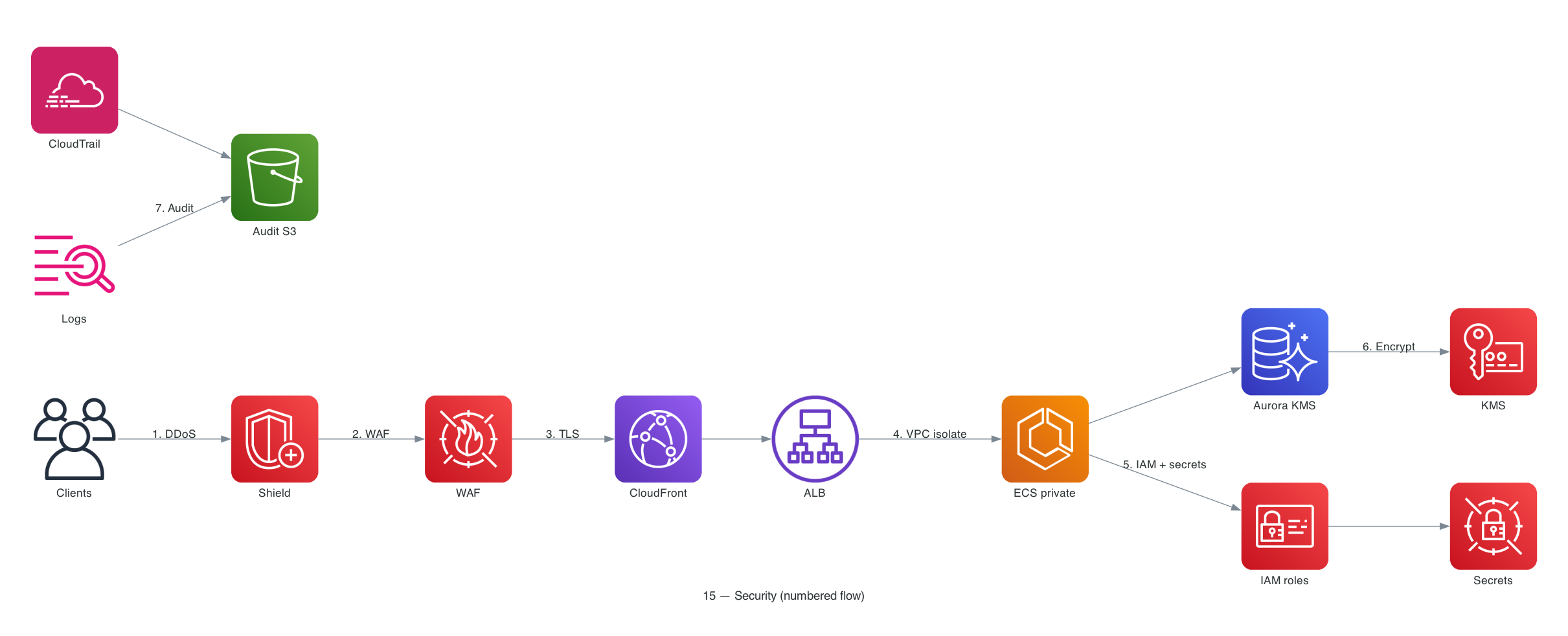
Step-by-step flow:
| Step | Action | Explanation |
|---|---|---|
| 1 | DDoS | Shield Standard at edge. |
| 2 | WAF | Rate limit, geo block, OWASP rules. |
| 3 | TLS | CloudFront TLS 1.3 termination. |
| 4 | VPC isolate | ECS in private subnets; SG allows ALB only. |
| 5 | IAM + secrets | Task role least privilege; Secrets Manager for Stripe key. |
| 6 | Encrypt | Aurora encrypted with KMS. |
| 7 | Audit | CloudTrail + CloudWatch Logs → S3 archive. |
16 — Observability
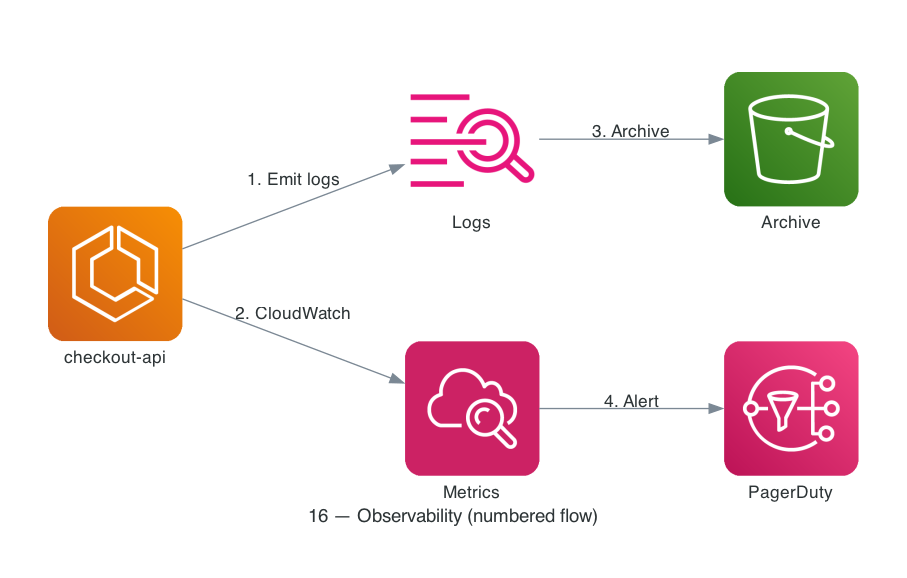
Step-by-step flow:
| Step | Action | Explanation |
|---|---|---|
| 1 | Emit logs | ECS structured JSON per charge. |
| 2 | CloudWatch | Logs + custom metrics dashboards. |
| 3 | Archive | S3 long-term storage. |
| 4 | Alert | Alarms → SNS → PagerDuty. |
| 5 | Query | Athena ad-hoc audit on S3 logs. |
17 — Idempotency Sweeper Lambda
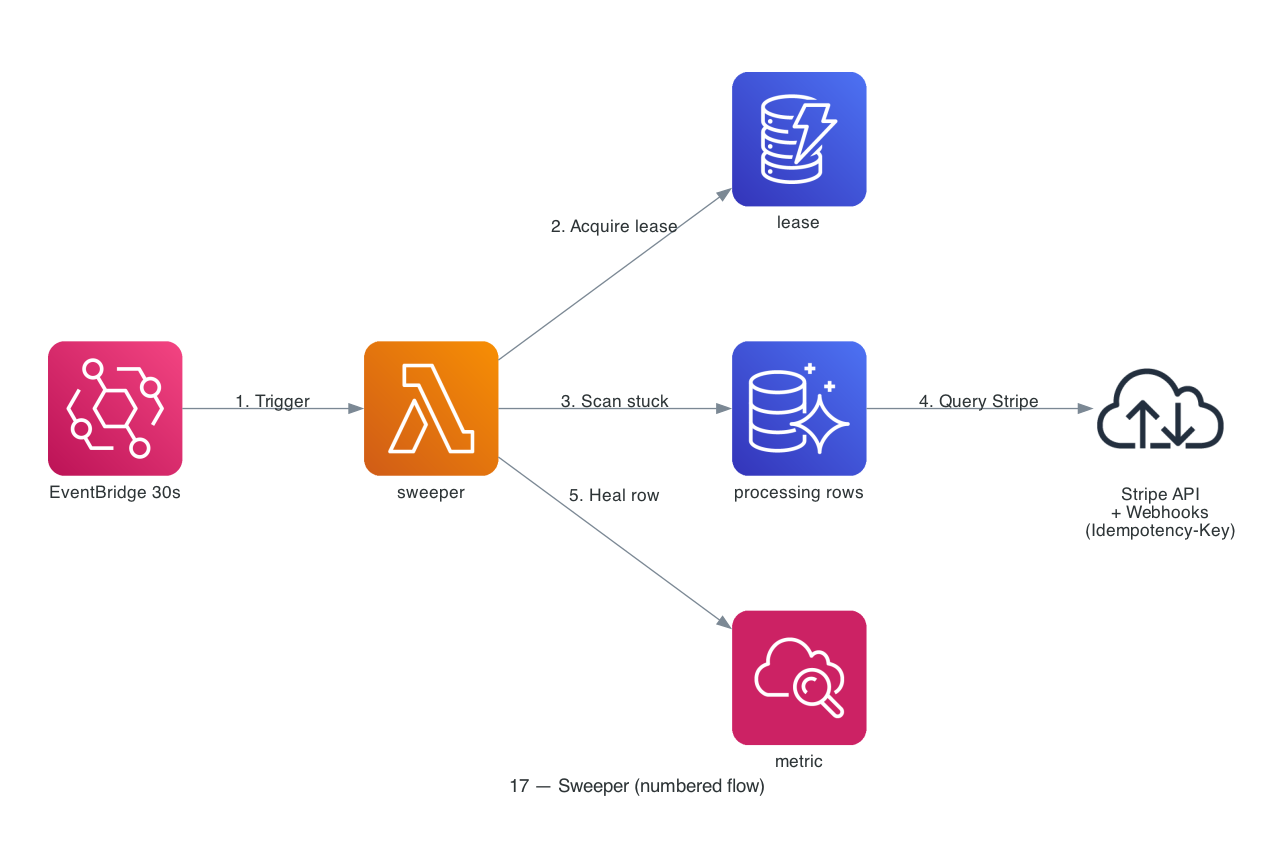
Step-by-step flow:
| Step | Action | Explanation |
|---|---|---|
| 1 | Trigger | EventBridge every 30 seconds. |
| 2 | Acquire lease | DynamoDB lease / advisory lock (singleton). |
| 3 | Scan stuck | SELECT processing older than 30s. |
| 4 | Query Stripe | GET PaymentIntent by metadata/key. |
| 5 | Heal row | Mark completed or failed; emit metric. |
18 — DR Game Day

Step-by-step flow:
| Step | Action | Explanation |
|---|---|---|
| 1 | Inject failure | AWS FIS stops east ECS/RDS. |
| 2 | Fail closed | SSM payments_fail_closed=true. |
| 3 | Promote DB | On-call promotes Aurora west. |
| 4 | DNS flip | Route 53 → west ALB. |
| 5 | Synthetic traffic | 100 checkouts with pre-set keys. |
| 6 | Verify | Exactly one pi_xxx per key in Stripe. |
19. Related Study
- Partial Failure
- Idempotency — §7.1 Scenario A (Stripe timeout at T+29s)
- CAP Theorem — CP posture for payments
- Stripe Idempotent Requests (official)
- Case study:
case-studies/stripe