Event-Driven Architecture
1. Executive Summary
Event-driven architecture (EDA) is a software design style in which components communicate by producing and consuming events—immutable records of something that happened—rather than invoking each other synchronously. EDA enables loose coupling, independent scaling, temporal decoupling, and multiple reactions to the same fact. It introduces challenges: eventual consistency, distributed debugging, schema evolution, ordering across aggregates, and duplicate event processing.
EDA spans patterns from simple event notification (fire-and-forget facts) to event-carried state transfer, CQRS (separate read/write models), and event sourcing (state derived from event log). Principal architects must distinguish choreography (decentralized reactions) from orchestration (central workflow control) and align transport semantics (at-least-once) with idempotent consumers.
This chapter covers EDA patterns, integration styles, consistency boundaries, schema governance, observability, failure modes, organizational implications, and principal-level design reviews.
2. Why This Topic Matters
Modern enterprises adopt EDA for microservices, real-time analytics, and integration hubs. Interviews ask: "Design a notification system when an order ships" or "How do services stay consistent without tight coupling?"
Strong candidates explain:
- Events are facts, not commands—naming and semantics matter (
OrderShippedvsShipOrder). - Choreography scales teams but obscures global flow; orchestration aids visibility.
- Read models lag behind write models in CQRS—UX and SLAs must account for delay.
- Event sourcing is not free—snapshotting, replay cost, and schema migration complexity.
Production failures include circular event dependencies, schema breaking changes taking down consumers, phantom events from at-least-once duplicates, and inability to trace a business transaction across 15 topics. Architects who adopt EDA without contracts and observability trade one monolith problem for a distributed graph problem.
3. Problems Being Solved
| Problem | Synchronous integration | Event-driven approach |
|---|---|---|
| Tight coupling | Caller knows callee API | Publisher unaware of subscribers |
| Availability cascades | Downstream failure blocks caller | Async buffer; consumer catches up |
| Multiple reactions | Orchestrator fans out calls | Multiple consumers same topic |
| Audit / analytics | Separate ETL batch | Stream from same event log |
| Peak load | Caller blocked | Queue absorbs spikes |
EDA solves decoupled integration and multi-subscriber fan-out. It does not solve immediate consistency, simple request-response latency, or automatic cross-service transactions without sagas/outbox patterns.
4. Assumptions and System Model
Assume microservices with private data stores and a message broker (often Kafka):
- Events are immutable once published (corrections via compensating events).
- Delivery is at-least-once unless infrastructure provides stronger guarantees.
- Consumers maintain idempotent handlers and versioned schema tolerance.
- Clocks are not synchronized—use event timestamps and versioning, not wall-clock ordering globally.
- Failures: Broker outage, consumer lag, poison messages, schema mismatch.
Event types:
| Type | Purpose | Example |
|---|---|---|
| Event notification | Signal occurred; consumer fetches detail | OrderPlaced with ID only |
| Event-carried state transfer | Payload includes needed data | OrderPlaced with line items |
| Domain event | Business-meaningful fact | PaymentCaptured |
| Integration event | Cross-bounded-context | CRM.CustomerUpdated |
5. Essential Terminology
| Term | Definition |
|---|---|
| Event | Immutable record of past occurrence. |
| Command | Request to perform action; one intended handler. |
| Choreography | Decentralized: services react without central controller. |
| Orchestration | Central coordinator directs steps (may use events). |
| CQRS | Command Query Responsibility Segregation—split write/read paths. |
| Event sourcing | Persist state changes as event sequence; rebuild state by replay. |
| Projection | Read model built from event stream. |
| Outbox pattern | Atomic DB write + event staging for reliable publish. |
| Schema registry | Central contract for event payload versions. |
| Eventual consistency | Replicas converge without simultaneous strong consistency. |
Mnemonic: Events are past tense; commands are imperative.
6. Core Mechanism
Choreographed order flow
Figure 1: Choreography—each service subscribes and publishes; no central workflow store.
CQRS with event projection
Figure 2: Write path appends events; projections build specialized read models asynchronously.
Outbox for reliable publishing
Figure 3: Outbox ties local commit to eventual publish—avoids dual-write inconsistency.
7. Step-by-Step Walkthrough
Scenario: Migrate monolith checkout to event-driven microservices.
| Phase | Action | Outcome |
|---|---|---|
| 1 | Identify bounded contexts | Order, Payment, Inventory, Shipping |
| 2 | Define domain events | OrderPlaced, PaymentFailed, StockReserved |
| 3 | Choose notification vs state transfer | Line items in event vs lookup API |
| 4 | Implement outbox per service | Reliable publish after local commit |
| 5 | Schema registry with Avro | Versioned contracts |
| 6 | Idempotent consumers | event_id dedup table |
| 7 | Observability | trace_id propagation in event headers |
| 8 | Saga for failure | Orchestrator or choreographed compensation |
Event notification variant:
| Step | Flow |
|---|---|
| 1 | OrderPlaced { order_id } published |
| 2 | Payment service calls Order API for details |
| 3 | Coupling reintroduced via API—acceptable if API stable |
Event-carried state transfer variant:
| Step | Flow |
|---|---|
| 1 | OrderPlaced { order_id, items, total } published |
| 2 | Payment processes without Order API call |
| 3 | Risk: Large payloads; stale if order changes—version events |
CQRS read lag example:
| Time | Write model | Read model (projection) |
|---|---|---|
| T0 | Order created | — |
| T1 | Event in log | Projector processing |
| T2 | — | Order visible in list API |
Customer may refresh before T2—design UX (spinner, optimistic UI) or read-your-writes routing.
Event naming and schema conventions (production governance):
| Rule | Good example | Bad example |
|---|---|---|
| Past tense, domain prefix | orders.OrderPlaced | createOrder |
| Version in schema, not topic | Avro OrderPlacedV3 | orders-v3-topic |
| Include correlation IDs | trace_id, causation_id | Bare payload |
| Immutable fields documented | order_id never changes | Undocumented renames |
| Avoid event-as-RPC | PaymentCaptured (fact) | ChargePayment (command on bus) |
Command Query Responsibility Segregation (CQRS) depth:
CQRS splits the write model (optimized for commands, validation, invariants) from read model (optimized for queries, denormalized views). In event-driven CQRS:
| Component | Responsibility |
|---|---|
| Command handler | Validate; append domain event to event store or outbox |
| Event bus | Distribute events to projectors |
| Projector | Transform events into read-optimized tables or search indexes |
| Query API | Serve reads only from projections—never from write DB directly |
When CQRS is justified: Multiple read patterns with different access paths (list view, detail view, search, analytics); high read:write ratio; need independent scaling of read side. When to avoid: Simple CRUD with one read pattern; team lacks operational maturity for projection lag monitoring.
Event sourcing vs event-driven (critical distinction):
| Aspect | Event-driven (notification) | Event sourcing |
|---|---|---|
| Source of truth | Database | Event log |
| State recovery | Read current row | Replay all events |
| Schema changes | Migrate tables | Upcast events |
| Complexity | Medium | High |
| Audit trail | Optional | Built-in |
Event sourcing stores all state changes as events and derives current state by replay—a specialized form of EDA. Most organizations need event-driven integration without full event sourcing.
Organizational implications of choreography:
| Team size | Choreography risk | Mitigation |
|---|---|---|
| 2–4 services | Low | Shared runbook |
| 5–10 services | Medium | Event catalog, tracing |
| 10+ services | High | Orchestration for critical paths; integration guild |
Without governance, choreography becomes implicit coupling—teams subscribe to events they do not own and break when producers change schemas silently.
Integration patterns catalog (Hohpe & Woolf mapped to EDA):
| EIP pattern | EDA manifestation |
|---|---|
| Publish-Subscribe Channel | Kafka topic with multiple consumer groups |
| Message Router | Content-based routing via headers or topics |
| Message Filter | Consumer-side filter on event type |
| Aggregator | Stream processor building composite events |
| Process Manager | Saga orchestrator (not pure choreography) |
| Dead Letter Channel | DLQ topic for poison events |
Strangler fig migration to EDA:
Incremental migration from monolith without big-bang rewrite:
| Phase | Action |
|---|---|
| 1 | Extract read APIs; add CDC from monolith DB |
| 2 | Publish domain events from CDC without changing monolith code |
| 3 | New microservice consumes events; builds read model |
| 4 | Route read traffic to new service (strangler) |
| 5 | Extract write path; monolith becomes thin or retired |
CDC-based event emission avoids dual-write during early phases—events reflect actual monolith commits.
Testing event-driven systems:
| Test type | Validates |
|---|---|
| Contract test | Schema compatibility producer ↔ consumer |
| Integration test | End-to-end event flow with test broker |
| Chaos test | Delayed events, duplicate delivery, broker outage |
| Property-based | Compensation order in sagas |
| Replay test | Projector rebuild from offset 0 matches production snapshot |
Event-driven architectures require test infrastructure investment—teams without contract tests in CI experience production schema breakage monthly.
Anti-patterns to flag in architecture reviews:
| Anti-pattern | Symptom | Remediation |
|---|---|---|
| Distributed monolith | Sync chains across 6 services | Consolidate or async boundary |
| Event notification hell | 50-line stack traces for one click | Orchestration or tracing |
| Shared database + events | Dual source of truth | Pick one write path |
Generic Event type | Untyped JSON blobs | Schema registry |
| Missing idempotency | Duplicate side effects on retry | Dedup keys mandatory |
Latency vs resilience tradeoff (quantitative framing):
Sync call chain of 5 services at 50ms p99 each ≈ 250ms best-case serial latency. Event-driven path: 5ms publish + 50ms consumer lag + 50ms processing ≈ 105ms minimum but unbounded upper tail if consumer lags. Choose sync when user waits for result; choose async when operation can complete in background with notification.
8. Invariants and Guarantees
| Property | Type | Statement |
|---|---|---|
| Event immutability | Safety (design) | Corrections via new events, not edits |
| Publisher unaware of subscribers | Decoupling | New consumers don't require publisher change |
| Cross-service immediate consistency | Not provided | Eventual unless sync read |
| Ordering | Per-partition/key typically | Global order not guaranteed |
| Exactly-once effect | Application | Idempotency required |
9. Failure Scenarios
Scenario 1: Cyclic event dependency
Setup: Service A emits event triggering B, which triggers A again.
Effect: Infinite loop or stack overflow in choreography.
Mitigation: Event ownership rules; state machines; idempotency; cycle detection in design reviews.
Scenario 2: Breaking schema change
Setup: Producer adds required field; old consumers fail deserialize.
Effect: Consumer stall; lag explosion.
Mitigation: BACKWARD/FULL compatibility modes; dual-schema period; consumer-first deploy.
Scenario 3: Missing event
Setup: Outbox relay down; order in DB but no OrderPlaced.
Effect: Payment never starts—stuck order.
Mitigation: Outbox monitoring; reconciliation job comparing DB to topic.
Scenario 4: Duplicate events
Setup: At-least-once redelivery.
Effect: Double shipment, double email.
Mitigation: Idempotency keys; dedup store.
Scenario 5: Slow projection
Setup: Analytics projection falls hours behind.
Effect: Stale dashboards—not always critical; SLA breach if used for fraud.
Mitigation: Separate consumer groups; scale projectors; prioritize critical projections.
Scenario 6: God topic anti-pattern
Setup: One mega-topic with 200 event types, no schema discipline.
Effect: Unmanageable consumers; coupling via shared topic.
Mitigation: Topic per bounded context; registry governance.
10. Performance Characteristics
| Factor | Impact |
|---|---|
| Async buffer | Absorbs spikes; adds end-to-end latency |
| Fan-out | N consumers × bandwidth per event |
| Projection rebuild | Replay time proportional to log size |
| Sync enrichment calls | Defeats decoupling benefits |
| Small chatty events | Overhead—batch or state transfer judiciously |
Latency budget: Event-driven paths often add tens to hundreds of ms vs sync RPC—acceptable for many domains, not for HFT-style systems.
11. Scalability Limits
- Consumer lag under sustained overload—unbounded retention costs.
- Projection complexity—each new read model is ongoing compute debt.
- Organizational scaling—choreography beyond ~10 services needs strong governance.
- Event store size—event sourcing growth requires compaction and archival strategy.
12. Operational Considerations
- Event catalog documenting producers, consumers, schemas, SLAs.
- Distributed tracing across publish/consume boundaries.
- Dead-letter queues per consumer with replay runbooks.
- Contract testing (Pact, schema compatibility CI).
- On-call playbooks for lag, DLQ depth, schema failures.
- Reconciliation jobs for money and inventory paths.
13. Security Considerations
- Event payloads may contain PII—encrypt sensitive fields.
- Topic ACLs restrict produce/consume principals.
- Tampering—sign events in high-trust domains.
- Authorization at consumer—don't trust event content without verifying source.
14. Cost Considerations
- Broker storage for retention and replay.
- Multiple projections multiply compute and storage.
- Engineering complexity vs monolith—higher initial cost.
- Saved cost when decoupling prevents cascade outages and enables independent deploy velocity.
15. Production Implementations
Netflix
Event-driven microservices at scale—anecdotal emphasis on resilient async pipelines and chaos testing.
Uber / Grab
Domain events for trip lifecycle—choreography with rigorous schema governance.
Zalando
Event-driven architecture guidelines—open internal patterns for event naming and versioning.
Banking event hubs
Kafka as integration backbone with schema registry and outbox from core banking—regulatory audit via immutable events.
Shopify (flash sales)
Async order processing absorbs traffic spikes—implementation choice combining queues and events.
16. Alternatives and Tradeoffs
| Style | Coupling | Consistency | Complexity |
|---|---|---|---|
| Sync REST/gRPC | High | Immediate | Lower |
| Event notification EDA | Low | Eventual | Medium |
| Event sourcing + CQRS | Low write coupling | Eventual reads | High |
| Batch ETL | Very loose | Hours delay | Medium |
| Orchestrated saga | Medium | Controlled steps | Medium-high |
17. Common Misconceptions
| Misconception | Reality |
|---|---|
| "EDA eliminates coupling" | Semantic and schema coupling remain. |
| "Events replace APIs" | Query APIs still needed for lookups. |
| "Event sourcing for everything" | High complexity—use where audit/replay justify cost. |
| "Choreography always scales better" | Debugging cost grows; orchestration helps critical paths. |
| "Async = faster" | Often higher latency; better throughput and resilience. |
18. Principal Architect Perspective
- Start with integration events, not full event sourcing, unless requirements demand replay.
- Mandate outbox for any DB + publish combination.
- Name events in past tense with versioned schemas.
- Choose orchestration for revenue-critical multi-step flows; choreography for orthogonal reactions.
- Invest in observability before service count exceeds tracing comprehension.
Organizational design: Assign event owners per bounded context; consumers propose schema changes via RFC—not ad hoc producer edits.
19. Architecture Review Exercise
Scenario: 8 teams publish to company-events topic; 40 consumer groups; no registry; events named update, change, notify.
Review prompts:
- Schema breakage risk?
- Can you trace one customer order?
- Who approves new event types?
- Refactoring plan?
Expected findings: Split topics by domain; Schema Registry; naming convention; event catalog; trace propagation; retire god topic gradually.
20. Whiteboard Explanation
90-second version:
"Event-driven architecture means services publish facts when something happens, and other services react asynchronously. It decouples producers from consumers—you can add a new subscriber without changing the publisher. Tradeoff is eventual consistency and harder debugging. Use past-tense domain events like PaymentCaptured, not commands. Pair database writes with an outbox so you don't publish without committing or commit without publishing. Consumers must be idempotent because delivery is at-least-once. CQRS separates write and read models updated by projections—reads lag writes. Choreography is decentralized reactions; orchestration uses a coordinator for multi-step flows like sagas. Schema registry and contract tests prevent breaking consumers. Not every interaction should be an event—sync APIs still fit query and low-latency paths."
21. Interview Questions
-
Event vs command?
- Signals: Past fact vs imperative request; multiple vs single handler.
-
Choreography vs orchestration?
- Signals: Decentralized events vs central coordinator.
-
Why outbox pattern?
- Signals: Atomic local state + reliable publish.
-
CQRS tradeoffs?
- Signals: Scaled reads; eventual read lag; complexity.
-
Event sourcing when?
- Signals: Audit, replay, temporal queries—not default CRUD.
-
Handle schema evolution?
- Signals: Registry, compatibility, optional fields, version.
-
Debug stuck workflow in choreography?
- Signals: Tracing, saga state, timeouts, event catalog.
-
Notification vs state transfer?
- Signals: Coupling vs payload size tradeoff.
-
Design order-shipped notifications.
- Signals: Domain event, fan-out, idempotency, DLQ.
-
When avoid EDA?
- Signals: Strong sync consistency, simple CRUD, low team maturity.
Scoring rubric:
| Dimension | Strong | Weak |
|---|---|---|
| Consistency | Eventual + mitigation | "Always consistent" |
| Patterns | Outbox, CQRS scope | Buzzwords only |
| Ops | Tracing, schema, DLQ | No governance |
22. Interview Follow-Ups
-
Read model 30s stale—acceptable?
- Signals: Domain dependent; fraud vs catalog browse.
-
Migrate monolith to EDA incrementally?
- Signals: Strangler; outbox; dual write avoidance.
-
Event sourcing snapshot strategy?
- Signals: Periodic snapshots + replay from offset.
22A. Production Low-Level Design (Interview + Game Day)
Outbox + idempotent consumers—choreography for reactions, saga for critical path. Production LLD and Game Day Standard.
Event contract
| Field | Purpose |
|---|---|
event_id (UUID) | Consumer dedupe / inbox |
aggregate_id | Partition key |
schema_version | Evolution |
occurred_at | Ordering hint (not global) |
Step-by-step flow:
| Step | Failure | Mitigation |
|---|---|---|
| 1 | Crash before commit | No event (good) |
| 2 | Publish OK, mark fail | Duplicate → inbox |
| 4–5 | Redelivery | Idempotent handler |
SLO
Outbox→Kafka lag p99 < 5s; consumer duplicate processing = safe (inbox hit rate logged).
22B. Game Day Playbooks
| # | Drill | Inject | Detect | Mitigate | Verify |
|---|---|---|---|---|---|
| GD-1 | Duplicate storm | Replay topic offset | Inbox dedupe ↑ | Idempotent handlers | No double reserve |
| GD-2 | Schema break | Deploy v2 without compat | Deser errors | DLQ + rollback | v1 consumers OK |
| GD-3 | Relay stall | Stop outbox poller | Lag alarm | Scale relay | Pending drained |
GD-1 — Duplicate event delivery
23. Strong Answer Example
Question: "Design event-driven order fulfillment."
Answer this as a 45-minute greenfield design using the PRACTICE framework. Below is how a strong student sounds aloud—facts via outbox, critical path as a saga, orthogonal reactions as choreography, and a sync read path for status.
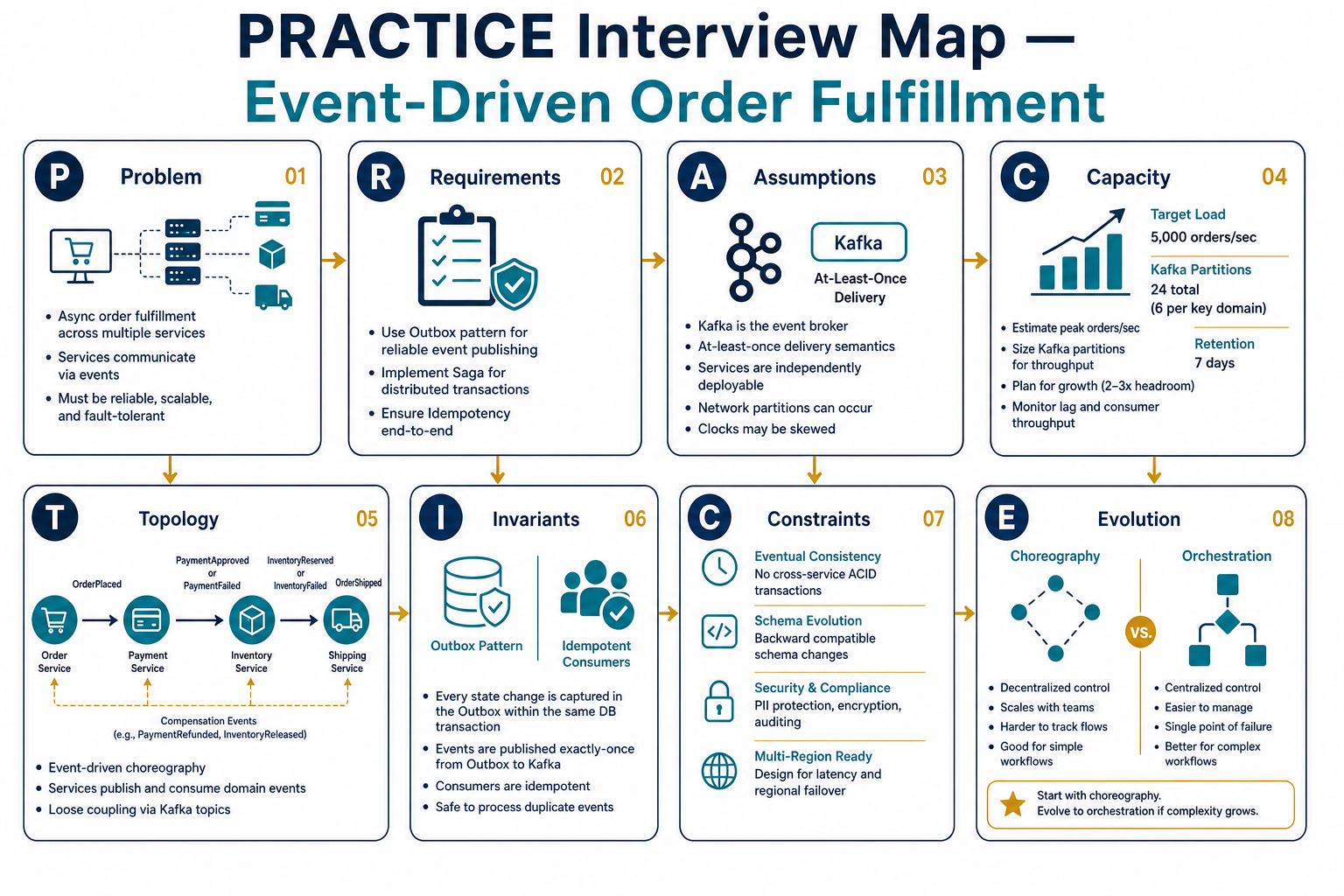
Figure A: PRACTICE map — Problem → Requirements → Assumptions → Capacity → Topology → Invariants → Constraints → Evolution.
Student interview script (PRACTICE)
P — Problem framing
"We're designing event-driven order fulfillment: customer places an order; we charge payment, reserve inventory, ship, and notify—without chaining every service in a sync call stack.
Events are past-tense facts (
OrderPlaced,PaymentCaptured), not commands on a bus. I'll keep sync APIs for place-order and status query.Non-goals for v1: full event sourcing of every aggregate, and replacing the customer status API with 'just read Kafka.'"
R — Requirements
| Type | Requirement |
|---|---|
| FR | Place order; payment; inventory reserve; ship; notify; cancel/compensate on failure |
| NFR | At-least-once publish/consume with idempotent handlers; p99 place-order API latency; eventual status consistency seconds not hours |
| Consistency | No dual-write (DB commit without event); compensation order defined for saga |
| Ops | Schema registry; DLQ; trace across topics; nightly reconciliation |
"I'll ask: orchestrated saga or pure choreography? Inventory before payment? I'll assume payment then inventory then ship, with orchestration for that path and choreography for email/analytics."
A — Assumptions (state aloud)
| Assumption | Why it matters |
|---|---|
| Kafka (or equivalent) log | Fan-out, replay, partition key = order_id |
| At-least-once delivery | Consumers must be idempotent |
| Outbox or CDC from order DB | Avoids dual-write inconsistency |
| Schema Registry | BACKWARD-compatible evolution |
| Not full event sourcing | Integration events + local state is enough for v1 |
"If they push pure choreography for payment→inventory→ship, I'd warn: compensation order and stuck states get hard to debug—I'd still orchestrate the revenue path."
C — Capacity (back-of-envelope)
Peak place-order QPS              → 2,000 (say)
Events per successful order       → ~5–8 (Placed, Paid, Reserved, Shipped, Notified, …)
Peak event publish                → ~10–15K/sec including failures/retries
Partition key                     → order_id (per-order ordering)
Consumer groups                   → payment, inventory, shipping, notify, analytics (separate)
Outbox lag SLO                    → p99 publish < 1–2s after commit
Read-model lag                    → status projection < few seconds
"I'd size partitions for consumer parallelism, not just broker disk—and keep analytics on its own consumer group so it can't starve fulfillment."
T — Topology (draw this)
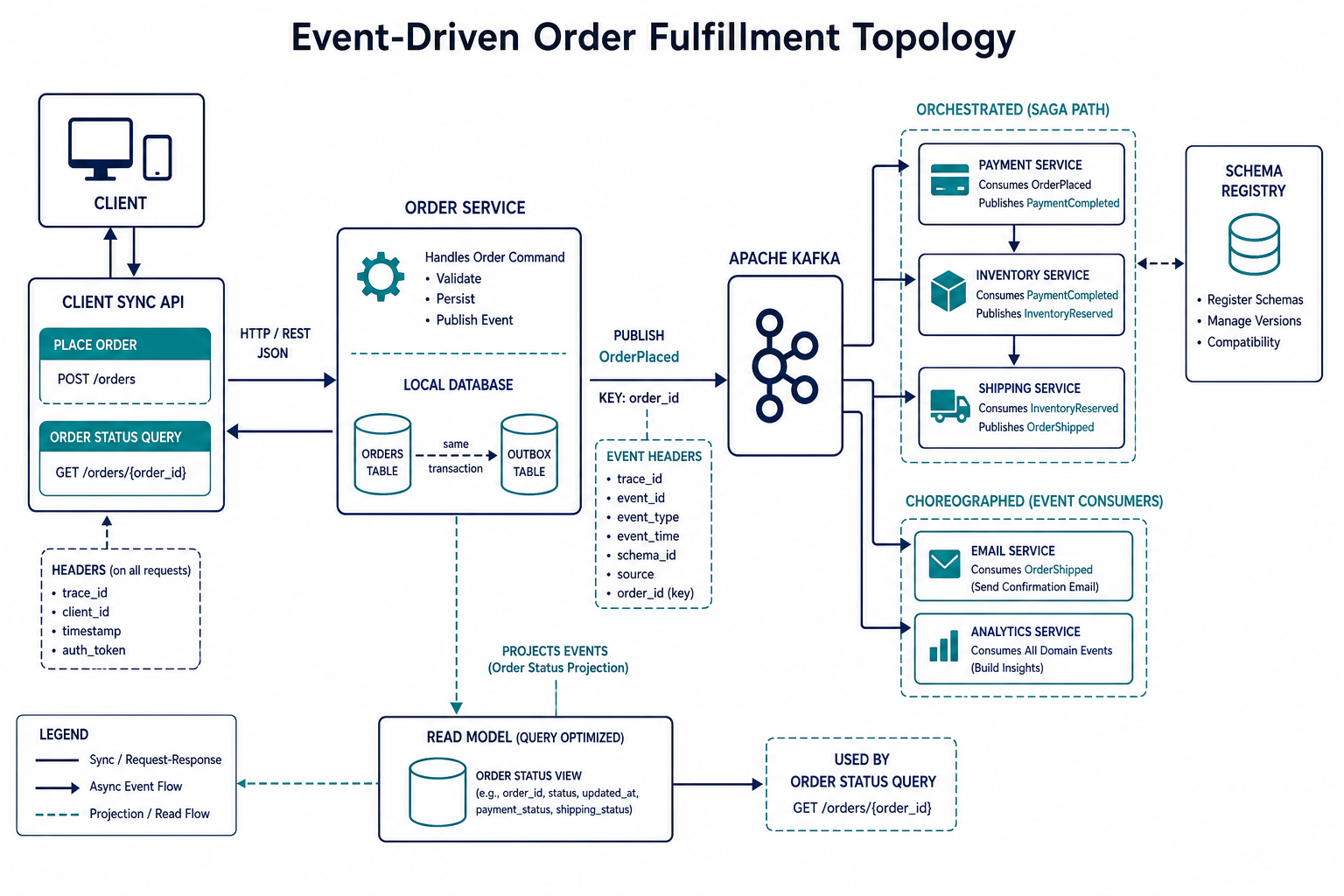
Figure B: Sync place-order/status API; Order service DB+outbox → Kafka; orchestrated payment→inventory→ship; choreographed notify/analytics; schema registry + read model.
Pattern split (say aloud):
| Path | Style | Why |
|---|---|---|
| Payment → inventory → ship | Orchestrated saga | Compensation order matters; need visibility |
| Email, analytics, CRM | Choreography | Orthogonal; add subscribers without changing order service |
| Customer status | CQRS read model | Sync query; projection from events—not N sync hops |
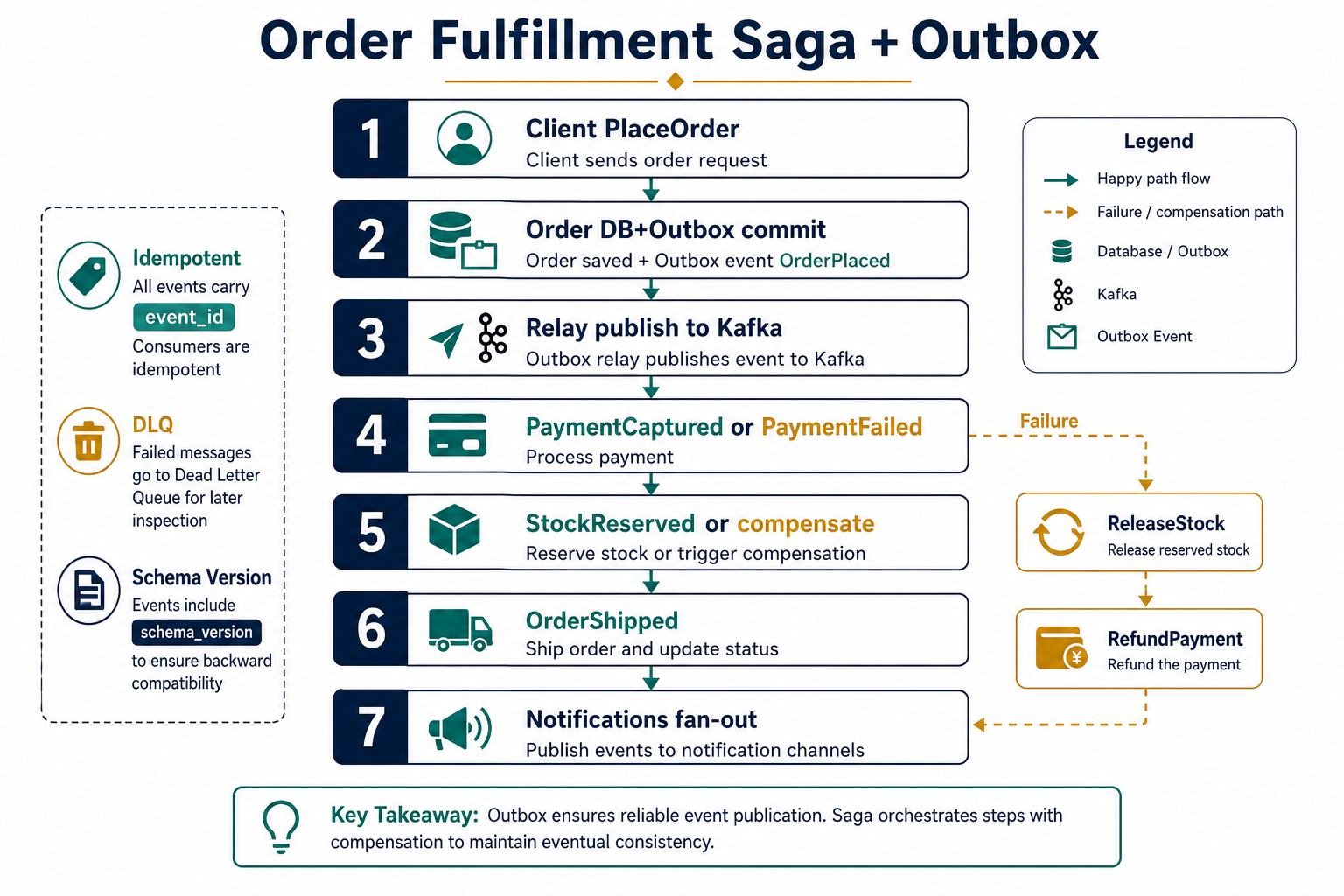
Figure C: Outbox OrderPlaced → payment → stock → ship; failure paths compensate; idempotent event_id; DLQ.
Happy path + failure (whiteboard):
- Client
PlaceOrder→ Order service validates → one TX: order row + outboxOrderPlacedV2. - Relay/CDC publishes to
orders.events(key=order_id). - Saga/orchestrator (or payment consumer) charges →
PaymentCaptured/PaymentFailed. - On success → reserve stock →
StockReserved/ compensate + fail order. - Ship →
OrderShipped→ notify + analytics fan-out. - On mid-flight failure → compensating events (
StockReleased,PaymentRefunded) in defined order. - Status projector updates read model for
GET /orders/{id}.
I — Invariants (safety)
"Non-negotiable:
- Outbox with local commit—never publish without DB commit or commit without eventual publish.
- Idempotent consumers on
event_id(or natural key)—at-least-once will duplicate.- Past-tense domain events—facts, not
ChargePaymentas a bus RPC.- Per-
order_idordering on the fulfillment topic; no global order assumption.- Saga compensations are explicit—don't leave reserved stock after payment failure."
C — Constraints (second C)
| Constraint | Design response |
|---|---|
| Eventual consistency | UX: "processing"; poll status / push notification |
| Schema breaks | Registry + BACKWARD; contract tests in CI |
| Poison messages | Retry with backoff → DLQ + alert after N |
| Dual-write temptation | Outbox/CDC only |
| God topic | Domain topics / event types owned by bounded context |
| Debugging | trace_id / correlation_id in headers; event catalog |
E — Evolution (phased rollout)
Phased delivery:
| Phase | Deliverable |
|---|---|
| M1 | Order service + outbox + OrderPlaced; one consumer (payment) |
| M2 | Inventory + shipping; saga compensations; idempotent stores |
| M3 | Notify/analytics choreography; schema registry |
| M4 | Status read model + sync query API; DLQ runbooks |
| M5 | Nightly reconciliation (orders DB vs event completeness); chaos: duplicate/delay |
Failure modes I'd mention:
| Failure | Mitigation |
|---|---|
| Outbox relay down | Lag alert; orders exist, events catch up—don't dual-write manually |
Duplicate OrderPlaced | Idempotent payment on order_id / event_id |
| Payment succeeds, inventory fails | Compensate refund or retry reserve per policy |
Missing OrderShipped | Timeout/watchdog in saga; reconciliation |
| Cyclic events | Ban A↔B trigger loops; orchestration for critical path |
Observability: outbox lag, consumer lag per group, DLQ depth, saga state age, place-order SLO, reconciliation diffs.
Closing line (interview)
"So: Order service commits DB + outbox atomically, publishes
OrderPlacedto Kafka keyed byorder_id. Orchestrated saga for payment→inventory→ship with compensations; choreography for email/analytics. Idempotent consumers, schema registry, DLQ, trace headers. Customer status via read-model projection—sync API stays. Not every hop is an event, and not every reaction is choreography."
Scoring signals
| Strong | Weak / red flag |
|---|---|
| Outbox / CDC for reliable publish | "Just publish after insert" |
| Saga vs choreography split | Kafka for everything, no failure story |
| Idempotent consumers | Ignore at-least-once duplicates |
| Sync status read model | "Clients read topics" |
| Schema registry + DLQ | No contracts / poison handling |
| Compensating actions | Happy path only |
Compact outline (if time-boxed to 2 minutes)
"Place order sync: DB + outbox
OrderPlaced. Kafka key=order_id. Orchestrated saga: pay → reserve → ship with compensations. Choreography for notify/analytics. Idempotentevent_id. Schema registry BACKWARD. Status = projected read model. DLQ + traces + nightly reconcile."
24. Weak Answer Example
Question: "Design event-driven order fulfillment."
"Use Kafka events between services whenever something happens."
Why weak / red flags: No outbox, schema, idempotency, saga/compensation, failure flow, or sync read path—buzzword EDA without reliability.
25. Hands-On Exercise
- Model 4 services with in-memory event bus.
- Implement outbox table + relay loop.
- Break schema—observe consumer failure.
- Add Avro/JSON schema version field.
- Inject duplicate events—test idempotency.
- Add OpenTelemetry trace across publish/consume.
- Draw event catalog for your domain.
26. Knowledge Check
- Events name tense? (Past tense.)
- Outbox solves? (Dual-write problem.)
- CQRS separates? (Commands/writes vs queries/reads.)
- Choreography weakness? (Hard global visibility.)
- Delivery default? (At-least-once.)
27. Flashcards
| # | Front | Back |
|---|---|---|
| 1 | Domain event | Business fact that occurred. |
| 2 | Choreography | Decentralized event reactions. |
| 3 | Orchestration | Central workflow control. |
| 4 | CQRS | Split write and read models. |
| 5 | Event sourcing | State from event replay. |
| 6 | Projection | Read model from stream. |
| 7 | Outbox | TX-safe event publish. |
| 8 | Schema registry | Versioned contracts. |
| 9 | Event notification | Thin event + lookup. |
| 10 | State transfer | Fat event payload. |
28. Cheat Sheet
EVENT RULES
  Past tense names
  Immutable — correct with new event
  Version schemas

PATTERNS
  Notification: thin event
  State transfer: fat event
  Outbox: DB + publish consistency
  CQRS: write log → projections

GOVERNANCE
  Event catalog
  Owner per bounded context
  Compatibility CI

FAILURE
  Idempotent consumers
  DLQ + replay
  Reconciliation
29. Related Concepts
- Message Delivery Semantics — consumer guarantees
- Kafka Architecture — typical EDA transport
- Sagas — multi-step consistency
- Transactional Outbox — reliable emission
- Microservices — common EDA deployment
30. References
Primary sources
- Hohpe, G., & Woolf, B. (2003). Enterprise Integration Patterns — event message patterns.
- Fowler, M. "Event-Driven Architecture" — event notification vs sourcing vs CQRS.
Engineering
- Kleppmann, M. DDIA — Ch. 11 streams; Ch. 12 data integration.
- Richardson, C. Microservices.io — Domain event pattern.
- Chris Richardson, CQRS pattern — microservices.io.
Distinction
| Claim type | Source |
|---|---|
| EDA pattern definitions | Hohpe & Woolf; Fowler |
| Outbox pattern | Engineering practice; DDIA |
| Production scale anecdotes | Company engineering blogs—verify independently |