Quorum Systems
1. Executive Summary
A quorum system is a collection of subsets (quorums) of replicas such that any two quorums intersect—share at least one member. In replicated storage, quorum reads and quorum writes use these sets to enforce that a read contacts enough replicas to overlap a prior write, enabling consistency properties, fault tolerance, and controlled availability tradeoffs without requiring every replica to participate in every operation.
The classic N, R, W formulation (from Gifford 1979 and popularized by Dynamo, DeCandia et al. 2007) parameterizes replica count N, read quorum R, and write quorum W. When R + W > N, read and write quorums intersect; when W > N/2, write quorums intersect—supporting monotonic write visibility and, under additional assumptions, stronger read guarantees. Quorum systems underpin Cassandra, DynamoDB (conceptually), Riak, and countless custom control planes.
Quorum correctness is a safety argument about set intersection; liveness (operations complete during failures) requires enough alive replicas to form a quorum. Sloppy quorums and hinted handoff (Dynamo) trade strict intersection during failure for availability—reintroducing eventual consistency obligations. This chapter covers formal intersection properties, N/R/W tuning, sloppy vs strict quorums, relationship to CAP, failure modes, performance, and principal-level design reasoning.
2. Why This Topic Matters
Quorum math appears in every principal-level system design interview involving replication: "How many nodes can we lose?" "Why R+W>N?" "Does QUORUM read guarantee latest value?" Wrong answers cause production incidents—stale reads after acknowledged writes, lost updates during partition, and mistaken belief that quorums imply linearizability.
Principal architects must:
- Derive intersection — Not memorize R+W>N without explaining why (pigeonhole principle on replica sets).
- Map quorums to consistency models — Intersection enables staleness bounds; does not alone imply linearizability without synchronization.
- Design failure behavior — Strict quorum rejects ops; sloppy quorum accepts with repair debt.
- Tune per workload — W=1, R=N for read-heavy; W=N, R=1 for write-once read-many—decision criteria, not universal rules.
Interview signal: explaining sloppy quorum + hinted handoff vs Raft majority shows operational depth beyond textbook formulas.
3. Problems Being Solved
| Problem | Without quorums | With quorum systems |
|---|---|---|
| Single point of failure | One primary | Replicate to N; tolerate failures |
| Read stale after write | Always possible on random replica | R+W>N intersection—potential for fresh read |
| Unbounded write conflicts | All replicas accept independently | W majority serializes write acceptance |
| Capacity during failure | All-or-nothing | Subset quorums continue if |quorum| alive |
| Config flexibility | Fixed primary | Tune R, W per operation type |
Quorum systems solve "which replicas must agree for an operation to count?" They do not automatically solve global ordering, linearizability, or transaction isolation without additional protocols (leader, version vectors, consensus).
4. Assumptions and System Model
Assume partial failure, asynchronous network, and crash-stop replicas unless noted:
- N replicas hold copies of each key (or partition); N is replication factor.
- Quorum sizes R (read) and W (write) are positive integers with (1 \leq R, W \leq N).
- Intersection property: Read set (Q_r) and write set (Q_w) each of size R and W; if (R + W > N), then (Q_r \cap Q_w \neq \emptyset).
- Versioning: Replicas store version metadata (timestamp, vector clock, HLC)—intersection alone returns some overlapping replica, not necessarily latest without comparison.
- CAP context: Under partition, strict quorums may fail to form (CP behavior); sloppy quorums may violate strict intersection (AP behavior).
Not assumed: Synchronized clocks for correctness; Byzantine quorum without BFT protocol; automatic latest-value read without version merge on contacted replicas.
5. Essential Terminology
| Term | Definition |
|---|---|
| Quorum | Subset of replicas sufficient to perform an operation. |
| Replication factor (N) | Total replicas for a partition/key. |
| Read quorum (R) | Number of replicas contacted for a read. |
| Write quorum (W) | Number of replicas that must ack a write. |
| Intersection (R+W>N) | Any read and write quorums share ≥1 replica. |
| Majority | Quorum with size (> N/2); any two majorities intersect. |
| Sloppy quorum | Use fallback replicas outside preference list when primary quorum unavailable (Dynamo). |
| Hinted handoff | Store write for temporarily down replica; deliver on recovery. |
| Read repair | Fix divergent replicas during read when versions differ. |
| Anti-entropy | Background reconciliation (Merkle trees, scans). |
| Consistency level (CL) | Cassandra/Dynamo terminology mapping to R, W. |
| PACELC | Latency vs consistency when no partition—quorum tuning affects both. |
Mnemonic: R + W > N = read and write "overlap somewhere"—not automatically "read is newest."
6. Core Mechanism
Intersection proof (pigeonhole)
Replicas indexed (1..N). Write quorum (Q_w), (|Q_w| = W). Read quorum (Q_r), (|Q_r| = R). If (R + W > N), then (|Q_r \cap Q_w| \geq R + W - N \geq 1). Therefore some replica participated in both operations—if that replica has the latest write applied and is consulted correctly, read can return fresh value.
Critical caveat: Intersecting replica may be stale if writes not fully applied, async replication within quorum, or sloppy quorum changed membership.
N, R, W tuning table
| Configuration | Intersection | Typical use | Caveat |
|---|---|---|---|
| R+W > N | Yes | Balanced RW | Need version compare on R replicas |
| W > N/2 | Write-write intersect | Serialize writes | Reads may still be stale if R small |
| W=1, R=N | Read sees any write | Write-heavy rare read | Weak write durability if one node dies |
| W=N, R=1 | Fast read one node | Write-once config | Read often stale |
| R=W=N/2+1 (majority) | Both RW intersect | CP-style | Reject if majority down |
Figure 1: With N=5, W=3, R=3, R+W>N guarantees at least one overlapping replica (N3). Read must use version merge to return latest among contacted nodes.
Strict vs sloppy quorum
Figure 2: Strict quorums preserve intersection among live preference-list replicas; sloppy quorums sacrifice strict overlap for availability.
Read path with version merge
Figure 3: Quorum read contacts R nodes; coordinator returns highest version; read repair propagates to lagging replica.
7. Step-by-Step Walkthrough
Scenario: N=3, W=2, R=2, strict quorum, versions on each replica.
| Step | Event | Replica states | Notes |
|---|---|---|---|
| 0 | Initial | all v=0 | — |
| 1 | Write v=1 | N1=1, N2=1, N3=0 | W=2 ack from N1,N2 |
| 2 | Read QUORUM | contact N2,N3 | Intersection: N2 has v=1 |
| 3 | Merge | N2=1, N3=0 → return 1 | Read repair N3 |
| 4 | N3 down | — | — |
| 5 | Write v=2 | N1=2, N2=2 | W=2 without N3 |
| 6 | N3 recovers | N3=0 stale | Anti-entropy / repair needed |
Walkthrough insight: R+W>N with N=3,W=2,R=2: intersection size ≥1. Coordinator must compare versions—returning arbitrary intersecting replica without merge can still be wrong if intersecting node is lagging and a higher version exists on non-contacted node (when R too small). With R+W>N and proper merge among all R responses, latest among quorum is at least as new as any completed write quorum.
Sloppy quorum walkthrough: N3 down; write uses fallback N4 (outside normal set). Hint stored for N3. Strict intersection with pre-failure reads broken until repair—eventual consistency debt.
8. Invariants and Guarantees
| Property | Condition | Type |
|---|---|---|
| Read-write intersection | R + W > N | Safety (set overlap) |
| Write-write intersection | W > N/2 | Safety (overlapping writes) |
| Durability of ack'd write | W replicas persisted | Safety—if those nodes survive |
| Latest read | R+W>N + version merge + sync apply | Not automatic—needs assumptions |
| Linearizability | Leader or sync + fencing | Not from quorum alone |
| Operation completion | ≥R, ≥W replicas alive | Liveness |
Safety vs liveness: Quorum intersection is combinatorial safety. Forming quorums under f failures requires n > 2f for majority—liveness constraint.
9. Failure Scenarios
Scenario 1: Stale quorum read after write
Setup: W=2, R=2, N=3; write acks; third replica had old value; read hits two including stale if merge wrong.
Effect: Client sees old value post-write—violates user expectation; may violate linearizability.
Mitigation: SERIAL reads, leader reads, or accept eventual consistency explicitly.
Scenario 2: Sloppy quorum during partition
Setup: Two partitions each accept writes with sloppy W.
Effect: Divergent versions—siblings; conflict resolution required.
Mitigation: Vector clocks, LWW with caution, application merge, or strict quorum reject.
Scenario 3: Hinted handoff loss
Setup: Hint node crashes before delivering to preferred replica.
Effect: Write lost until anti-entropy—durability risk.
Mitigation: Hint replication, reduced W only with eyes open, monitoring hint queue depth.
Scenario 4: Asymmetric R and W mis-tuning
Setup: W=1, R=1 for "speed."
Effect: No intersection guarantee; lost updates common.
Mitigation: R+W>N minimum for freshness arguments; document weak guarantees.
Scenario 5: GC grace period violation (Cassandra)
Setup: Removed node before replication completes.
Effect: Permanent data loss for some keys.
Mitigation: Ops procedures, repair before decommission, appropriate replication factor.
10. Performance Characteristics
| Factor | Effect |
|---|---|
| Higher W | Write latency ↑ (more acks); durability ↑ |
| Higher R | Read latency ↑; fresher reads possible |
| R+W>N | Minimum coordination for intersection reads |
| Cross-datacenter W | WAN RTT dominates write path |
| Read repair | Read amplification; background write load |
| Hinted handoff | Extra writes on recovery bursts |
Qualitative rule: Quorum latency ≈ slowest of W or R replica responses in coordinator's set—often p99 tail matters. Do not quote universal ms figures; measure per datacenter topology.
PACELC: When no partition, low R and W improve latency at consistency cost—normal case tuning matters as much as partition case.
11. Scalability Limits
- Coordinator hotspot: Popular keys serialize through coordinator—separate from quorum math but coupled in Cassandra.
- Replication factor ceiling: Higher N improves fault tolerance but increases W cost if W scales with N.
- Quorum cross-region: W across regions makes writes latency-bound by WAN—often use LOCAL_QUORUM patterns.
- BFT quorums: Need (3f+1) nodes for f Byzantine faults—different intersection arithmetic.
When quorums strain scale: Global W=ALL for every write—consider per-operation CL downgrade for analytics reads.
12. Operational Considerations
- repair: Run
nodetool repair/ anti-entropy on schedule—quorums leave debt. - Monitor hinted handoff queue: Backlog signals recovery pressure.
- Decommission procedure: Wait for streaming completion; verify quorum health.
- Consistency Level per query: Document service defaults; code review CL overrides.
- Load test CL matrix: ONE vs QUORUM vs ALL under node loss.
13. Security Considerations
- Quorum bypass attack: Compromised coordinator skips R replicas—use authenticated replication protocol.
- Replica impersonation: Attacker joins token ring—mutual TLS between nodes.
- Read repair amplification: Attacker triggers expensive repairs—rate limit.
- Small W exploits: W=1 allows single-node write acceptance—tamper target.
Quorum math assumes correct, authenticated replica responses.
14. Cost Considerations
- Infrastructure: Higher N increases storage and replication bandwidth linearly.
- WAN quorums: Cross-region W multiplies egress charges.
- Read repair: Hidden write load on read path—increases IOPS cost.
- Engineering: Tuning CL per use case; incident analysis of sibling conflicts.
Savings: R=1, W=quorum for read-heavy rarely updated data—explicit weak consistency acceptance.
15. Production Implementations
Amazon Dynamo (paper)
Sloppy quorum, vector clocks, hinted handoff, Merkle tree anti-entropy—foundational AP quorum design (DeCandia et al., 2007).
Apache Cassandra
Configurable CL: ONE, QUORUM, LOCAL_QUORUM, ALL, etc. LOCAL_QUORUM uses R+W per datacenter—implementation of Dynamo concepts.
Amazon DynamoDB
Synchronous replication within region; quorum-like majority for durability—managed; product docs define consistency models (ConsistentRead).
Riak / Basho
Quorum properties with sloppy quorum options—verify version-specific behavior.
etcd / Raft
Majority quorum for log commit—strict; CP tendency; different from Dynamo sloppy quorum.
Distinction: Consensus majorities enforce one log order; Dynamo quorums enforce overlap without global order unless added.
16. Alternatives and Tradeoffs
| Mechanism | Consistency | Availability | Notes |
|---|---|---|---|
| Strict R+W>N quorum | Bounded staleness potential | Reject if quorum down | Version merge required |
| Sloppy quorum + hints | Eventual | Higher during failure | Dynamo path |
| Single leader (Raft) | Strong order per log | Unavailable without majority | CP |
| Chain replication | Strong if head-tail | Head failure blocks | Different topology |
| No quorum (W=1,R=1) | Weak | Highest | Explicit trade |
Tradeoff axis: Strict quorums move toward CP; sloppy toward AP—align with CAP framing from prerequisite chapter.
17. Common Misconceptions
| Misconception | Reality |
|---|---|
| "R+W>N means linearizable" | Intersection ≠ real-time order; need leader/sync. |
| "QUORUM read always latest" | Need version merge; async apply; sloppy quorum breaks strictness. |
| "Higher N always better" | More replicas = more failure modes and repair debt. |
| "Majority = quorum" | Majority is special quorum; general quorums need pairwise intersection design. |
| "Hinted handoff is free" | Durability and consistency debt until replay. |
| "W=ALL is always safest" | Availability suffers; one slow node blocks writes. |
18. Principal Architect Perspective
- Derive on whiteboard — Show R+W>N proof in interviews; credibility signal.
- Per-operation CL — Same cluster, different guarantees by API path.
- Sloppy vs strict — Document partition behavior in ADR.
- Pair quorums with conflict handling — Vector clocks, CRDTs, or LWW with eyes open.
- Don't conflate with consensus — Quorum overlap ≠ total order.
Interview signal: Dynamo vs Raft quorum comparison without hand-waving.
19. Architecture Review Exercise
Scenario: Cassandra cluster, RF=3, default CL ONE for reads and QUORUM for writes. Finance team wants read-after-write for account balance.
Review prompts:
- Does W=QUORUM, R=ONE satisfy RYW?
- What CL for balance read after write?
- Cost of
SERIAL/LOCAL_SERIAL? - Sticky coordinator vs CL change?
- Partition behavior with
LOCAL_QUORUM?
Expected findings: R=ONE breaks freshness; recommend QUORUM or LOCAL_QUORUM reads; session stickiness; quantify latency impact.
20. Whiteboard Explanation
90-second version:
"Quorum systems pick subsets of N replicas for reads and writes so sets overlap. Classic rule: R plus W greater than N guarantees read and write quorums share at least one node—that node saw some write, but you must compare versions across the R nodes and return the latest. W greater than N/2 makes write quorums overlap each other. Dynamo added sloppy quorums: if preferred nodes are down, accept writes on fallback nodes and hint to the real owner later—that trades availability for owing repair. Cassandra exposes this as consistency levels: ONE, QUORUM, ALL. Quorums don't give linearizability by themselves—you can still read stale values if you're not merging versions or you use sloppy quorums under partition. Raft uses strict majority quorum for a totally ordered log—different beast. Tune R and W per operation: reads that need freshness need higher R; write-heavy paths might use lower W only if you accept durability risk."
21. Interview Questions
-
State the R+W>N rule and why it holds.
- Signals: Pigeonhole; intersection ≥ R+W-N.
-
Does R+W>N imply linearizability?
- Signals: No; version merge, sloppy quorum, async.
-
W > N/2 purpose?
- Signals: Write-write intersection; single latest write quorum overlap.
-
Sloppy quorum vs strict?
- Signals: Fallback replicas, hints, availability vs overlap.
-
Hinted handoff risks?
- Signals: Hint loss, consistency debt, recovery storms.
-
Read repair purpose?
- Signals: Fix lagging replica on read path.
-
Cassandra ONE vs QUORUM?
- Signals: R=1 vs R=majority; latency vs freshness.
-
How many failures with N=5, majority?
- Signals: f=2 crash failures tolerable for majority quorum.
-
Quorum vs Raft majority?
- Signals: Overlap vs total order log.
-
W=1, R=N use case?
- Signals: Rare reads, fast writes, weak durability—explicit.
-
LOCAL_QUORUM benefit?
- Signals: Avoid cross-DC WAN for quorum; scope per DC.
-
Anti-entropy vs read repair?
- Signals: Background full compare vs eager on read.
-
Sibling values in Dynamo?
- Signals: Concurrent writes; vector clock conflict.
-
Design RF and CL for AP banking reads?
- Signals: Higher R, session tokens, or don't use AP for balances.
22. Interview Follow-Ups
-
N=4, W=2, R=2—intersection?
- Signals: R+W=4, not >N; no guarantee—fix to R+W>4 or adjust.
-
Geo-replication quorum strategy?
- Signals: LOCAL_QUORUM, per-region leaders, Causal+session.
-
Calculate ops availability with f failures.
- Signals: Need n > w+f-1 style reasoning for strict W.
-
Migrate ONE to QUORUM without outage.
- Signals: Gradual client rollout, latency testing.
-
When choose chain replication over quorum?
- Signals: Strong order, different failure profile, head bottleneck.
22A. Production Low-Level Design (Interview + Game Day)
Design a leaderless quorum KV (N,R,W) with honest limits. Production LLD and Game Day Standard.
Parameters
| Knob | Typical | Effect |
|---|---|---|
| N | 3 | Replica set size |
| W | 2 | Write quorum |
| R | 2 | Read quorum |
| R+W>N | yes | Overlap ⇒ read sees latest durable write (not full linearizability alone) |
Step-by-step flow:
| Step | Action | Caveat |
|---|---|---|
| 1–2 | Write W nodes | Partial write if crash mid-W |
| 3–5 | Read R + reconcile | Need versions; not magically linearizable |
LLD extras
- Sloppy quorum / hinted handoff under failure.
- Read repair + anti-entropy.
- Don't claim linearizability from R+W>N alone (need real-time + single-copy semantics).
22B. Game Day Playbooks
| # | Drill | Inject | Detect | Mitigate | Verify |
|---|---|---|---|---|---|
| GD-1 | One replica down | Kill 1/N | Elevated latency | W=2 still works | Durability holds |
| GD-2 | Dirty read risk | Read R=1 after W=2 | Version skew | Raise R or repair | Consistent read policy |
| GD-3 | Partial write | Crash after 1/W acks | Hinted / repair backlog | Read repair | Convergence |
GD-1 — Replica loss
23. Strong Answer Example
Question: "We have N=3, W=2, R=2. Are our reads linearizable?"
Answer this as a 45-minute design discussion using the PRACTICE framework. Below is how a strong student sounds aloud—not necessarily, and R+W>N ≠ linearizability.
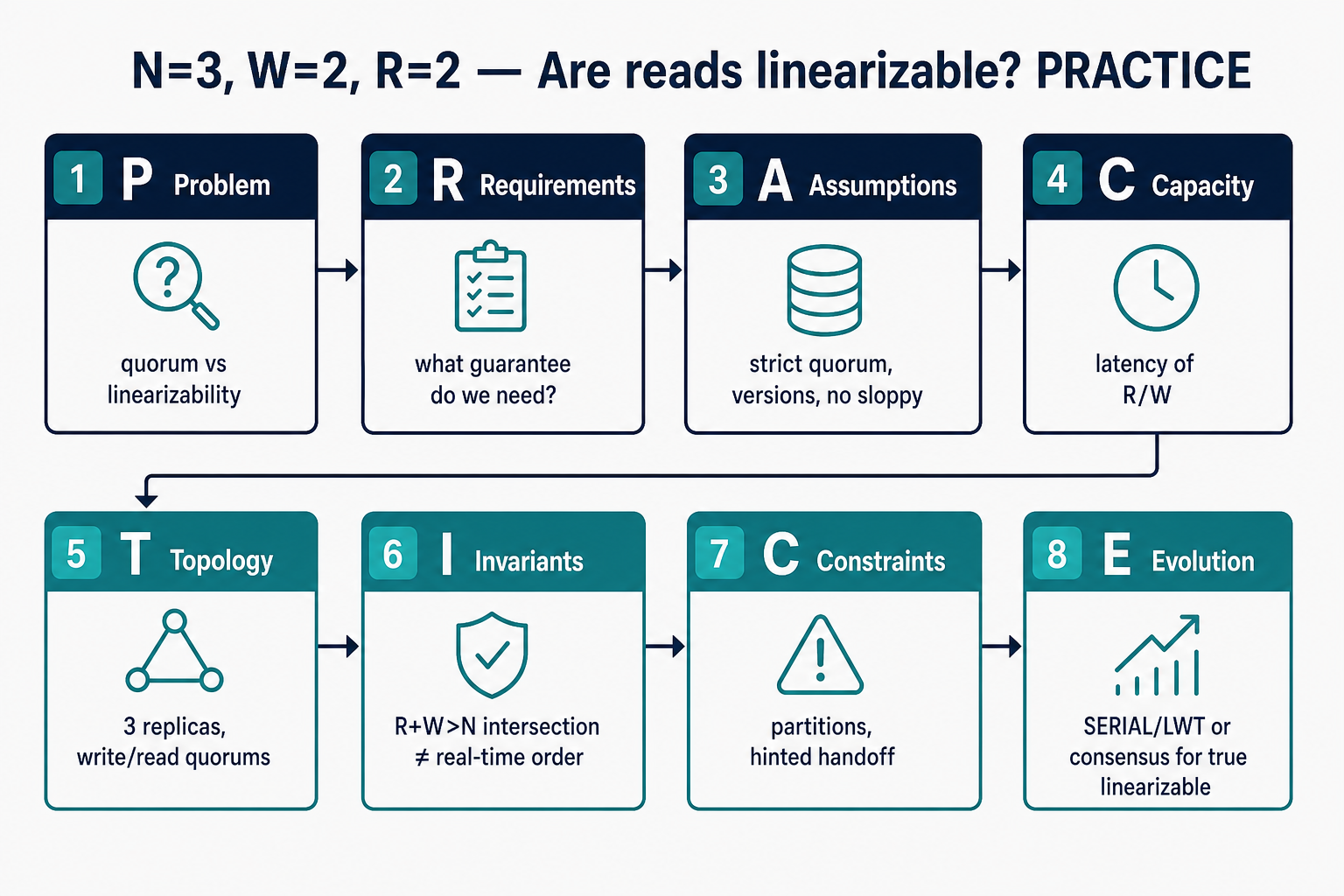
Figure A: PRACTICE map — Problem → Requirements → Assumptions → Capacity → Topology → Invariants → Constraints → Evolution.
Student interview script (PRACTICE)
P — Problem framing
"N=3, W=2, R=2 means R+W>N—read and write quorums intersect. That's a strong freshness argument for completed writes when we merge versions under strict quorum.
Linearizability is stricter: every operation appears to take effect at a single point between its start and end, in real time. A read that starts after another client's write completes must see that write.
Short answer: No, not necessarily. We likely have quorum intersection freshness, not linearizable reads—unless we add leader/consensus/
SERIAL-style mechanisms."
R — Requirements
| What the interviewer might mean | What I'd clarify |
|---|---|
| "Consistent" / "always see latest" | Latest completed write via quorum? Or true linearizable? |
| Read-your-writes after own put | Often OK with R+W>N + merge on same client path |
| Cross-client real-time order | Needs linearizability (or session + sync), not quorum alone |
| Survive 1 replica failure | Yes for liveness: still form W=2 / R=2 with 2 of 3 up |
"I'd ask: strict vs sloppy quorum? Version merge on the coordinator? Hinted handoff? Cassandra CL vs
SERIAL?"
A — Assumptions (state aloud)
| Assumption | Why it matters |
|---|---|
| Strict quorum (preferred replica set) | Sloppy/hints can break intersection |
| Coordinator merges all R responses by version | Returning one arbitrary replica can still be stale |
| Write ACK means W replicas durably applied | Async apply inside W set weakens the story |
| No claim of global real-time order | Intersection ≠ linearizability |
| W > N/2 also (here W=2 > 1.5) | Overlapping write quorums for write-write safety |
"Under those assumptions: after a write completes, a later quorum read with merge should see a value at least as new as that write. That's still not linearizability for concurrent overlapping ops."
C — Capacity (cost tradeoff)
QUORUM R=2, W=2 (N=3)     → ~2× replica RTT; good availability (tolerate 1 down)
ALL / sync to N=3         → higher write latency; stronger durability story
SERIAL / LWT / Raft read  → linearizable path; lower throughput, contention
ONE / LOCAL_ONE           → fast; no intersection guarantee
"I'd keep QUORUM for most reads/writes and pay for linearizable only on money/inventory/fencing keys."
T — Topology (draw this)
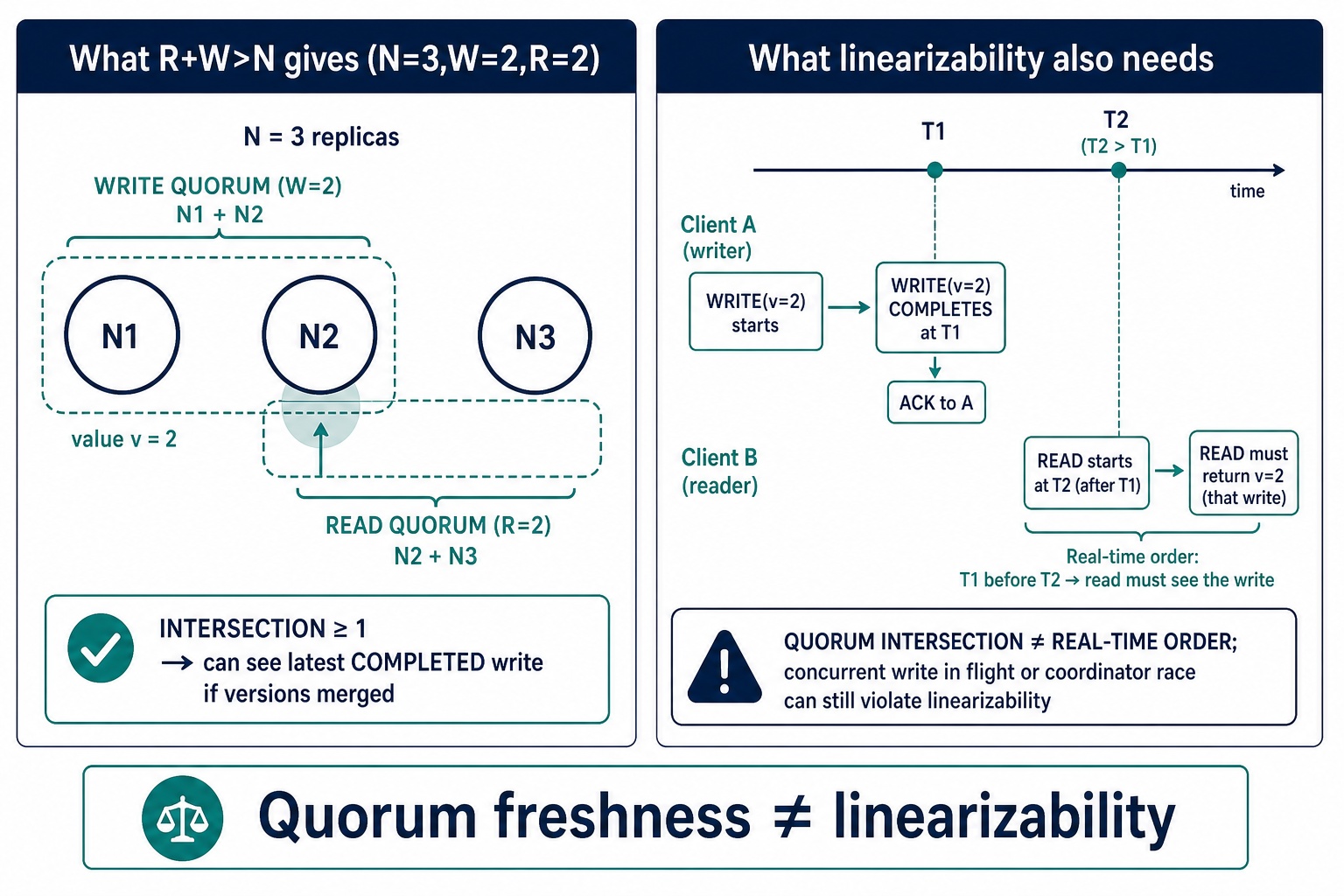
Figure B: Left — R+W>N intersection can catch the latest completed write. Right — linearizability also needs real-time order across clients.
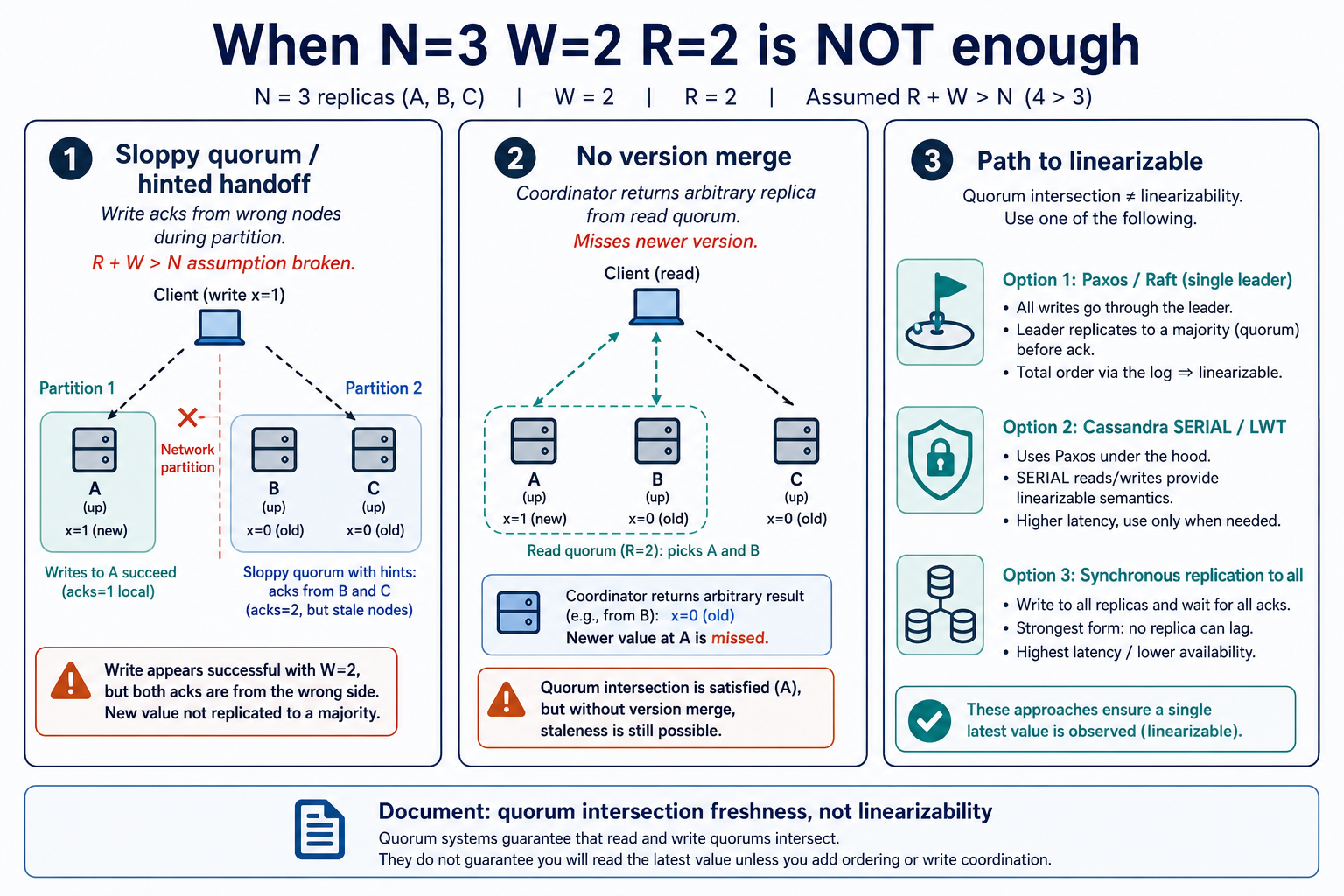
Figure C: Sloppy quorum / missing version merge break the freshness story; true linearizable needs SERIAL/LWT, leader, or sync replication.
| Mechanism | What you get |
|---|---|
| R+W>N + version merge + strict quorum | Intersection freshness for completed writes |
| Sticky / session token | Client-centric RYW (still not global linearizable) |
Cassandra SERIAL / LWT (Paxos) | Linearizable compare-and-set / serial reads |
| Raft/etcd single-key reads via leader | Linearizable (with correct read path) |
| Sloppy quorum + hinted handoff | Availability ↑; intersection assumptions broken until repair |
I — Invariants (safety)
"I'd nail the invariants on the whiteboard:
- R+W>N → every read quorum intersects every write quorum (set overlap).
- W > N/2 → write quorums intersect each other.
- Merge versions across all R replies — required; intersection alone isn't enough if you pick a random replica.
- Linearizability is not implied by (1)–(3)—need real-time order / consensus / leader.
- Sloppy quorum / lost hints can violate the overlap story we just claimed."
C — Constraints (second C)
| Constraint | Design response |
|---|---|
| Partition / one replica down | Still form R=2 or W=2 with 2 live nodes |
| Multi-DC latency | LOCAL_QUORUM vs EACH_QUORUM—document weaker cross-DC story |
| Ops use hinted handoff | Treat as EC debt; don't call it linearizable |
| Product says "strongly consistent" | Clarify: quorum freshness vs linearizable; upgrade hot paths |
| Coordinator races / concurrent writes | Quorum merge ≠ single global order without consensus |
E — Evolution (prove it)
Phased delivery:
| Phase | Deliverable |
|---|---|
| M1 | Document per API: QUORUM freshness vs linearizable required |
| M2 | Enforce version merge + read repair on quorum reads |
| M3 | Disable sloppy for critical keys / alert on hint backlog |
| M4 | SERIAL/LWT or Raft for keys that need true linearizability |
| M5 | Jepsen-style / linearizability checker on critical workload |
Failure modes:
| Failure | Mitigation |
|---|---|
| "Yes, R+W>N so we're linearizable" (wrong) | Teach intersection ≠ real-time order |
| Coordinator returns one of R without merge | Always take max version / reconcile |
| Sloppy write during partition | Strict quorum reject or accept EC + repair |
| Concurrent write in flight | Don't claim linearizability; use consensus for that |
Observability: CL mismatch alerts, hint queue depth, read-repair rate, stale-read canaries (write then cross-client read), SERIAL contention metrics.
Closing line (interview)
"So: N=3, W=2, R=2 is not enough to claim linearizable reads. R+W>N plus version merge under strict quorum gives intersection freshness for completed writes. Linearizability needs real-time order—I'd use SERIAL/LWT, a leader/consensus read path, or sync replication for those keys, and I'd document the rest as quorum-consistent, not linearizable. I'd also ask about sloppy quorum and hinted handoff, because those quietly invalidate the overlap story."
Scoring signals
| Strong | Weak / red flag |
|---|---|
| "Not necessarily" + names linearizability | "Yes, R+W>N so always consistent" |
| Intersection vs real-time order | Conflates quorum with linearizability |
| Mentions version merge | Ignores merge / pick-any-replica |
| Flags sloppy / hints | Assumes perfect replicas always |
| Path to SERIAL / Raft / leader | No upgrade story when product needs strong |
| Per-key consistency levels | One CL for everything |
Compact outline (if time-boxed to 2 minutes)
"No. R+W>N means quorums intersect—with version merge and strict quorum you get freshness for completed writes, not linearizability. Linearizability needs real-time order: SERIAL/LWT or consensus leader. Ask about sloppy quorum and hints. Document quorum freshness vs linearizable per API."
24. Weak Answer Example
Question: "We have N=3, W=2, R=2. Are our reads linearizable?"
"Yes, R+W is greater than N so reads are always consistent."
Why weak / red flags: Conflates quorum intersection with linearizability; ignores version merge, concurrent real-time order, sloppy quorum, and formal definitions—classic interview trap on Dynamo-style systems.
25. Hands-On Exercise
Lab: labs/lab-004-replicated-kv-store/ — replicated KV on :8095
cd labs/lab-004-replicated-kv-store
go test ./... -v
docker compose -p lab004 -f docker/docker-compose.yml up --build -d
chmod +x scripts/demo_kv.sh && ./scripts/demo_kv.sh
| Step | Endpoint | What happens |
|---|---|---|
| 1 | PUT /v1/keys/user:42 | Write to W=2 replicas on routed shard |
| 2 | GET /v1/keys/user:42 | Quorum read — highest version |
| 3 | GET /v1/keys/{key}/replicas | Inspect per-replica versions |
| 4 | POST /v1/chaos/replica-down | Simulate replica failure |
| 5 | GET /v1/keys/{key}?repair=true | Read repair lagging replicas |
Swagger: http://localhost:8095/docs
Engineer guide: how the local stack works
- 3 shards × 3 replicas — in-process simulation; each shard has independent N=3, R=2, W=2.
- Routing —
hash(key) % 3picks shard (consistent-hash stand-in from Lab 001). - Write quorum —
PUTwrites to first W available replicas; fails if fewer than W alive. - Read quorum —
GETreads R replicas, returns max version (Dynamo-style). - Read repair —
?repair=truepushes latest version to lagging replicas without incrementing version.
Pairs with Lab 003 Raft — production systems use Raft per shard instead of hand-rolled quorum.
Build-from-scratch exercise (optional)
- Implement quorum intersection calculator: given N, R, W, return whether R+W>N.
- Simulate 3 replicas; random W and R sets; verify intersection empirically.
- Configure Cassandra or local docker cluster; run write with QUORUM, read with ONE—observe stale read.
- Write ADR: CL matrix for your service's read/write paths.
26. Knowledge Check
- Minimum intersection size when R+W>N? (At least R+W-N, often 1.)
- Majority quorum size for N=5? (3.)
- Sloppy quorum purpose? (Availability when preferred nodes down.)
- Read repair when? (Read detects version mismatch among quorum.)
- R+W>N sufficient for linearizability? (No.)
- Dynamo sibling values cause? (Concurrent partitioned writes.)
27. Flashcards
| # | Front | Back |
|---|---|---|
| 1 | R + W > N | Read/write quorums intersect (pigeonhole). |
| 2 | W > N/2 | Any two write quorums intersect. |
| 3 | Replication factor N | Total replicas per partition. |
| 4 | Sloppy quorum | Fallback replicas outside preference list. |
| 5 | Hinted handoff | Queue write for down replica; deliver later. |
| 6 | Read repair | Update stale replica during read. |
| 7 | Anti-entropy | Background replica reconciliation. |
| 8 | Gifford (1979) | Early quorum work on replicated data. |
| 9 | Dynamo (2007) | Sloppy quorum, vector clocks, AP design. |
| 10 | vs Raft majority | Quorum overlap ≠ total ordered log. |
| 11 | LOCAL_QUORUM | Quorum scoped to local datacenter. |
| 12 | Version merge | Coordinator picks latest among R responses. |
28. Cheat Sheet
QUORUM BASICS
  N = replicas
  R = read quorum size
  W = write quorum size
  R + W > N  →  read ∩ write ≠ ∅
  W > N/2    →  write ∩ write ≠ ∅

FRESH READ (strict, idealized)
  - R+W>N + version merge on R nodes
  - NOT linearizability

DYNAMO AP PATTERNS
  - Sloppy quorum + hinted handoff
  - Read repair + anti-entropy
  - Vector clock siblings

CASSANDRA CL (examples)
  ONE, QUORUM, ALL, LOCAL_QUORUM

VS CONSENSUS
  - Raft: majority + single log order
  - Dynamo: overlap + eventual merge

FAILURES
  - Stale ONE reads
  - Hint loss
  - Partition divergent writes
29. Related Concepts
- CAP Theorem — prerequisite; partition tradeoffs framing quorum behavior
- Eventual Consistency — sloppy quorum outcome
- Session Guarantees — client freshness layered on quorum reads
- Linearizability — stronger than quorum intersection alone
- Replication — sync vs async replication paths
- Vector Clocks — conflict detection with quorum writes
30. References
Primary sources
- Gifford, D. K. (1979). "Weighted Voting for Replicated Data." SOSP — quorum intersection foundations.
- DeCandia, G., et al. (2007). "Dynamo: Amazon's Highly Available Key-value Store." SOSP — N/R/W, sloppy quorum, hinted handoff.
- Gilbert, S., & Lynch, N. (2002). "Brewer's Conjecture and the Feasibility of Consistent, Available, Partition-Tolerant Web Services." SIGACT News — CAP context for quorum choices.
Engineering
- Apache Cassandra documentation — consistency levels and tunable consistency (verify current revision).
- Martin Kleppmann, Designing Data-Intensive Applications (O'Reilly) — Ch. 5–6 replication and quorums.
- Abadi, D. (2012). "PACELC: Beyond the CAP Theorem." — latency vs consistency tuning.
Distinction
| Claim type | Source |
|---|---|
| R+W>N intersection | Combinatorial proof; Gifford; textbooks |
| Sloppy quorum behavior | DeCandia et al. (2007) |
| Cassandra CL semantics | Apache Cassandra project docs |
| Linearizability requires more than quorum | Herlihy & Wing; engineering interpretation |